Lemmings for the Amiga
By RolyRetro · · Commodore Amiga
Some of the best games ever made started life as a carefully considered design document. Lemmings started life as an argument about how small you could draw a little man.
It was August 1989, in the offices of a young Dundee studio called DMA Design, and the team were working on a game called Walker. Artist Scott Johnston had drawn some tiny soldiers in a 16×16 pixel box, and Mike Dailly reckoned that was extravagant: you could do it in 8×8. So he went off into Deluxe Paint to prove it, animated a little green-haired figure trudging along, and then, having made his point, worked out several ways to kill it. As you do. Colleague Russell Kay watched it, laughed, and said: “There’s a game in that!”
He was right, which must have been annoying for everyone else in the room. Eighteen months later the doodle was Lemmings, and the money it made kept DMA going long enough to make a modest little follow-up called Grand Theft Auto.
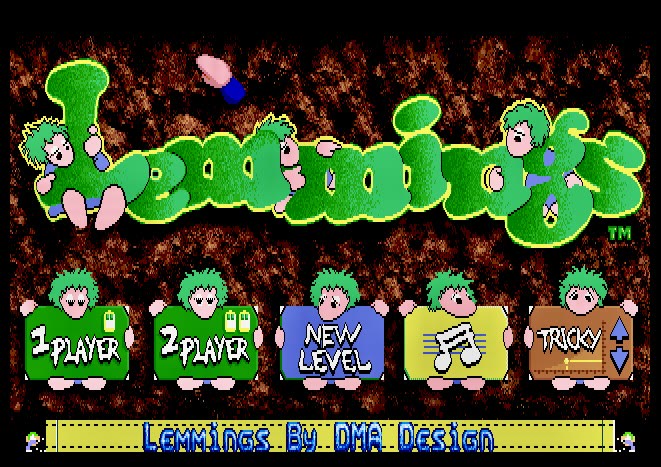 The title screen. Note the lemmings holding the menu options, the only useful job most of them will ever do.
My Lemmings Story
I should admit up front, in an article about the Amiga version, that I never played Lemmings on the Amiga. When it came out in 1991 I was at university, and my computing world consisted of VAX terminals and early Apple Macs, neither of which had much to offer in the way of games (not that I didn’t look).
A friend in my dorm, however, had an early 386 PC, and with it a games library of exactly three titles: Arkanoid, Prince of Persia and Lemmings. Of those three, it was Lemmings that became a near-permanent fixture of our late-night sessions. Prince of Persia is a one-person game with everyone else watching and offering unhelpful advice. Lemmings is the same, except the unhelpful advice is the whole point. Put a puzzle in a room full of students and you get a committee, each member certain they know exactly where the blocker should go, and none of them holding the mouse.
What I didn’t know at the time was that the PC version we were huddled around had been programmed by Russell Kay, the very man who had laughed at Mike Dailly’s animation and said there was a game in it. So I suppose I have him to thank for several thousand hours of lost sleep.
“There’s a Game in That!”
From a Timex factory to a computer club
The DMA Design story starts with Dave Jones, an electronics engineer at the Timex factory in Dundee, who took voluntary redundancy with a cheque for around £3,000 and spent a good chunk of it on an Amiga 1000. Some people buy a car. Jones was the oldest of a group of young enthusiasts who met on Thursday evenings at the Kingsway Amateur Computer Club, in Kingsway Technical College, and DMA Design grew out of that group. Their first game, the shoot-’em-up Menace, was published by Liverpool’s Psygnosis, followed by Blood Money.
Both did reasonably well. Neither suggested that the same people were about to make one of the most famous games of the decade, and then, for an encore, Grand Theft Auto.
Eight pixels by eight
Lemmings really was an accident. While DMA got on with Walker, Mike Dailly’s little 8×8 walker did the rounds of the office, with Gary Timmons adding the details that gave it a personality: the mouth, the clapping hands. Russell Kay saw the potential, and Kay was also the one who first called the creatures “Lemmings”. A rough demo was put together and shown to Psygnosis at the PCW Show in 1989.
The clever bit is that you never control a lemming directly. They just walk, endlessly and without a thought in their heads, until they fall off something or walk into something with blades on it. All you can do is hand out jobs (climber, floater, bomber, blocker, builder, basher, miner and digger) from a strictly limited supply. It’s less a platform game and more like managing a building site staffed entirely by the cast of Dad’s Army.
 The skills panel: release rate, eight jobs, pause, and the mushroom cloud. You will come to know the mushroom cloud well.
The premise is, of course, based on the popular belief that lemmings throw themselves off cliffs en masse. They don’t. That idea owes a lot to Disney’s 1958 documentary White Wilderness, in which the lemmings didn’t jump so much as get a helping hand from the film crew. It went on to win an Oscar. So in a sense the game is a rescue mission for an entire species’ reputation, although I doubt that was the pitch to Psygnosis.
Everyone’s a level designer
The levels came from the whole studio. Steve Hammond, who was in DMA’s design department, has said that everyone was free to pitch in with level design, and a few of his levels made it into the finished game, though he can’t remember which ones. The team reportedly competed with the level editor for cash prizes, which explains a great deal about the later Mayhem levels. These are not the work of people who wanted you to succeed.
The finished game had 120 levels across four difficulty settings, Fun, Tricky, Taxing and Mayhem, the names charting a fairly accurate descent in the player’s mood. There was also a two-player mode on the Amiga, with a mouse each and a tribe each on a split screen, which is an excellent way to find out who your real friends are.
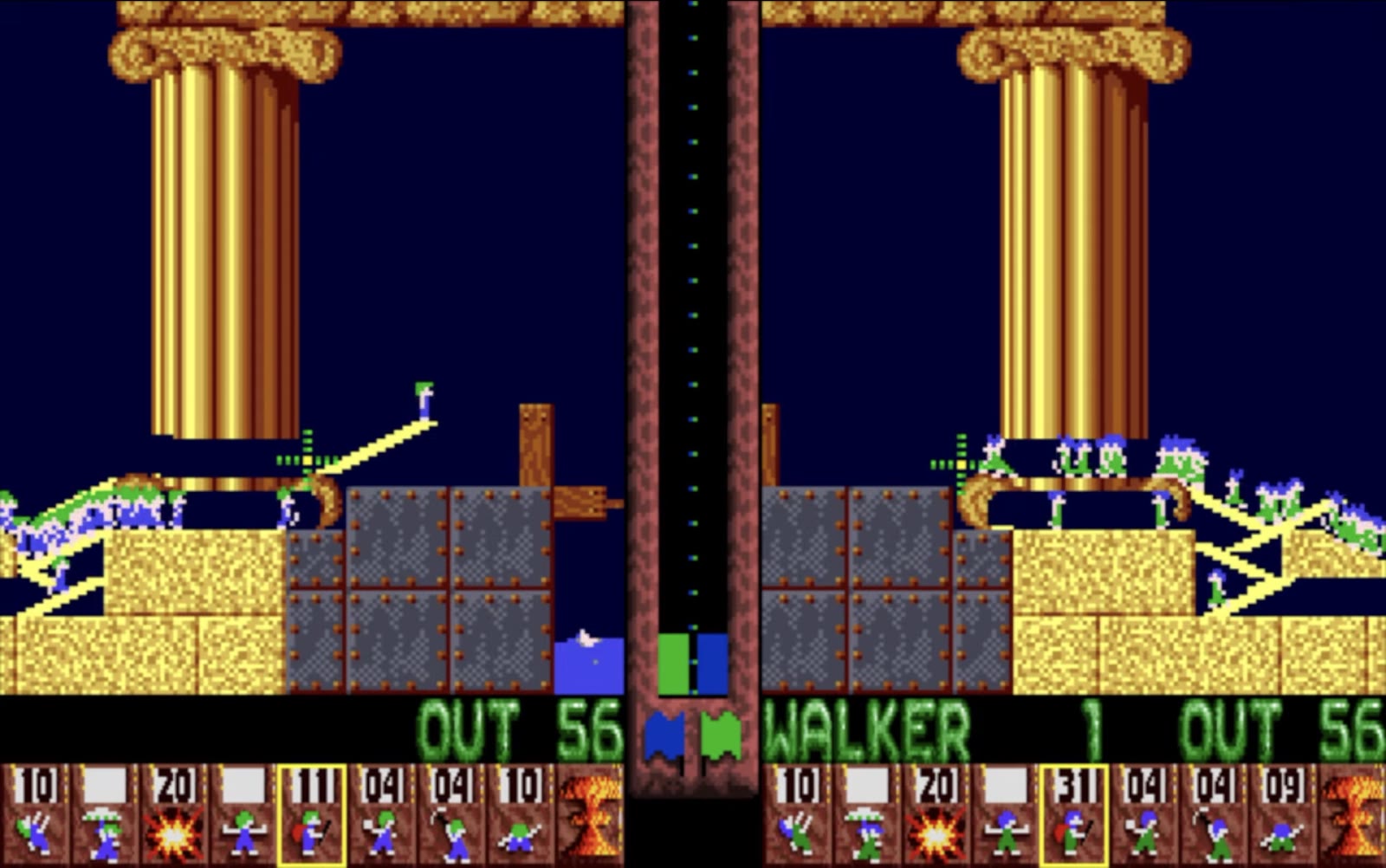 Two-player mode: green lemmings on one side, blue on the other, and a long tradition of steering your opponent’s lot into your own exit.
Valentine’s Day 1991
Psygnosis released Lemmings for the Amiga on 14 February 1991, a game about preventing mass rodent suicide, released on the most romantic day of the year. By one account it sold around 55,000 copies on its first day, more than double the lifetime sales of Menace. It was then converted to just about everything with a screen, and total sales across the series run into the millions, with figures of 15 million and more often quoted. Not bad for a sprite eight pixels tall.
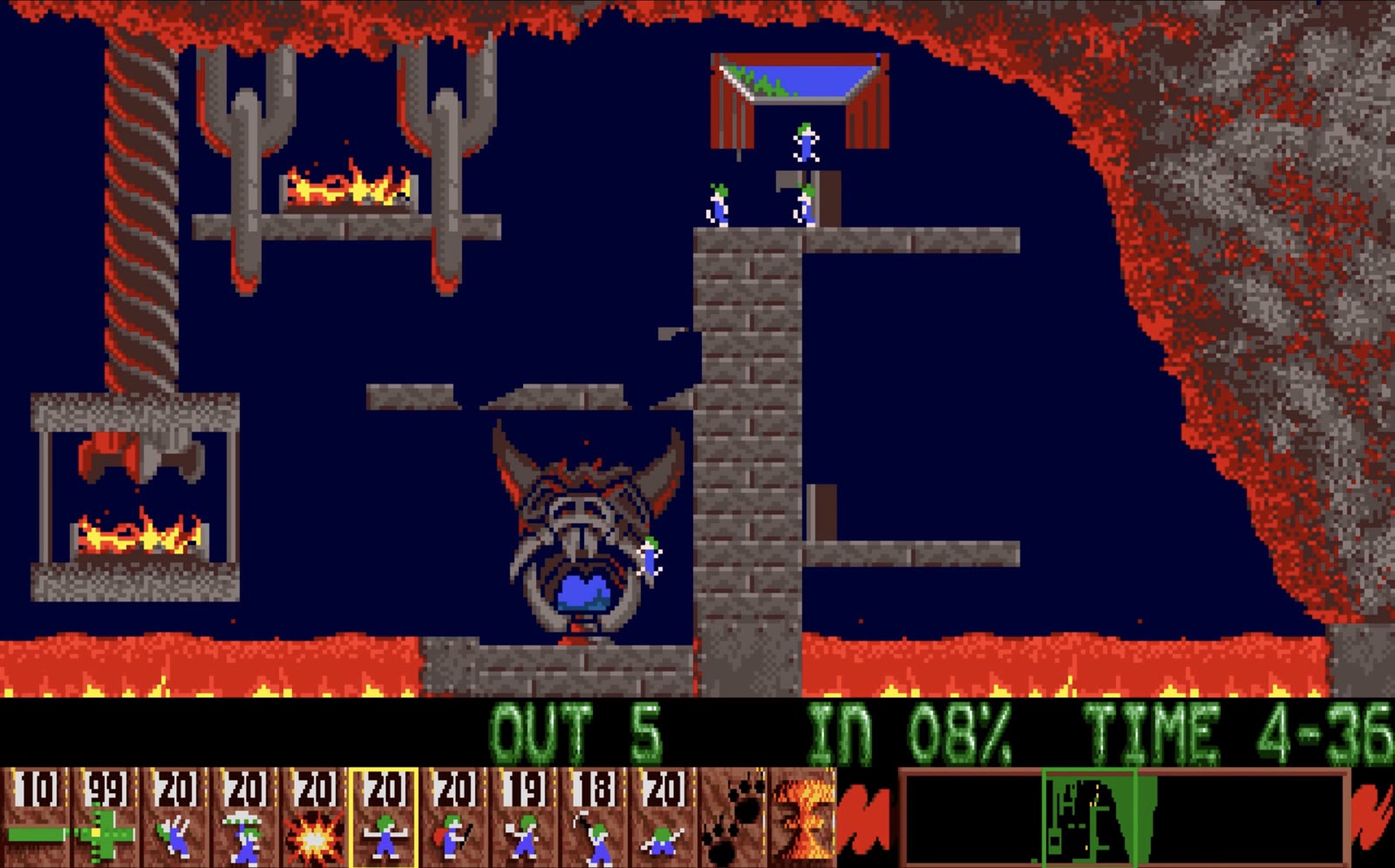 One of the fire-and-brimstone levels. The exit is the demon’s mouth, which tells you something about the game’s sense of humour.
What They Said at the Time
The magazines were, it’s fair to say, keen. Thanks to the scans on the Internet Archive (and a screenshot of Amiga Format’s pages), I’ve been able to dig out what some of them actually said.
CU Amiga got in first, its readers having already had a go via the coverdisk (“CU Amiga coverdisk owners were the first to be treated to its simple aim”), and its February 1991 review opened with a prediction that aged rather well:
“Lemmings could be the first surprise smash of 1991. With the minimum of hype, Psygnosis have released this incredibly original but visually so-so product – and now it’s on the tips of everyone’s tongues.” — CU Amiga, February 1991
“Visually so-so” is a bold call for a game whose graphics are now on a statue in Dundee (more on that later), although the reviewer did concede the animation was “excellent, combining humour with clarity”. They also noticed the music, singling out “a mixture of ‘here comes the bride’ and ‘how much is that doggie in the window’” as the most bizarre tune. Which is saying something. The verdict:
“Lemmings is the perfect family game. The difficulty levels mean that it’s playable by all ages… The only problem I came across was trying to select a particular lemming in a crowd of around a hundred – but chaos is half the fun with Lemmings. A truly excellent game.” — CU Amiga, February 1991 (94%)
Anyone who has tried to click on one specific lemming in a pile-up at the foot of a ladder will recognise that “only problem”. Chaos is half the fun. The other half is swearing.
A month later Amiga Format gave it a Format Gold, and Trenton Webb noted that “although only a few pixels high, the little folk have real character. They hold their heads in despair if instructed to self destruct and tap their toes as they get bored of blocking.” Which is fair enough. You would get bored too.
“Lemmings thrives on panic, lateral thinking and accurate mouse work… Succeed and your grin will shame a Cheshire cat, fail and you have to try again.” — Amiga Format, March 1991 (92%)
He signed off with “There is, as the old saying goes, more than one way to explode a lemming”, which is not an old saying, but probably should be. The verdict box managed it in five words: “Amusing and simultaneously frustrating. Perfect.”
Zzap!, still covering the Amiga alongside the C64 in those days, enjoyed the irony of the publisher famous for flashy graphics winning on gameplay alone:
“Lemmings is the epitome of the thoughtful, imaginative programs that people so often claim ‘aren’t made anymore’. Surprisingly enough Psygnosis, the masters of graphical glitz, have proven the falseness of that argument by resisting the temptation to slip in even a single layer of parallax scroll, instead focusing on the brilliantly original gameplay.” — Zzap!, April 1991 (94%)
The second reviewer added a note of caution: “As long as you don’t feel too sentimental about fluffy animals, Lemmings should have you in stitches.”
Amiga Computing’s Jason Holborne, meanwhile, opened with a bit of natural history about lemmings hurling themselves off cliffs (see above, re: Disney) and finished with no reservations whatsoever:
“If you only ever intend buying one game for your Amiga, then it’s got to be Lemmings. Put simply, Lemmings is an absolute Amiga classic.” — Amiga Computing, May 1991 (97%)
Ninety-seven per cent. For a game about rodents with a death wish. The full scorecard:
- CU Amiga (February 1991): 94%, CU Super Star
- Computer + Video Games (February 1991, reviewed by Richard Leadbetter): 93%, C+VG Hit
- Amiga Format (March 1991, reviewed by Trenton Webb): 92%, Format Gold
- Zzap! (April 1991): 94%
- Amiga Action (April 1991): 90%
- Amiga Computing (May 1991, reviewed by Jason Holborne): 97%, ACJ Award
- Amiga Power (December 1991 round-up): 5 out of 5
Not one score under 90%, which for a puzzle game with no spaceships in it was unusual. There were explosions, to be fair, but you had to make those yourself.
In the Culture
Dundee has taken the lemmings to heart. In the Seabraes gardens on Perth Road, a few hundred yards from DMA’s old office in the Nethergate, there’s a sculpture by artist Alyson Conway of three lemmings climbing a pillar: one keeping lookout at the top, one climbing up after him, and a builder at the bottom, presumably still waiting for someone to give him something to do. It was put up after Colin Anderson of Dundee studio Denki suggested the city should have some public art celebrating its games industry. Not many cities have a statue of a video game rodent. Dundee has three.
 The Seabraes lemmings: one lookout, one climber and one builder, who appears to be doing all the actual work. (Photo: Wikimedia Commons)
The V&A Dundee also features Lemmings in its Scottish Design Galleries, including footage of Mike Dailly himself playing the game. Presumably he’s quite good at it by now.
For the 30th anniversary, publisher Exient commissioned a two-hour documentary, Lemmings: Can You Dig It?, directed by Richard Wilcox of That Video Company. It premiered in Dundee in December 2021 and went up free on YouTube in February 2022, with many of the original DMA team and the late Ian Hetherington of Psygnosis. Two hours is a big commitment for a game about eight-pixel rodents, but it earns it.
And then there’s the music. Composer Brian Johnston built the soundtrack largely from traditional and classical tunes, so you get to watch a lemming plunge to its death to a jaunty arrangement of “How Much Is That Doggy in the Window?” or “She’ll Be Comin’ Round the Mountain”. It shouldn’t work. It does, and it will now be in your head for the rest of the day. Sorry.
What Players Remember
It seems I wasn’t the only one for whom Lemmings was a group activity with a noise problem. Over on MetaFilter, one Amiga owner remembered strolling back across campus on a summer’s day and hearing “oh no!” drifting out of the open window of their dorm room, where their mates were playing Lemmings on their Amiga. Different university, different computer, same soundtrack.
On Hacker News, one commenter said that Lemmings “helped me get through a rough patch in my childhood”, which is a lovely thing to say about a game whose main activity is watching small creatures die. Another admitted that despite many hours of playing as a kid, they never managed to finish it. They are not alone. And on The Register’s forums, one reader said they couldn’t begin to estimate “the countless hours I spent playing that game”, which is about as close to a universal Lemmings experience as you’ll get.
Playing Lemmings Today
The easiest way to play the Amiga original now is through emulation, with WinUAE or Amiga Forever, and it runs perfectly well. On real hardware it’s a cheap and common find, and runs happily on an A500. Use a mouse. It was designed for one, and the console versions with a joypad never felt quite right.
A few tips from someone who has made every mistake available:
- Blockers are your friend. Get one down early to hold the queue while you work out what you’re doing.
- Use the pause. There’s no shame in it. Well, a little, but nobody’s watching.
- Mind the release rate. Slowing the lemmings down buys thinking time; speeding them up is sometimes the only way to beat the clock.
- The nuke button is not admitting defeat. It’s admitting defeat loudly. When a level goes wrong (and it will), setting off the whole tribe in a chain of little “oh no!” explosions is oddly therapeutic.
The nuke in action. Ninety-seven lemmings, eight minutes on the clock, and none of it was going to plan anyway.
Once you’ve finished the original (or given up), there’s Oh No! More Lemmings, an expansion with another 100 levels, and the Christmas Lemmings releases, in which the lemmings wear Santa hats and die just the same. There’s also the 2006 PSP remake and the modern mobile game, if you’d like the frustration in your pocket.
The Legacy of Lemmings
It’s hard to think of a better example of a throwaway idea getting out of hand. A lad in Dundee wanted to win an argument about pixels, a colleague laughed and said there was a game in it, and that game paid for the studio that went on to make Grand Theft Auto and later became Rockstar North. Every studio has someone who mucks about in Deluxe Paint when they should be working. It’s worth keeping an eye on them.
For me, Lemmings will always mean a small dorm room, a borrowed 386 PC with three games on it, and a group of students who should have been asleep, all shouting at an eight-pixel creature to dig. I never owned it on the Amiga, but it’s earned its place on my top 10 Amiga games list regardless. If you’ve never played it, it’s well worth an evening. Possibly several. Possibly the rest of your degree.
Sources
Quotes and images from elsewhere, for anyone who wants to read more:
- Russell Kay’s “There’s a game in that!”: Mike Dailly’s history of Lemmings, via lemmings.info
- CU Amiga, February 1991 (issue 12), Internet Archive
- Amiga Format, March 1991 (issue 20), scans at Amiga Magazine Rack
- Zzap!, April 1991 (issue 72), Internet Archive
- Amiga Computing, May 1991 (issue 36), Internet Archive
- Player memories: MetaFilter, Hacker News, The Register forums
- Seabraes statues photo: Wikimedia Commons
More like this

Top 10 Amiga Games
My top 10 Amiga games, from Turrican II and Cannon Fodder to Lemmings, SWOS and Another World, plus the near misses and how to play them today.
Comments