The Great Giana Sisters for the Commodore 64
By RolyRetro · · Commodore 64
Most games that borrow heavily from a bigger, more famous game keep their heads down and hope nobody notices. The Great Giana Sisters went the other way. Its UK cassette inlay has a graffiti-covered brick wall on it, and scrawled across that wall, in the sort of lettering usually found on the back of a school bus seat, are four words: The Brothers are History!
The brothers in question were, of course, Mario and Luigi. And Nintendo, it turned out, had seen the wall.
Within months of its UK release the game was gone from the shops, the finished Spectrum version had been cancelled, and a cheerful little C64 platformer that Zzap!64 had just asked might be “the best platform game of all time” had become the most famous game you couldn’t buy. Which, as it turned out, did it no harm at all.
Stage 6, underground, with punk Giana and Chris Hülsbeck’s music (my own play, emulated on the Steam Deck)
Me and the Giana Sisters
I’ll be honest from the start: I was a Spectrum and BBC Micro kid, so The Great Giana Sisters belonged to the other side of the playground. It’s the number one in my top 10 Commodore 64 games all the same, and I’ve made my peace with that.
These days I play it the way most people have played it since 1988: on an emulator, in my case on the Steam Deck, which makes a surprisingly good C64 once you’ve persuaded it which button is the joystick fire. I would quite like an original copy for the collection. But a boxed UK copy costs rather more than I’m prepared to explain at home, so for now the Steam Deck will have to do.
The Story Behind The Great Giana Sisters
“Make us one of those”
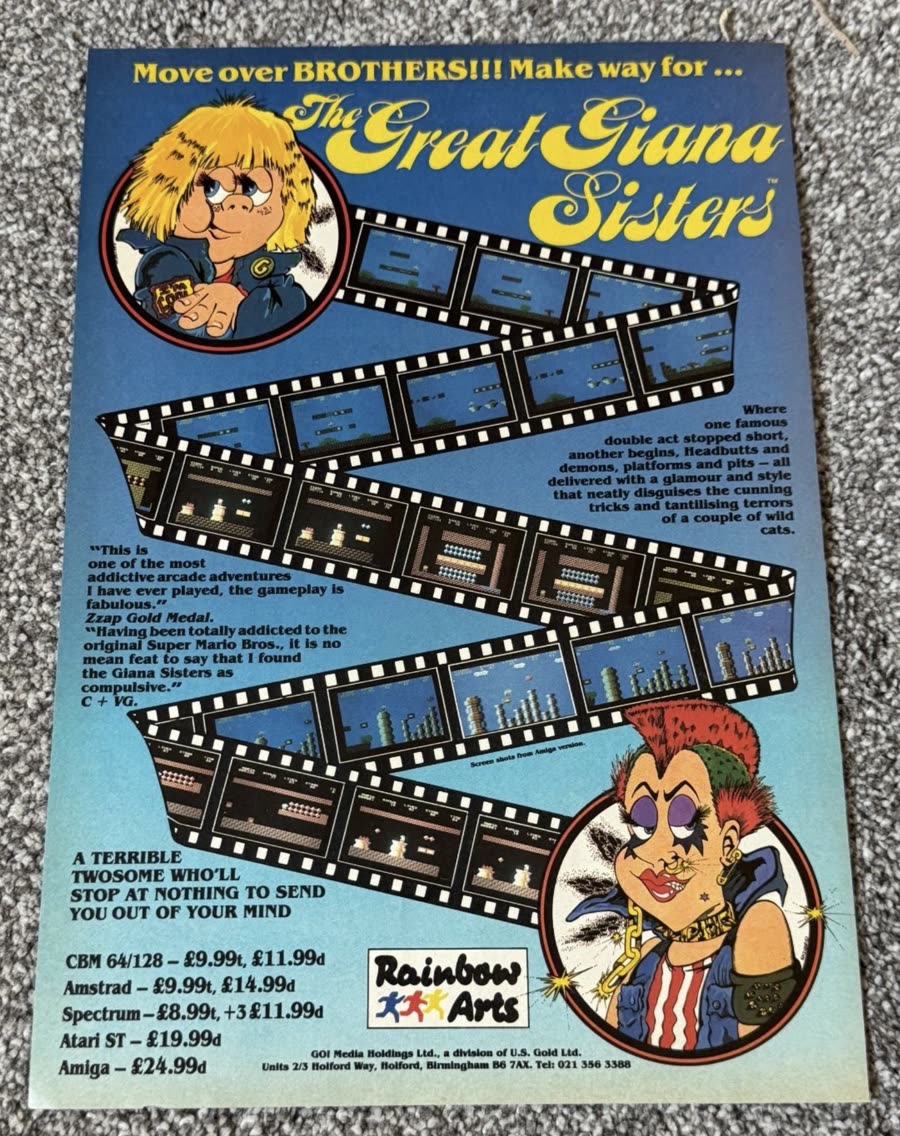
The game started with a simple brief. Marc Ulrich, who ran the West German publisher Rainbow Arts, had seen Super Mario Bros. on the NES (the number one in my top 10 NES games) and wanted something similar for the home computers. Nintendo didn’t make games for the C64, so as far as Rainbow Arts were concerned there was a gap in the market, and they asked two young members of their in-house team to fill it.
Armin Gessert wrote the code. The graphics were by Manfred Trenz, who had come third in a graphics competition in the German magazine 64’er and joined Rainbow Arts in 1987; Giana was his first in-house project. The music came from Chris Hülsbeck, who had got his job by ringing the company up with some of his C64 tunes. The whole thing took about six or seven months.
Not quite copying
Trenz, by his own admission, wasn’t really a platform game person. He was, he later said, “more interested in games like Defender”, and he wasn’t keen on a straight copy either. He told Retro Gamer he thought “it would be incredibly cheeky to simply copy the enemies as they were in Super Mario Bros.”, so he invented his own: giant bees, lobsters, wriggling worms, bouncing blobs and assorted things that look like they’ve wandered in from somebody else’s dream. Which, given the plot, is exactly what they are.
He even shrank Giana herself, because a bigger sprite “would have been too close” to Mario. Quite how close everything else was is the rest of the story.
Because the bones of it are very familiar. Giana runs left to right through 32 levels against a 100-second clock, head-butting blocks for crystals (100 of them gets you an extra life), hopping on enemies and dropping down hidden holes into bonus rooms. Pick up the fireball power-up and she turns from a sweet little blonde girl into a spiky-haired punk who can smash bricks with her head. A second player takes over as her sister Maria. If you’ve played Super Mario Bros., you’ve played the first level of Giana Sisters before you’ve even loaded it.
The Brothers are History
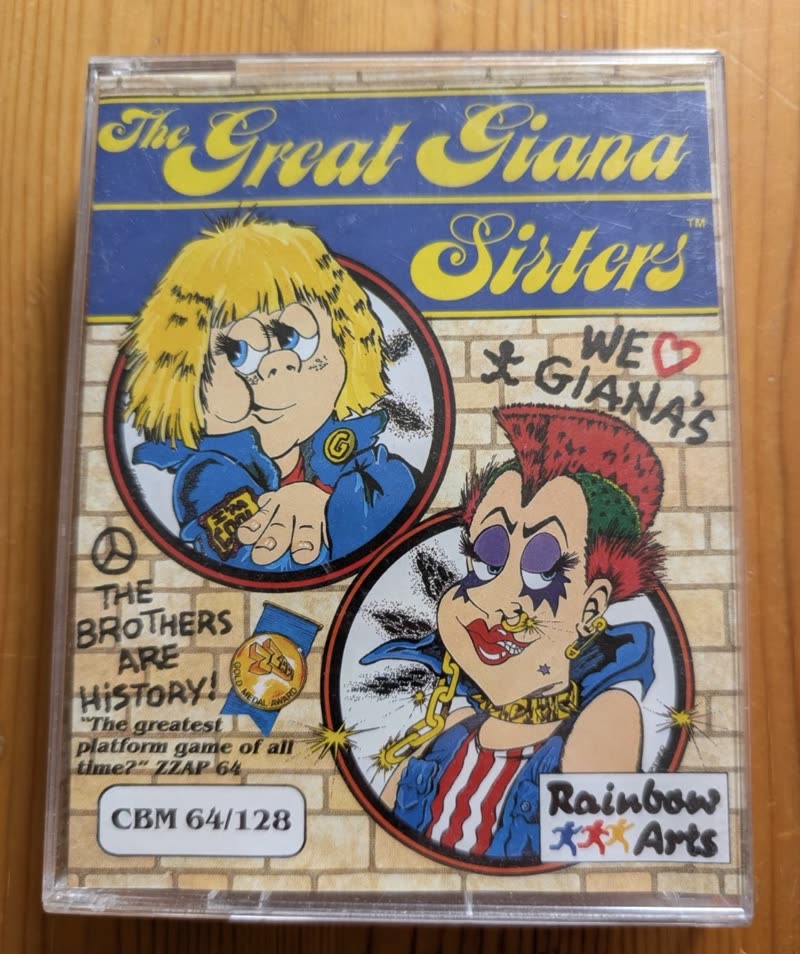
The game came out in West Germany on 6 May 1987 and, by most accounts, sold steadily there for months without anyone in Kyoto taking much notice. The trouble started when it crossed the Channel.
In the UK it was handled by GO!, a label of Birmingham’s US Gold, and the British packaging was considerably louder than the German one. There’s the graffiti wall, there’s “We ♥ Giana’s”, there’s a Zzap!64 Gold Medal badge and a quote from the magazine’s cover, and there, in the bottom left, is the line that has been quoted in every article about this game ever since: The Brothers are History!
Trenz didn’t like the British cover much (he thought his sisters had come out looking a bit like Miss Piggy), and he was never sure exactly what got the game pulled. But, as he told Retro Gamer, putting that slogan on the box “certainly couldn’t have helped”.
A nasty letter
The popular version of the story is that Nintendo sued. It’s a good story, but it isn’t quite what happened. What Rainbow Arts actually received was what Chris Hülsbeck later called a “nasty letter”: no court case, but a list of the similarities to Super Mario Bros. and a clear warning to take the game off the market. Rainbow Arts’ owners later said the matter was settled out of court. The British distributor withdrew the game in 1988, and the Spectrum version, which was finished and had already been reviewed, was quietly cancelled.
Not every copy disappeared overnight, mind you. Mail-order adverts in Commodore User that November and December were still offering “Gt Giana Sisters” for £5.95, alongside Football Manager 2 and Bionic Commando. Whoever ran those shops either hadn’t been told or had a warehouse full of cassettes and no intention of throwing them in a skip.
Armin Gessert, for his part, was always fairly modest about the whole thing. “I think it’s a great game,” he said years later, “but it never reached the detail and class of Super Mario Bros.” Which is about as gracious as anyone has ever been about a legal letter.
What They Said at the Time
The magazines loved it. Zzap!64 put it on the cover of issue 39 (July 1988) under the line “The best platform game of all time?”, gave it a Gold Medal and 96%, and one reviewer called it “one of the most addictive arcade adventures I’ve ever played”. Another was a little more measured:
“Anyone lucky enough to have Super Mario Bros won’t find this particularly appealing because SMB is far more refined, but for those without, Great Giana Sisters offers a fiendishly playable platform game that’ll have you burning the midnight oil for weeks.” — Zzap!64, issue 39, July 1988
Which, since hardly anyone in Britain had a NES in 1988, was most people. The verdict summed it up as “a fabulous, compelling and constantly rewarding arcade adventure”, and added that it was “the best game of its type since Bubble Bobble and there can’t be many higher recommendations than that”. Given Bubble Bobble is my number two, I’m not going to argue.
Computer and Video Games gave it 9/10, with a reviewer who had clearly been down this road before:
“Having been totally addicted to the original Super Mario Bros., it is no mean feat to say that I found the Giana Sisters as compulsive.” — C+VG, quoted in the GO! advert, 1988
My favourite review, though, is Crash’s. It gave the Spectrum version 92% and concluded that “those Super Mario Bros have certainly met their match”. Spectrum owners never got to find out, because that version never came out. Look back at the bottom of that advert and there it is: Spectrum, £8.99. As a Spectrum owner, I feel I’m owed £8.99.
The Music
You can’t talk about Giana Sisters without talking about the music. Chris Hülsbeck’s title tune is one of the best-known pieces of music on the C64, and the in-game tunes are the ones C64 owners still hum. It’s a big part of why so many of them will tell you, with a straight face, that they prefer Giana to Mario.
It has had a better afterlife than most game music, too. The Giana Sisters tunes were played by a full orchestra at the Symphonic Game Music Concerts in Leipzig in the 2000s, by the Royal Stockholm Philharmonic Orchestra in 2009, and on the Symphonic Shades album of Hülsbeck’s music. Not bad for something written for a three-voice sound chip in a breadbin.
Playing The Great Giana Sisters Today
An emulator is the obvious way in. VICE runs it perfectly on a PC or Mac, and so does the Steam Deck, which is where I play it.
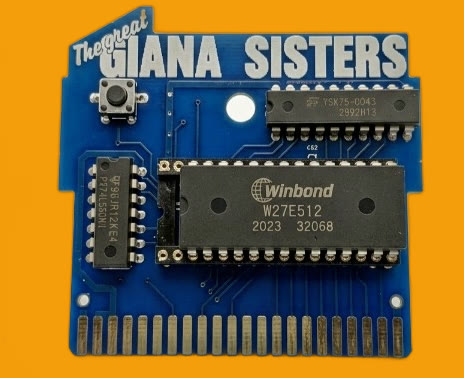
If you’ve got a real C64 and don’t fancy paying collector prices for an original tape, there’s a halfway house. Hobbyist makers sell Giana Sisters on a cartridge: a modern circuit board with the game on an EPROM chip, which plugs into the cartridge port and starts the moment you switch on. No loading, no tape counter, no turning the volume up and down on the datasette. The one in the photo is a shared project on PCBWay, where you can order the board in kit form and build it yourself. Ready-made ones also turn up on sites like Tindie and Etsy, from about $35 for a bare board, with boxed versions too.
They’re made by fans rather than licensed by whoever owns the game these days, so think of one as a way to play it on the real thing rather than a collectable. Whichever way you play it, a few tips:
- Head-butt everything. Ordinary-looking blocks often hold crystals, and a few hold several.
- Not every hole kills you. Some lead down to bonus rooms full of crystals. Working out which is which is half the game (and the other half is finding out the hard way).
- Look after the power-ups. The punk hairdo lets you smash bricks, and the extra power-ups after it give her bouncing and homing “dream bubbles” to shoot. Losing a life takes them all away again, which stings later on.
- There are hidden warp blocks that skip you forward several levels, and a famous cheat: hold down A, R, M and N together (Armin’s name, more or less) to skip a level.
If you’d rather play something newer, the series came back in 2009 with Giana Sisters DS, Armin Gessert’s last game. It’s a remake rather than a port: new levels, much prettier graphics and a world map, but the same head-butting, the same punk transformation and the same urge to drop down every hole in case there’s a bonus room at the bottom. Each world also hides red diamonds, and collecting them all opens up a bonus level, as the sign in my clip helpfully points out. It plays on any DS, and on a 3DS too.
Giana Sisters DS (2009): the first world, and a hint about those red diamonds
After that came Giana Sisters: Twisted Dreams in 2012, which flips between a cute dream world and a darker punk one at the press of a button and has a soundtrack co-written by Hülsbeck.
The Legacy of The Great Giana Sisters
The odd thing about The Great Giana Sisters is that being pulled from the shops made it far more famous than staying in them would have. Copies went round the playgrounds on C90 tapes, and as Trenz himself pointed out, it only really found its audience once you couldn’t buy it.
The people behind it did all right in the end, too. Manfred Trenz went on to make Turrican, Chris Hülsbeck went on to score it (and the Amiga’s Turrican II is in my top 10 there), and Armin Gessert founded Spellbound Entertainment, the studio behind Desperados and Airline Tycoon. His last game was Giana Sisters DS, released in 2009, shortly before he died at the age of 46.
So Nintendo got their letter written, the brothers carried on doing rather well, and the sisters ended up with a Gold Medal, an orchestra and a sequel on a Nintendo console. History, it turns out, is a matter of opinion.
Sources
- Zzap!64 issue 39, July 1988: review and cover (scan on the Internet Archive)
- Commodore User, November and December 1988: mail-order adverts (November scan)
- C+VG and Crash quotes: from the 1988 GO! advert and as quoted on Wikipedia
- Manfred Trenz and Armin Gessert quotes: Retro Gamer (Darran Jones, 2008), as quoted on Wikipedia
- Cartridge photo: the Giana Sisters cartridge project on PCBWay
More like this
Paradroid for the Commodore 64
Andrew Braybrook wrote Paradroid in public, diary entry by diary entry in Zzap!64, then watched it score 97%. The story behind a C64 masterpiece.

Top 10 Commodore 64 Games
My top 10 Commodore 64 games, from Boulder Dash and Paradroid to IK+ and The Great Giana Sisters, with trivia and platform comparisons.
Comments