Paradroid for the Commodore 64
These days we’re used to developers sharing everything — dev blogs, Discord updates, early access, the lot. Back in the summer of 1985, that just didn’t happen. Games appeared in the shops, fully formed, and you had no idea how they got there.
Then Zzap!64 did something brilliant. It asked a young programmer called Andrew Braybrook to keep a diary while he wrote his next game, and printed it, month by month, while he was still writing it. For four issues, Commodore 64 owners watched a game come together on paper — the ideas, the bugs, the late nights, the publisher on the phone. And when it finally came out, the same magazine gave it 97% and a Gold Medal.
That game was Paradroid, and it was well worth the wait.
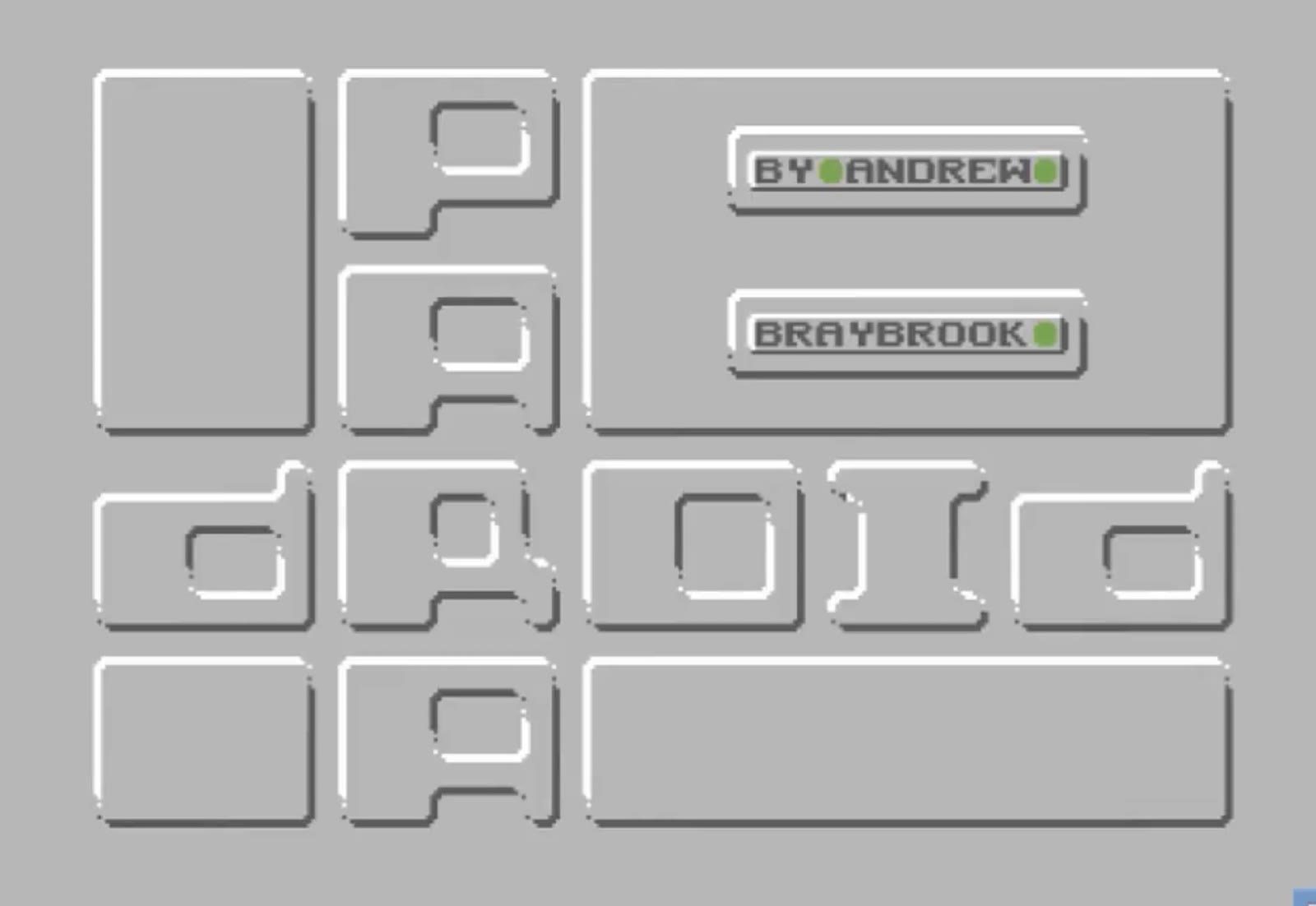 The Paradroid title screen, in Braybrook’s very own “giant-sized letters”
My Paradroid Story
As regular readers will know, I grew up with a Spectrum and a BBC Micro, so the Commodore 64 was always the machine on the other side of the playground argument. But I do remember the first time I saw Paradroid.
It was in a local computer shop in Grays, back in the days when you could wander in and try out whatever games they had loaded up on their Spectrum, BBC Micro or C64. I never really got a proper go on it, but I remember being struck by how slick it looked and sounded compared to a lot of the other games on offer.
Fast forward about 40 years. When I was putting together my Top 10 Commodore 64 Games, I finally sat down and played it properly — on my Steam Deck, using EmulationStation and the VICE emulator. It took a bit of fiddling with the settings to get the Steam Deck’s joysticks working (it turns out the game only reads joystick port 2, a classic C64 gotcha), but once that was sorted I was up and running with the game I’d first seen in that shop in Grays all those years earlier.
The Story Behind Paradroid
From Cute to High-Tech
Andrew Braybrook was working at Graftgold, Steve Turner’s small development team in Essex, who wrote games for publisher Hewson. He’d come in converting games for the Dragon 32, moved on to the Commodore 64 when the Dragon market dried up, and had just finished Gribbly’s Day Out — a sweet, colourful game about a little creature bouncing around rescuing baby Gribblets.
His next game was going to be completely different. As he wrote in his very first diary entry: “Gribbly’s was all cute so this one is going to be high-tech.”
The ideas came from all over the place. The core mechanic — taking over enemy robots — was partly inspired by Taito’s arcade game Front Line, where your soldier could climb into a tank and had to bail out when it was hit. The look and atmosphere borrowed from the film Aliens. And, my favourite bit, Braybrook has said the cover of Black Sabbath’s Technical Ecstasy album — two robots meeting on an escalator, apparently “interfacing” — was another inspiration. Not many games can trace their DNA to Ozzy Osbourne.
Birth of a Paradroid
Zzap!64 ran Braybrook’s diary as “Birth of a Paradroid” across four issues, from issue 3 in July 1985 to issue 6 in October. The magazine introduced it as a chance to follow the game’s “programming, production and promotion actually through the eyes of the people concerned.”
What’s fascinating, reading it now, is how ordinary and human it all is. The game started with notes on a huge spaceship full of robots, and grew piece by piece. Some of the enemy routines were lifted straight from Gribbly’s Day Out. Bugs were found and fixed — there’s an entry from 15 July about robots colliding with each other. And ideas came from unexpected places: when Gordon Hewson phoned up to check on progress, the diary records him suggesting that if you lost a droid you’d taken over, it should be destroyed rather than you — so you’d drop back to your feeble little Influence Device instead of dying outright. It’s one of the things that makes the game work, and it came from the publisher on the phone.
I’ve got a scan of Part Three from the September 1985 issue, and it’s an absolute joy. The intro calls it “our everyday story of programming folk”, and promises that “this month Andrew suffers from errant disk drives and missing robots, but at least Kenny Everett is looking better…”
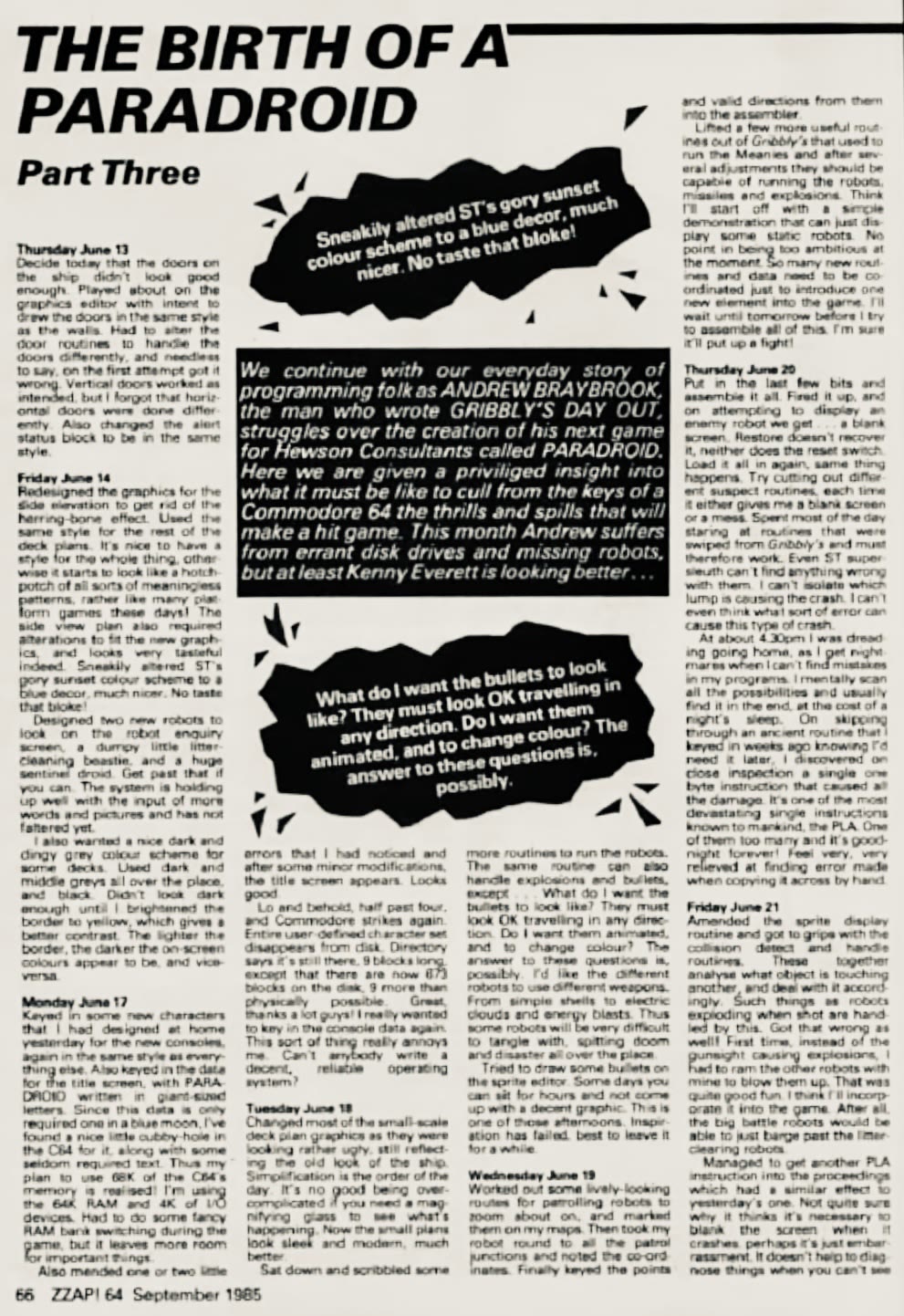 The Birth of a Paradroid, Part Three — Zzap!64, September 1985
Over a single week in June you get the full range of a programmer’s life. On 14 June he redesigns the deck plans so the ship doesn’t look like “a hotch-potch of all sorts of meaningless patterns, rather like many platform games these days!” — and can’t resist a dig at his boss: “Sneakily altered ST’s gory sunset colour scheme to a blue decor, much nicer. No taste that bloke!”
On 17 June the computer eats his work: “Entire user-defined character set disappears from disk… Can’t anybody write a decent, reliable operating system?” On 20 June, after a day of blank screens and crashes, he admits: “At about 4.30pm I was dreading going home, as I get nightmares when I can’t find mistakes in my programs.” The culprit turned out to be a single instruction he’d mistyped copying code across by hand — “one of the most devastating single instructions known to mankind, the PLA.”
And then, on 21 June, the moment the game’s signature idea arrives, almost by accident:
“First time, instead of the gunsight causing explosions, I had to ram the other robots with mine to blow them up. That was quite good fun. I think I’ll incorporate it into the game.” — Andrew Braybrook, Zzap!64, September 1985
If you’ve ever rammed a droid in Paradroid, that’s where it came from. By the final instalment the game was finished and on its way to the shops, and readers had been along for the whole ride.
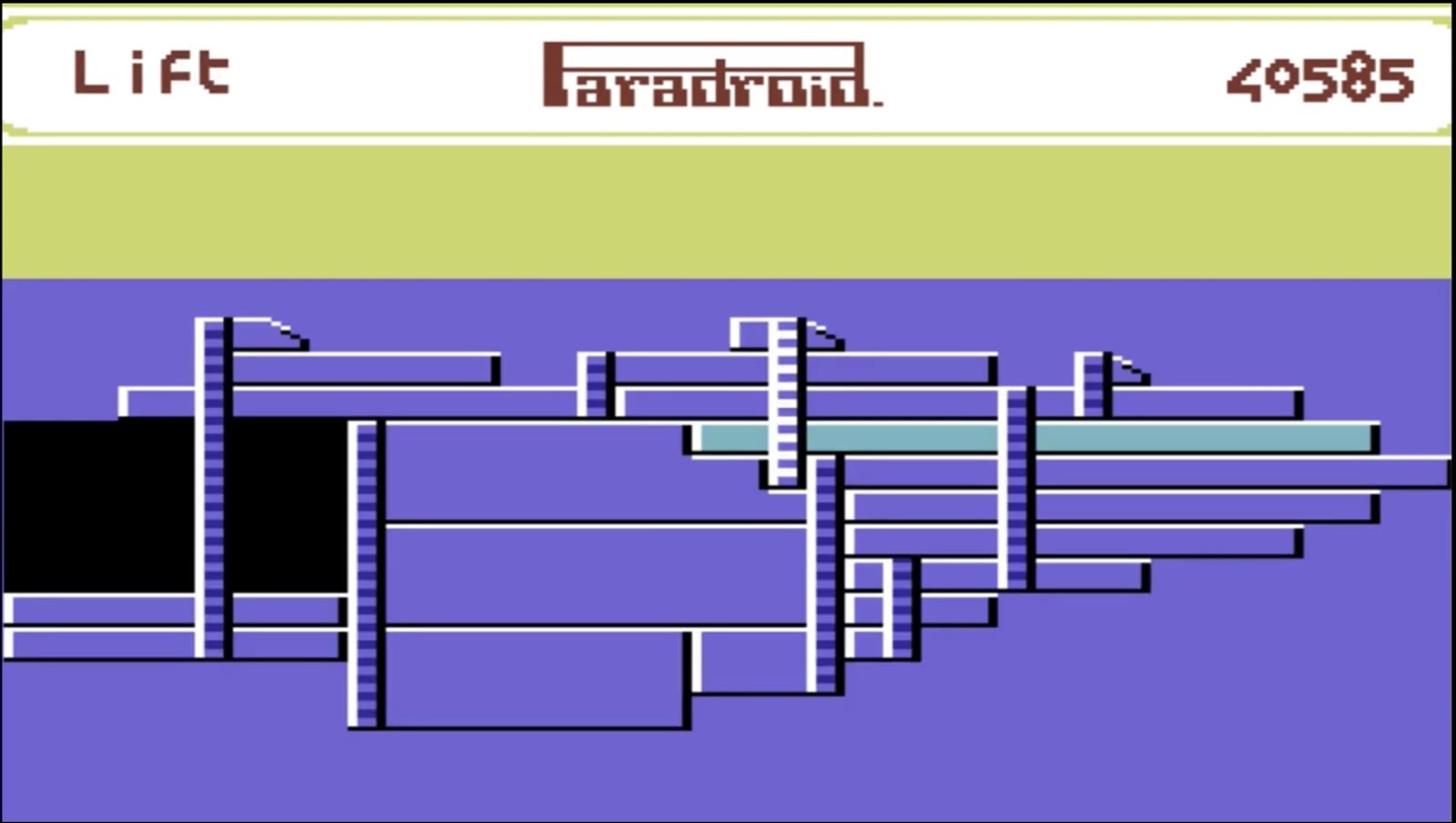 The lift screen — a side view of the ship, the same “side elevation” Braybrook was redesigning in his diary on 14 June
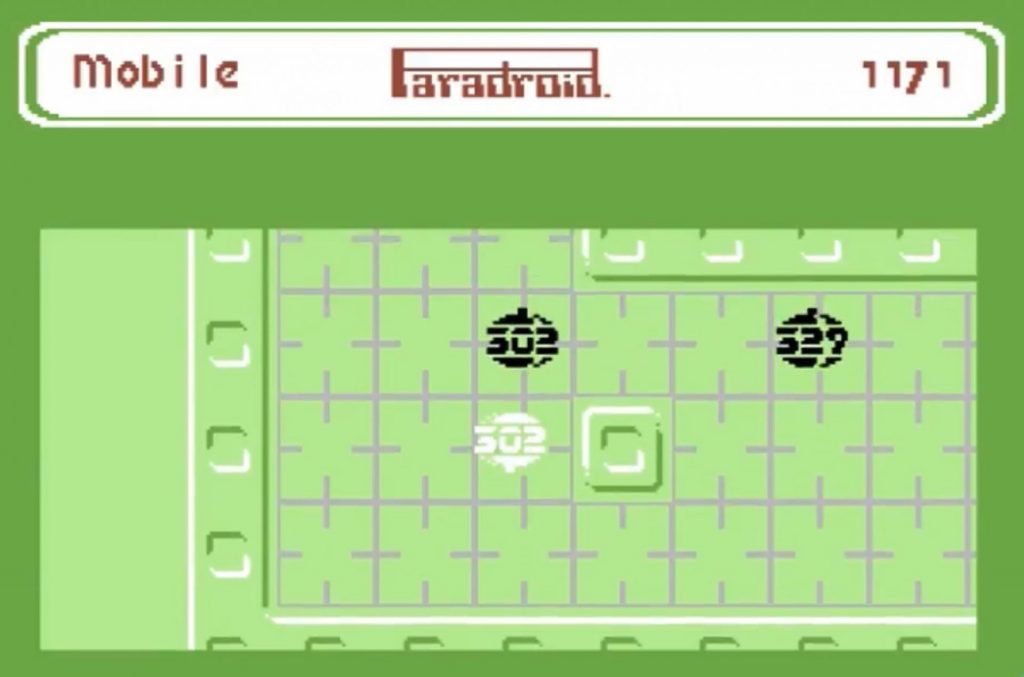 Now in control of a 302 (in white), with another 302 and a 329 for company
How It Plays
You’re the Influence Device, droid 001 — the weakest robot on a fleet of starships whose robots have turned against their crews. Every droid on board is identified by a three-digit number, and the first digit tells you how dangerous it is, all the way up to the 999 command cyborg. Wandering around as a 001 is a quick way to die.
So instead of just shooting everything, you take over the droids. Ram into one and you play the transfer game: a little circuit-board duel where you and the enemy route power along wires to win control of a central column before time runs out. Win, and you’re now that droid, with its weapons, speed and armour. Lose, and you’re toast (or, if you were already inside a droid, back to being a 001). The trick is climbing the ladder — taking over bigger and bigger droids so you can survive the deck, and the deck after that.
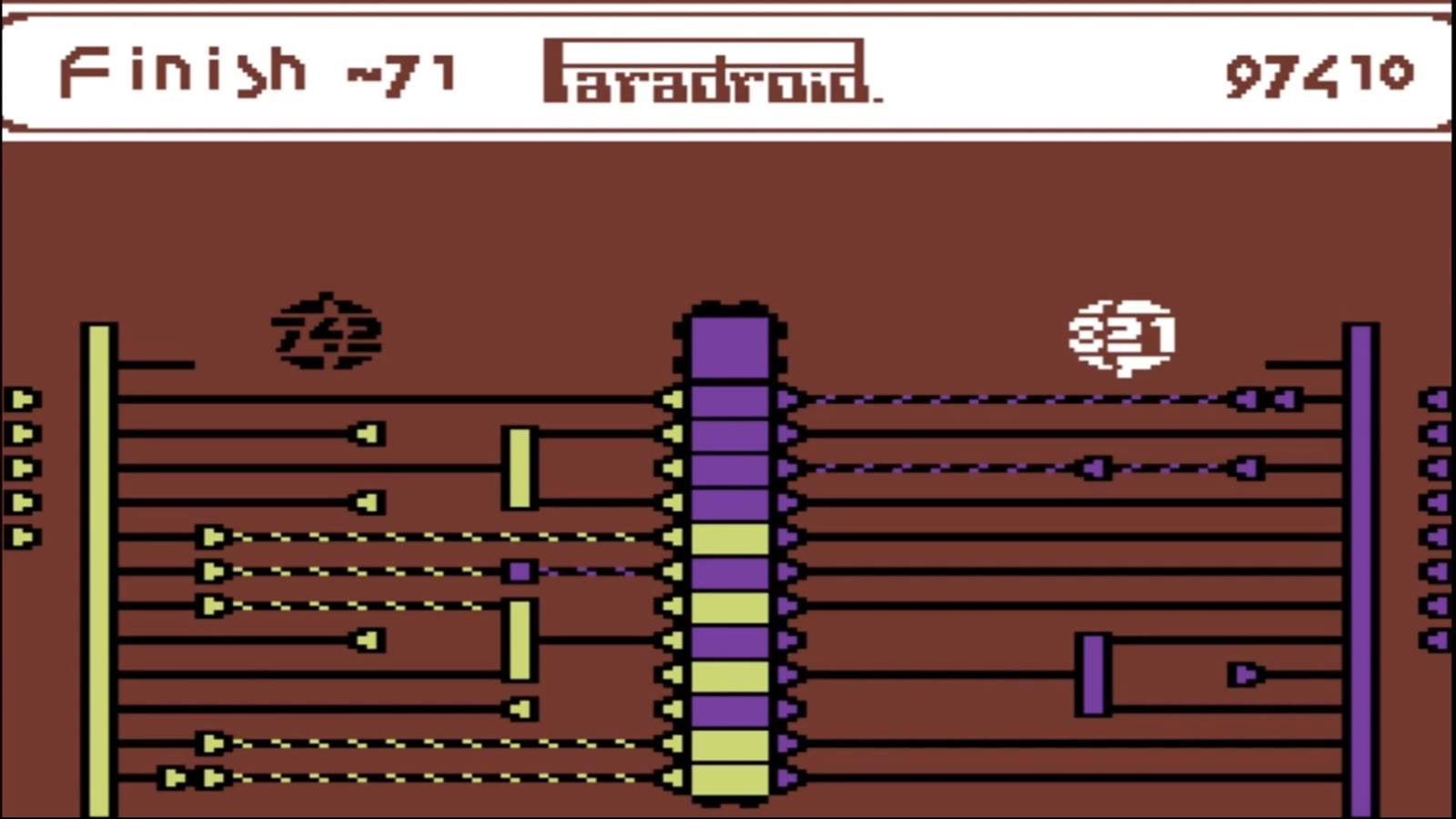 The transfer game — 743 versus 821, a battle of wires and pulses for control of the central column
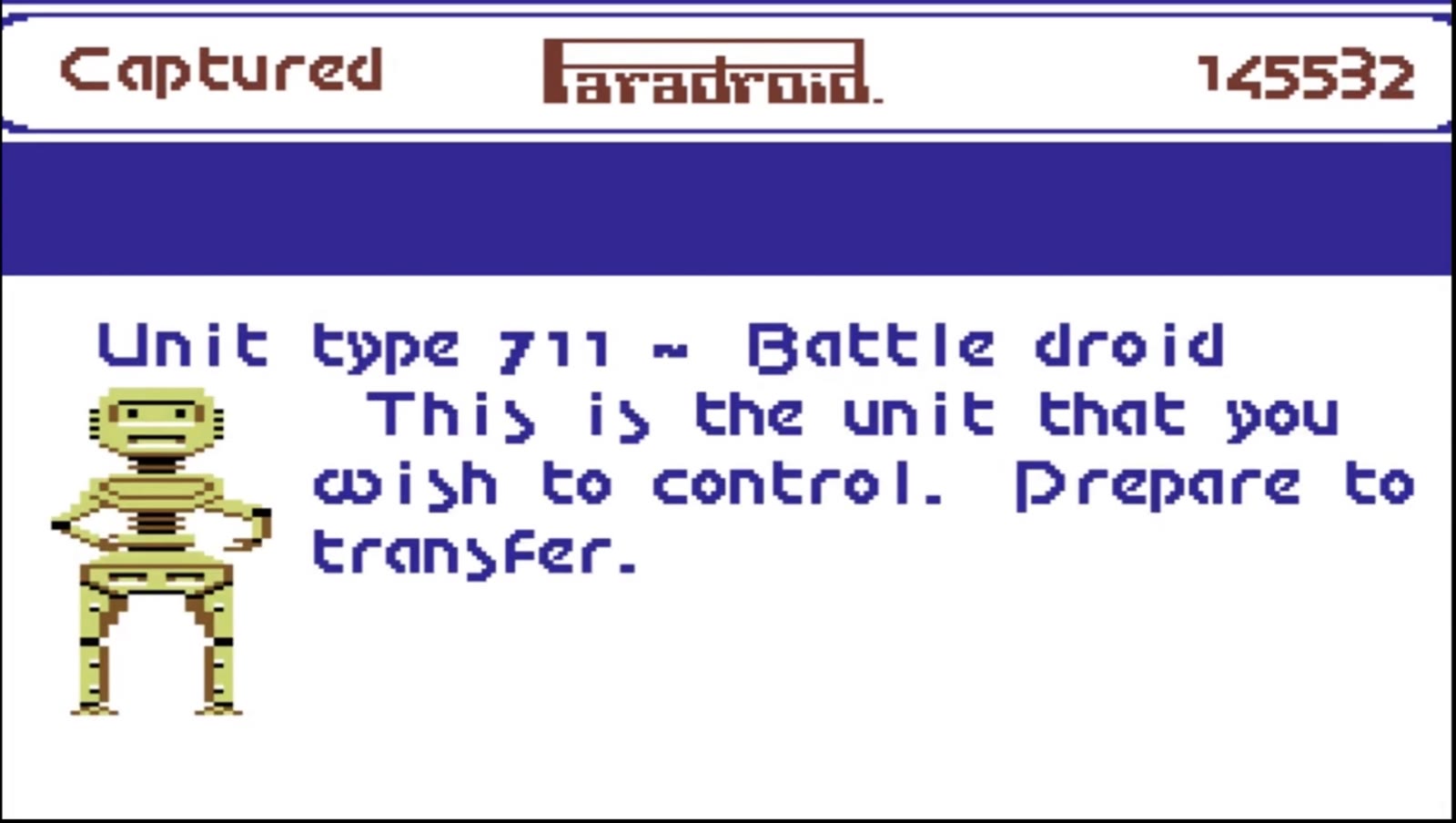 Going for the big one: a 711 Battle droid. “Prepare to transfer.”
It’s a shoot ’em up, a puzzle game and a strategy game all at once, and I don’t think anything else on the C64 felt quite like it.
What They Said at the Time
All those months of diary entries had built up plenty of expectation — and, as it turns out, a bit of nervousness at Zzap!64 towers. When the finished game landed for review in issue 7 (November 1985), Julian Rignall was refreshingly honest about it:
“When Paradroid finally arrived in the office I wondered if it would be as good as Gribbly’s and whether after three months of build up the game would be a flop. I needn’t have worried — it’s absolutely superb!” — Julian Rignall, Zzap!64, November 1985
He loved the “fantastic spaceship atmosphere” of the graphics and sound (and told readers to “listen to the robot conversation on the title screen too”), and singled out the transfer game, where “there can be some rather tense moments (especially when you try to go from 001 to 883)!”. His summing up was about as high as praise got in 1985:
“Overall Paradroid is one of the best programs I’ve seen on the 64, and is one that has been keeping my interest for several weeks, something that a game hasn’t done for some time.” — Julian Rignall, Zzap!64, November 1985
Gary Penn was just as taken, calling its fresh take on the shoot ’em up stunning and praising the presentation. He reckoned the scrolling was like Gribbly’s Day Out, only better — with “no noticeable screen glitch at all”, which on a C64 in 1985 was no small boast.
Zzap!64 gave it a Gold Medal and 97% overall, and the sub-scores tell the story:
| Presentation | Graphics | Sound | Hookability | Lastability | Value | Overall |
|---|---|---|---|---|---|---|
| 100% | 97% | 88% | 98% | 98% | 98% | 97% |
At the time, the Gold Medal was reserved for the very highest scores, so this put Paradroid firmly at the top table of C64 games. Commodore User also reviewed it in issue 26 (November 1985), and it’s been on just about every “best C64 games” list since — including mine.
In the Culture
In 2024 Paradroid got its own documentary, Paradroid: Creating a Masterpiece, in which Andrew Braybrook and Steve Turner talk through how the game was made. It’s available on Amazon Prime Video. The same year brought The Graftgold Story, a book covering the whole company through interviews with the people involved — so if the diary leaves you wanting more, there’s plenty to read and watch.
What Players Remember
People don’t tend to describe Paradroid as a “good game” — they describe it as an addiction. One Nintendo Life commenter summed it up as “one of the most addictive I’ve ever played”, which is a fair description of trying to get past just one more deck.
Over on the wirelessmoves blog, one writer explained how they’d forgotten exactly how Paradroid played but remembered being completely hooked — then installed the free Freedroid remake, having not played a game in years, and lost hours to it all over again. That’s the thing about Paradroid: the hook never really goes away.
Playing Paradroid Today
Tips
- Don’t stay a 001 for long — the Influence Device is weak. Grab the first decent droid you can and work your way up.
- Pick your side carefully in the transfer game — look at both sides of the circuit board before you choose. Some layouts are much better than others.
- Bigger isn’t always a sure thing — the higher the droid number, the harder the transfer. Sometimes a solid mid-range droid is the safer bet.
- Droids wear out — a captured droid slowly burns out, so you’ll need to keep transferring to stay alive.
- Use the consoles — the computer terminals on each deck let you look up droid stats and see the ship’s layout. Knowing what you’re up against helps.
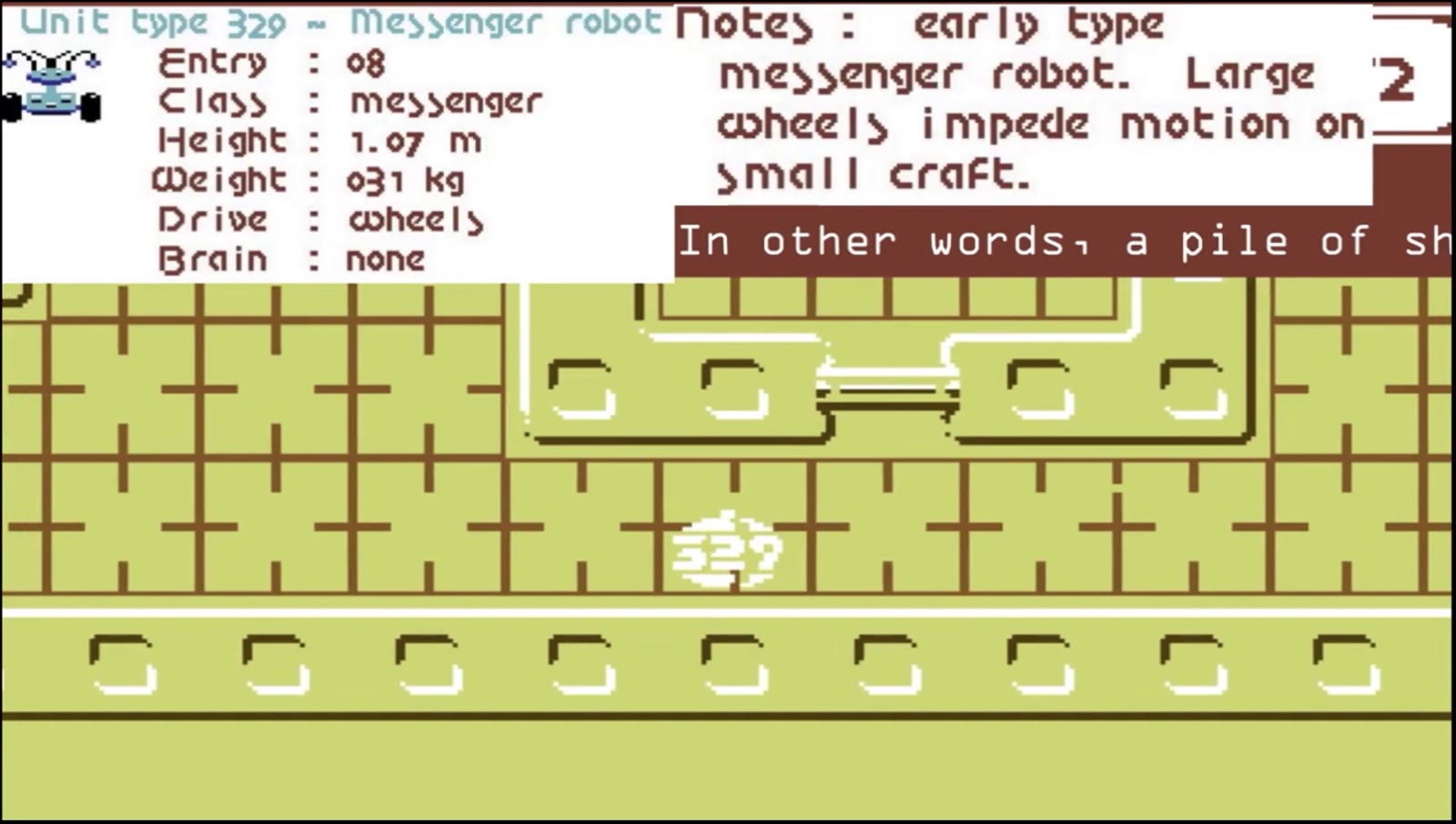 The console’s verdict on the 329 messenger robot: brain “none”, and a scrolling summary that starts “In other words, a pile of sh…” before running off the edge of the screen
Where to Play It
The original runs perfectly on any decent C64 emulator, and it’s a great choice if you’ve got TheC64 or a real breadbin. I play it on the Steam Deck with EmulationStation and VICE — just make sure your controller is mapped to joystick port 2, or Influence Device 001 won’t budge an inch. Heavy Metal Paradroid — a revamped version with new graphics — is available on Evercade as part of TheC64 Collection 3. If you fancy something more modern, the open-source Freedroid is free on PC and Linux.
Other Versions
Braybrook didn’t leave it there. Paradroid Competition Edition (1986) came bundled with Uridium+ and ran around 50% faster, thanks mainly to improved scrolling code. Heavy Metal Paradroid gave the game a new metallic look. Paradroid 90 brought it to the Amiga and Atari ST (Braybrook kept another diary for Amiga Action while writing it), and Paradroid 2000 arrived on the Acorn Archimedes. Spectrum owners got Quazatron — Steve Turner took Paradroid’s mechanics and patrol paths and dropped them into his isometric engine. Even we didn’t miss out completely.
The Legacy of Paradroid
There’s a reason people still talk about Paradroid forty years on, and it isn’t only the game. “Birth of a Paradroid” let ordinary C64 owners see behind the curtain for the first time — that games were made by real people, with real bugs and real deadlines and phone calls from the boss — long before anyone had heard of a dev blog.
And then the game turned out to be a masterpiece. Braybrook went on to write Uridium, Morpheus and Rainbow Islands conversions with Graftgold, but for a lot of people Paradroid is the one. If you’ve only ever been on the Spectrum side of the playground like me, it’s well worth crossing over for — even if, like me, it takes you 40 years to get from the shop window to the joystick.
If you like this, have a look at my Top 10 Commodore 64 Games, or for something from my side of the fence, the story of Manic Miner.
Frequently Asked Questions
Who made Paradroid?
Paradroid was written by Andrew Braybrook at Graftgold and published by Hewson for the Commodore 64 in 1985.
What score did Paradroid get in Zzap!64?
It received 97% and a Gold Medal in Zzap!64 issue 7 (November 1985).
What was “Birth of a Paradroid”?
A four-part development diary Andrew Braybrook wrote for Zzap!64 while he was making the game, published in issues 3 to 6 (July to October 1985).
Was Paradroid on the ZX Spectrum?
Not directly, but Graftgold’s Quazatron brought Paradroid’s gameplay to the Spectrum in an isometric style.
Can I play Paradroid today?
Yes — on C64 emulators, TheC64, original hardware, or as Heavy Metal Paradroid on Evercade. The free Freedroid remake runs on modern PCs.
Sources
- Birth of a Paradroid, Part 1 — Zzap!64 issue 3 (and parts 2–4 in issues 4–6)
- Birth of a Paradroid, Part 3 — Zzap!64 issue 5, September 1985, p66 (from my own scan)
- Paradroid review — Zzap!64 issue 7, November 1985
- Paradroid diary and Zzap!64 review — Codetapper’s C64 Site
- Paradroid — Wikipedia (citing Retro Gamer interviews)
- Heavy Metal Paradroid spotlight — Evercade
- Quazatron — Wikipedia
- Paradroid: Creating a Masterpiece — Prime Video
- The Graftgold Story — The Video Game Library
- Paradroid Today — wirelessmoves
More like this

Top 10 Commodore 64 Games
My top 10 Commodore 64 games, from Boulder Dash and Paradroid to IK+ and The Great Giana Sisters, with trivia and platform comparisons.
Comments