Manic Miner for the ZX Spectrum
· Updated · ZX Spectrum
In 1983 a teenager in Wallasey sat down with a notebook, a Tandy TRS-80 and a ZX Spectrum he’d been lent by a software company across the Mersey. About eight weeks later he had a finished game. No team, no studio, no budget to speak of — just Matthew Smith, a lot of Z80 assembly language and some seriously odd ideas about killer toilets.
That game was Manic Miner, and it pretty much defined what a platformer could be on the Spectrum. It gave the world Miner Willy, put continuous music on a machine that supposedly couldn’t do it, and turned a schoolboy-aged programmer into one of the first celebrities of the British games industry — with everything good and bad that came with that.
My Manic Miner Story
I first played Manic Miner round a friend’s house, on the Spectrum he’d got for Christmas. I remember struggling at first with the timing of those big sweeping jumps — regularly hitting my head on obstacles or launching myself into voids. But after a while it just clicked, and suddenly you’re hooked, mapping routes in your head and trying to squeeze past that one robot you know is going to get you.
Now for the confession. Many people (my 13 year-old self included) will have discovered the game via a tape-to-tape copy. We did unfortunately copy the hell out of this game — to the point where copies of copies of copies were so bad that we had to club together to buy an original cassette just so we could share it further. Which, when you think about it, is a strange sort of compliment to Matthew Smith.
I’ve since acquired my own physical copy, so feel slightly less guilty. Sorry Matthew!
The Story Behind Manic Miner
A Tandy, a Notebook and a Borrowed Spectrum
Matthew Smith’s family moved to Wallasey, on the Wirral, when he was seven. He started programming on a Tandy TRS-80 that he got around Christmas 1979, and by the time the Spectrum arrived in 1982 he was already a capable Z80 programmer. The Merseyside scene was buzzing — Liverpool had Bug-Byte, Imagine and a whole crowd of young coders (more on one of them later) — and Smith got his foot in the door with Bug-Byte, who lent him a Spectrum in exchange for freelance work.
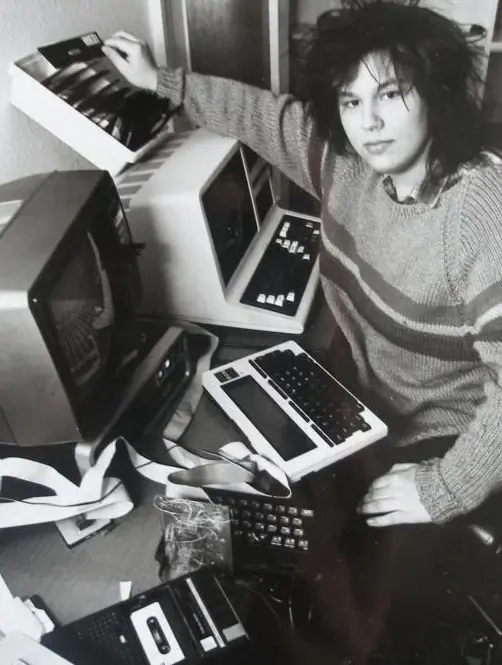 Matt Smith programming with 3 different TRS-80 variants
What I love about this bit of the story is that Manic Miner wasn’t really written on a Spectrum at all. Smith told Sinclair User in December 1984 that he wrote the game on the Tandy, with its proper keyboard, and then wrote a routine so the Spectrum could read Tandy tapes. The finished code was squirted across and, hey presto, a Spectrum game.
Eight Weeks
The brief came from Bug-Byte’s Alan Maton, who wanted something along the lines of Donkey Kong. Smith took his inspiration from Bill Hogue’s arcade-style Miner 2049er and ran with it somewhere far stranger. Asked years later how long it took, he was matter-of-fact about it: “Manic Miner took 8 weeks from notebook to final mastering.”
Eight weeks. For twenty screens, each with its own name, layout and collection of baddies, plus a title tune and continuous in-game music. (There’s some debate among Spectrum historians about the exact dates, and talk of an earlier 16-screen version, but the eight weeks figure is Smith’s own.)
Despite the Spectrum’s constraints — 48K of memory, a beeper for a sound chip and the dreaded attribute clash — Manic Miner managed things that genuinely felt new:
- Pixel-perfect collision detection that made the platforming feel fair (if brutal)
- Continuous in-game music, a real rarity on the Spectrum
- A surreal, very British sense of humour — telephones, penguins, performing seals and flapping toilets as enemies
Eugene, Skylab and a Driving Licence
Smith filled the game with in-jokes. Eugene’s Lair is named after Eugene Evans, the young Imagine programmer who was famously (and much-publicised) earning a fortune at the time — Smith turned him into a giant floating head. Skylab Landing Bay is a nod to the real Skylab space station crashing to Earth in 1979. And the famous cheat code, 6031769, is Smith’s own driving licence number.
The £25,000 Row
Manic Miner was a hit for Bug-Byte, but it didn’t stay with them for long. By Smith’s account, the deal was a few sentences, largely verbal, and the royalties didn’t arrive. “It was £25,000 at one time,” he told Sinclair User. “Whenever I called in they either fobbed me off or refused to see me.”
So he cancelled Bug-Byte’s licence and walked out — taking Alan Maton with him. Together with Liverpool businessman Tommy Barton they founded Software Projects, and Manic Miner was re-released on the new label as the game that got the company off the ground. The Software Projects version swapped the cheat code for “TYPEWRITER”. Both versions are now collector’s items.
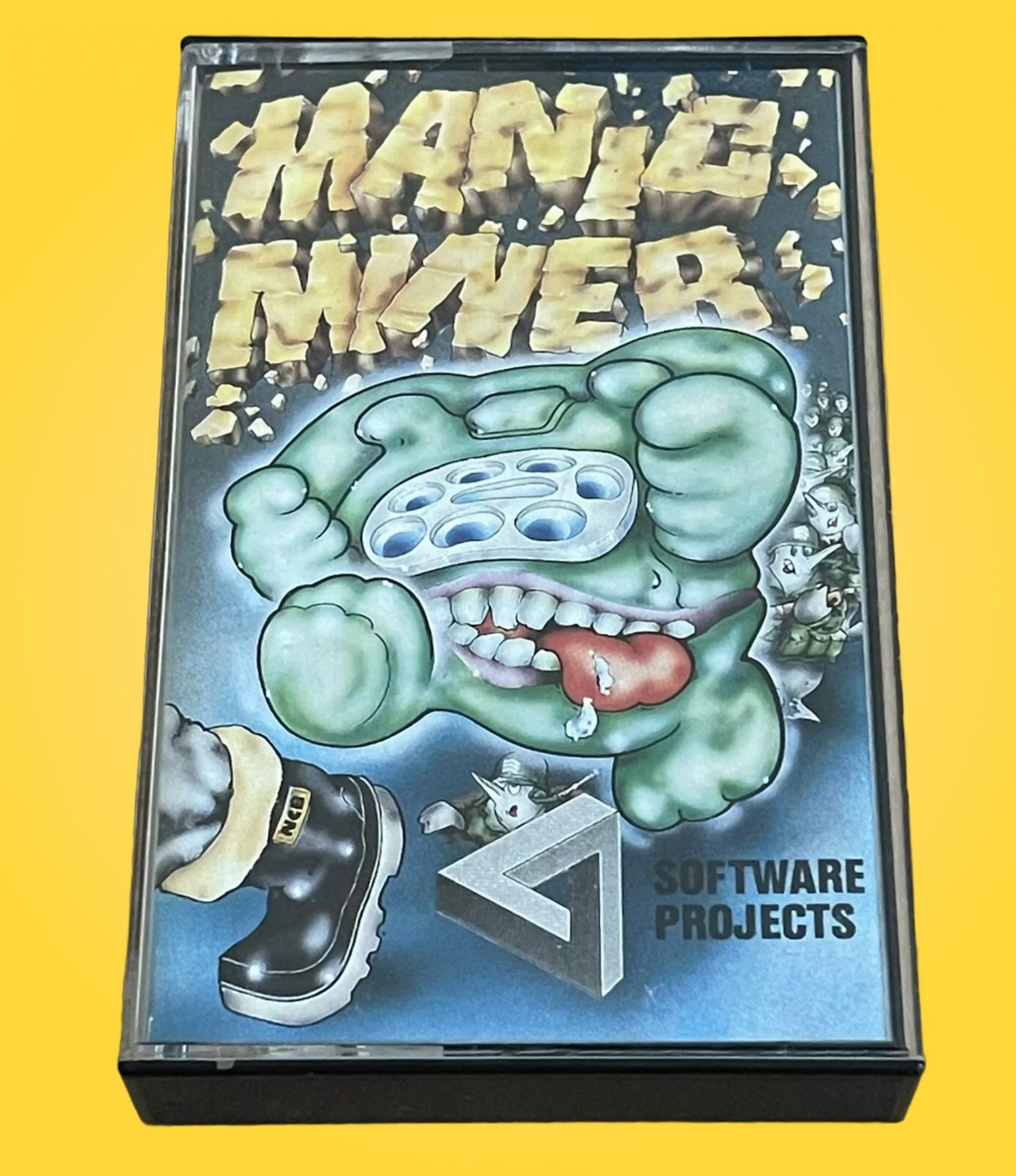 The Software Projects release
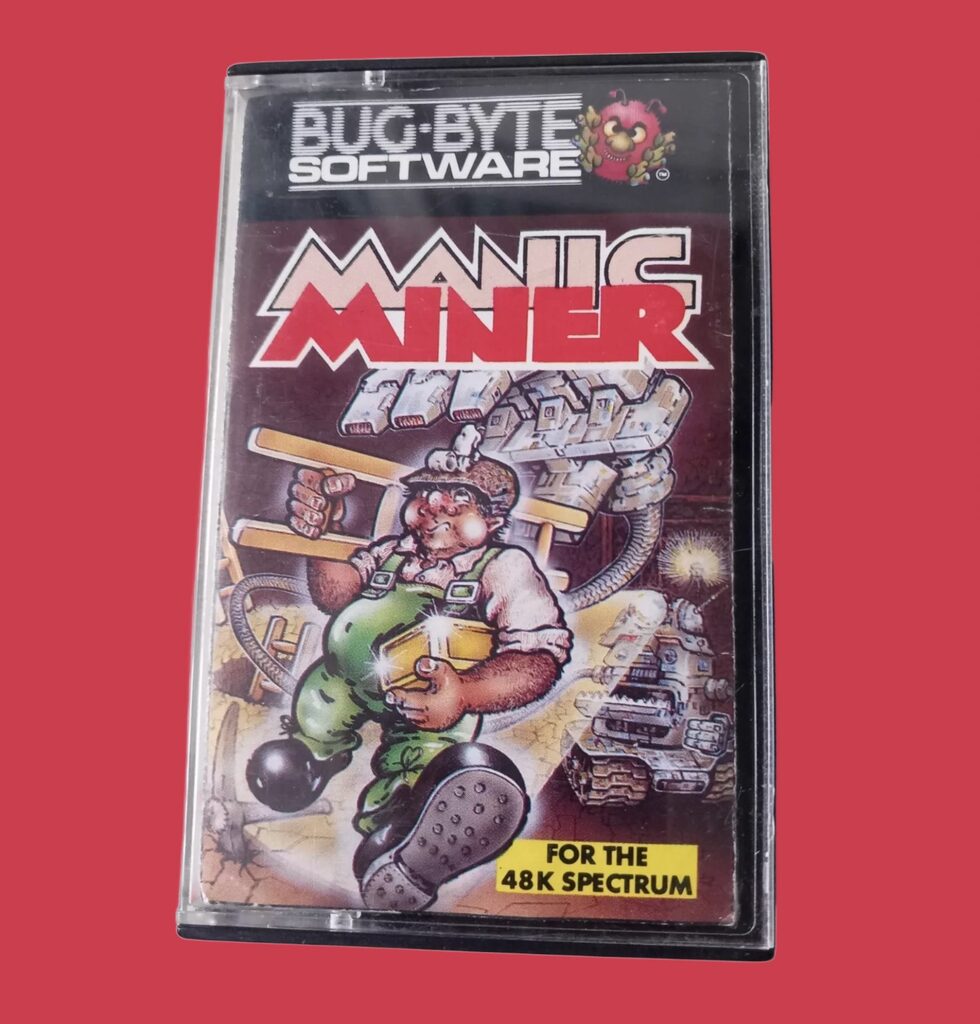 The original Bug-Byte release
Software Projects came back in 1984 with Jet Set Willy, and for a while Matthew Smith was about as famous as a Spectrum programmer could be. That fame didn’t sit easily. The much-hyped follow-up never appeared, and by 1988 he’d left the games industry altogether — at one point living in a commune in the Netherlands — before returning to Britain in 1997. A teenager who wrote a landmark game in eight weeks, and then found that the world wanted another one, which is a very human sort of story.
What They Said at the Time
The press loved it. Popular Computing Weekly‘s John Scriven gave it a perfect 10 out of 10 in September 1983, the same month Computer & Video Games made it a Reviewers’ Choice. Personal Computer Games handed it a “Screen Star” award in January 1984, and Crash reviewed it in its very first issue in February 1984 (and gave the 1989 budget reissue a whopping 92% — not bad for a game that was six years old by then).
It also won the Golden Joystick for Best Arcade-Style Game of 1983, and Sinclair User placed it third in its 1984 Top 50 Spectrum Software Classics. Across the contemporary reviews collected on Spectrum Computing, it averages over 90%. In other words, this wasn’t one of those games that only became a classic in hindsight — everyone knew straight away.
In the Culture
Matthew Smith is one of the interviewees in From Bedrooms to Billions, Anthony and Nicola Caulfield’s crowdfunded documentary about the British games industry — one reviewer called him one of the film’s more elusive contributors. The documentary also has a bonus feature on the making of Manic Miner, which it describes as one of the most iconic British video games of all time. It’s well worth tracking down if you grew up with a Spectrum.
What Players Remember
Ask anyone who had a Spectrum about Manic Miner and the first thing they usually mention isn’t the gameplay — it’s the music. Over on TheSixthAxis, one writer remembered the title screen’s electronic piano take on The Blue Danube as strange and borderline migraine-inducing, yet completely unforgettable. I know exactly what they mean — I can still hear it now.
Others remember the ritual of loading. On a Hexus forum thread about Spectrum memories, one poster recalled loving the anticipation of waiting for Manic Miner to load, despite the agonising load times. And plenty of people admit they only ever finished it thanks to a POKE for infinite lives passed around the playground — stop the tape, type in the magic numbers, carry on loading.
When The Register revisited the game in 2011, the writer singled out Eugene as their favourite of the game’s oddball enemies, alongside the penguins, flapping toilets and performing seals. Comments like that pop up again and again — it’s the weirdness people remember as much as the difficulty.
Playing Manic Miner Today
The Objective
You control Miner Willy, who must navigate a series of caverns filled with hazards, enemies and traps. In each one you collect all the flashing keys and reach the exit before your oxygen runs out. The caverns are supposedly the remnants of a long-lost civilisation that used robots to mine for precious materials. The civilisation died out, but the robots remain — and Willy has to dodge them along with poisonous pansies, spiders and all manner of surreal nasties.
There are 20 caverns. Platforms are either solid or crumbling (they erode as you stand on them, so no hanging about), and conveyor belts push you in one direction, often straight into a robot. Every level is an exercise in mapping your route to each key and back to the exit, and a game can be over in seconds if you lose focus.
Memorable Levels
The Central Cavern — The first level, and the one everyone remembers. It introduces the core mechanics — jumping, avoiding enemies, collecting keys — and while it seems simple enough, it sets the tone for everything that follows.
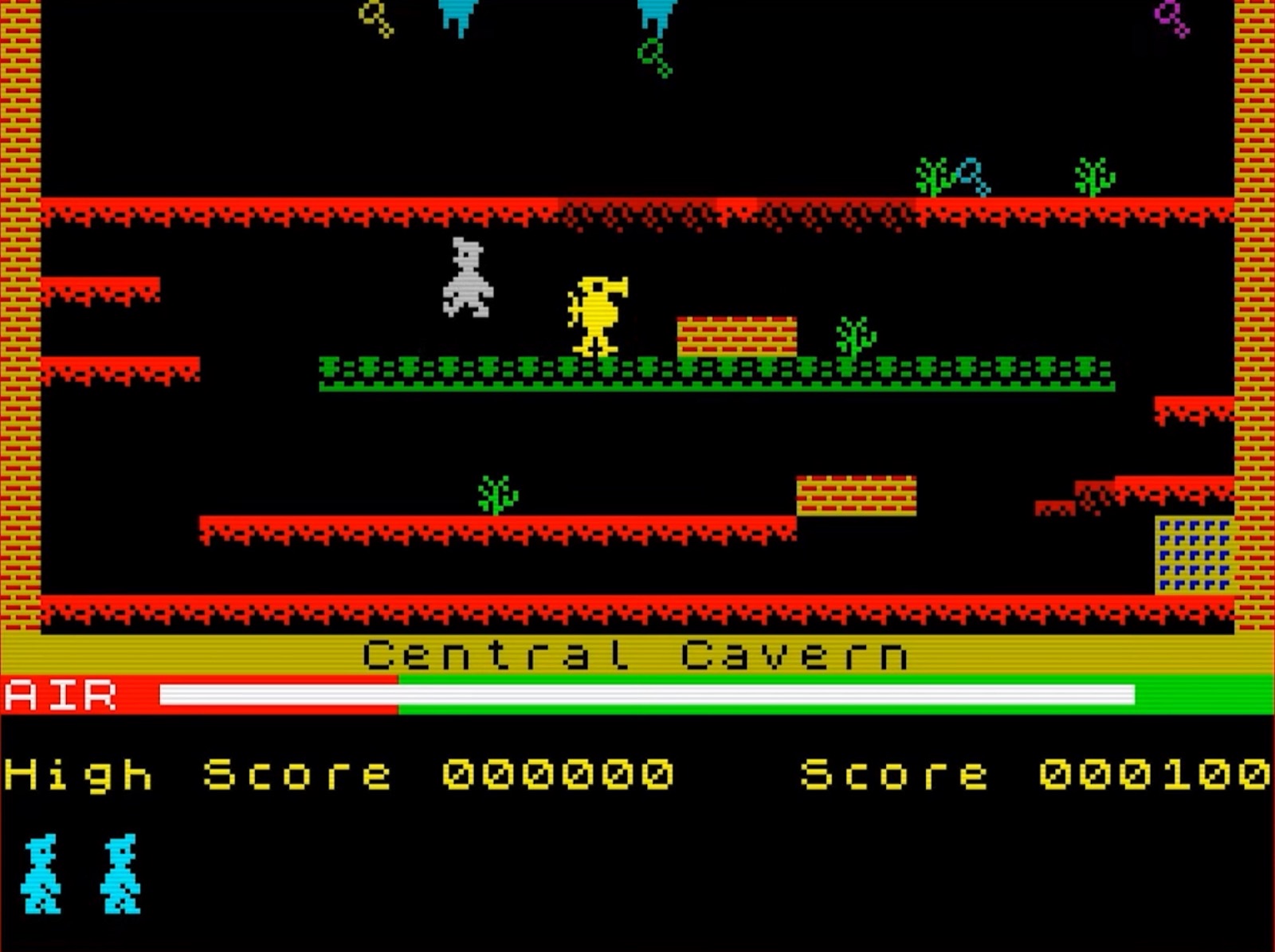 The Central Cavern — where it all begins
Eugene’s Lair — The giant mutant Eugene patrols the screen, and you need to time your movements carefully to avoid him. Collect all the keys and he turns nasty, camping out in front of the exit.
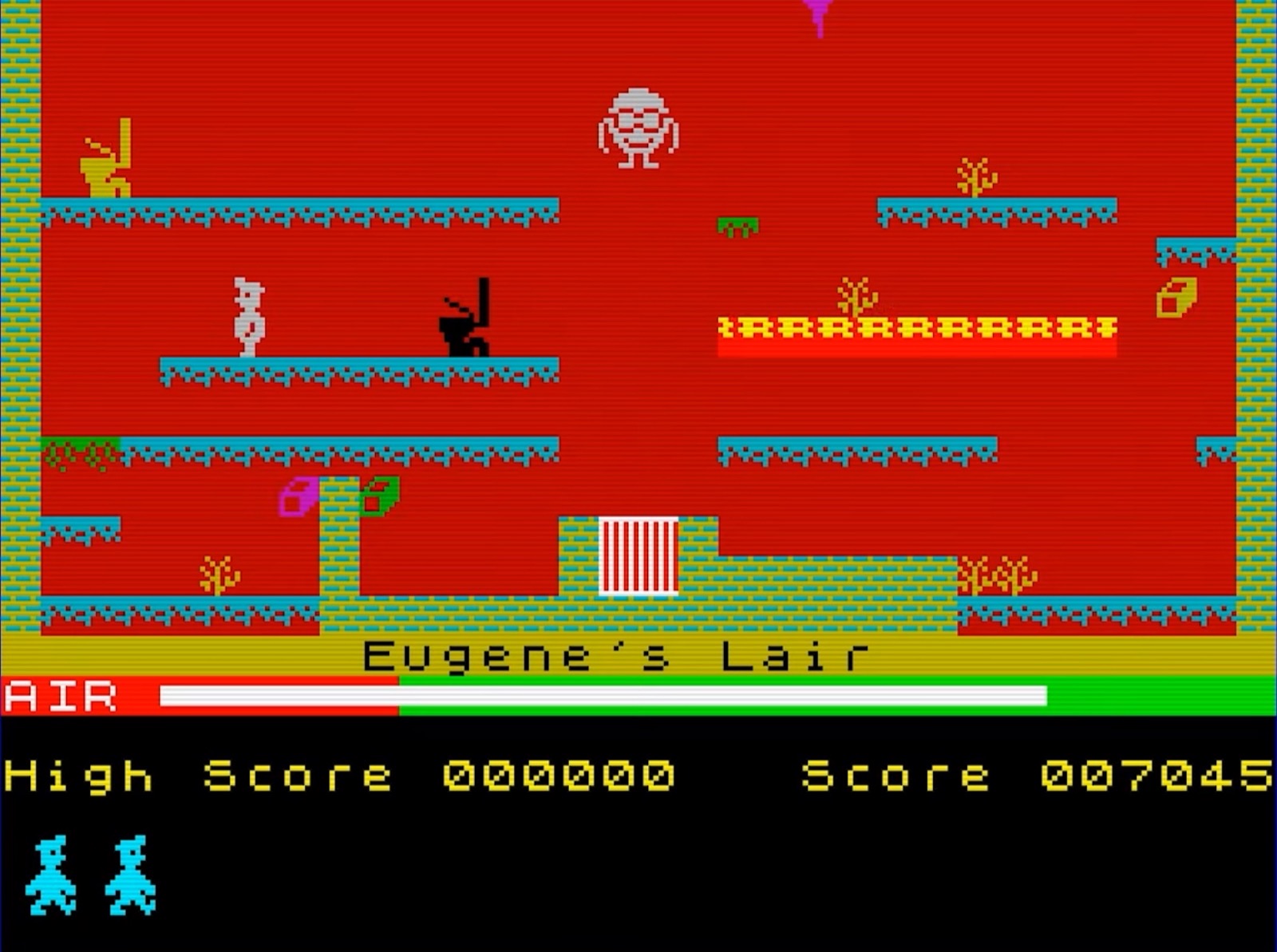 Eugene’s Lair — watch out for the big fella
The Menagerie — A visually striking level full of surreal bouncing creatures. Perfect timing and route planning are essential here.
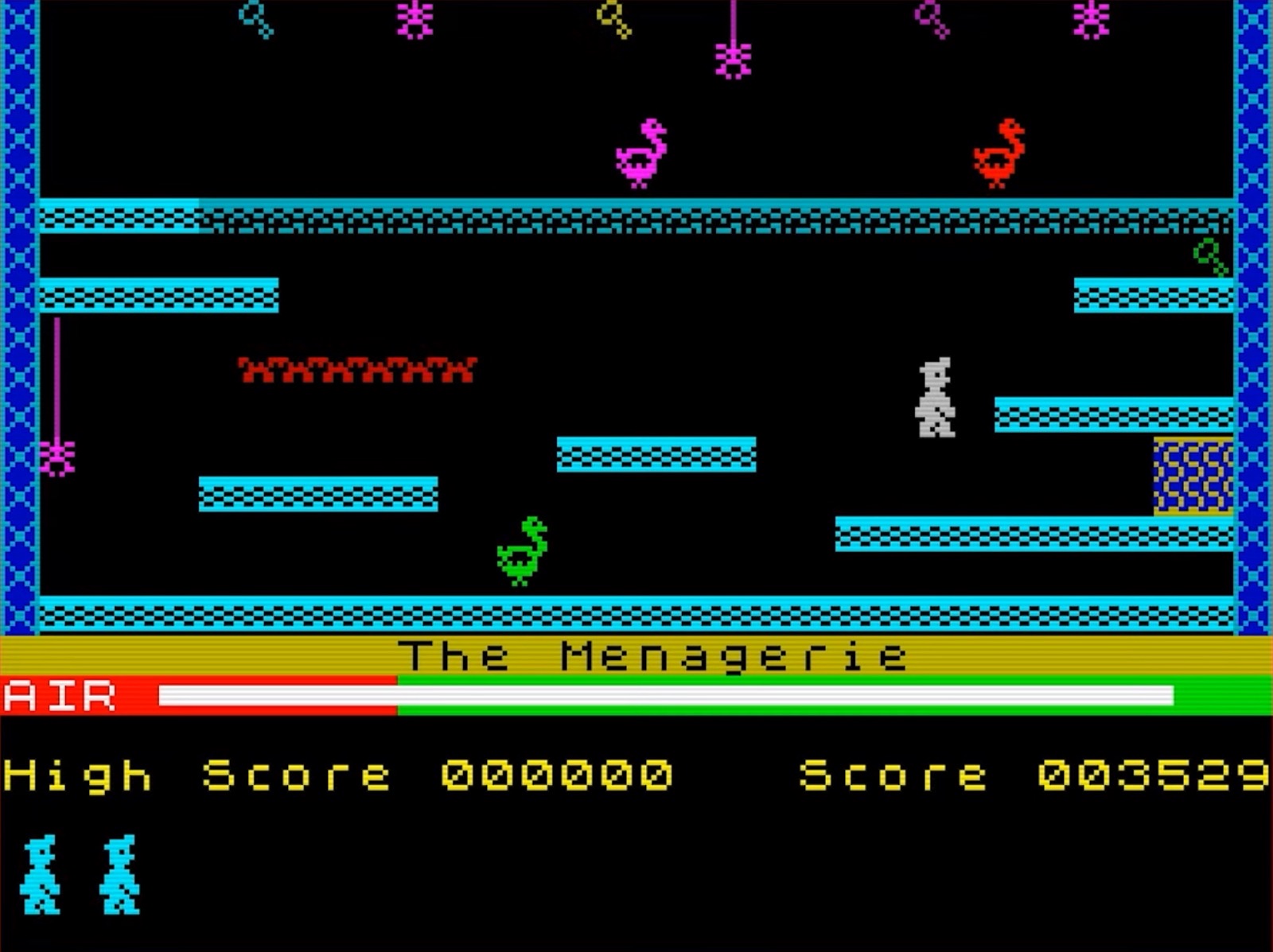 The Menagerie
The Endorian Forest — Tricky platform placement makes this one a test of precision jumping. The moving obstacles can easily end a run if you’re not careful.
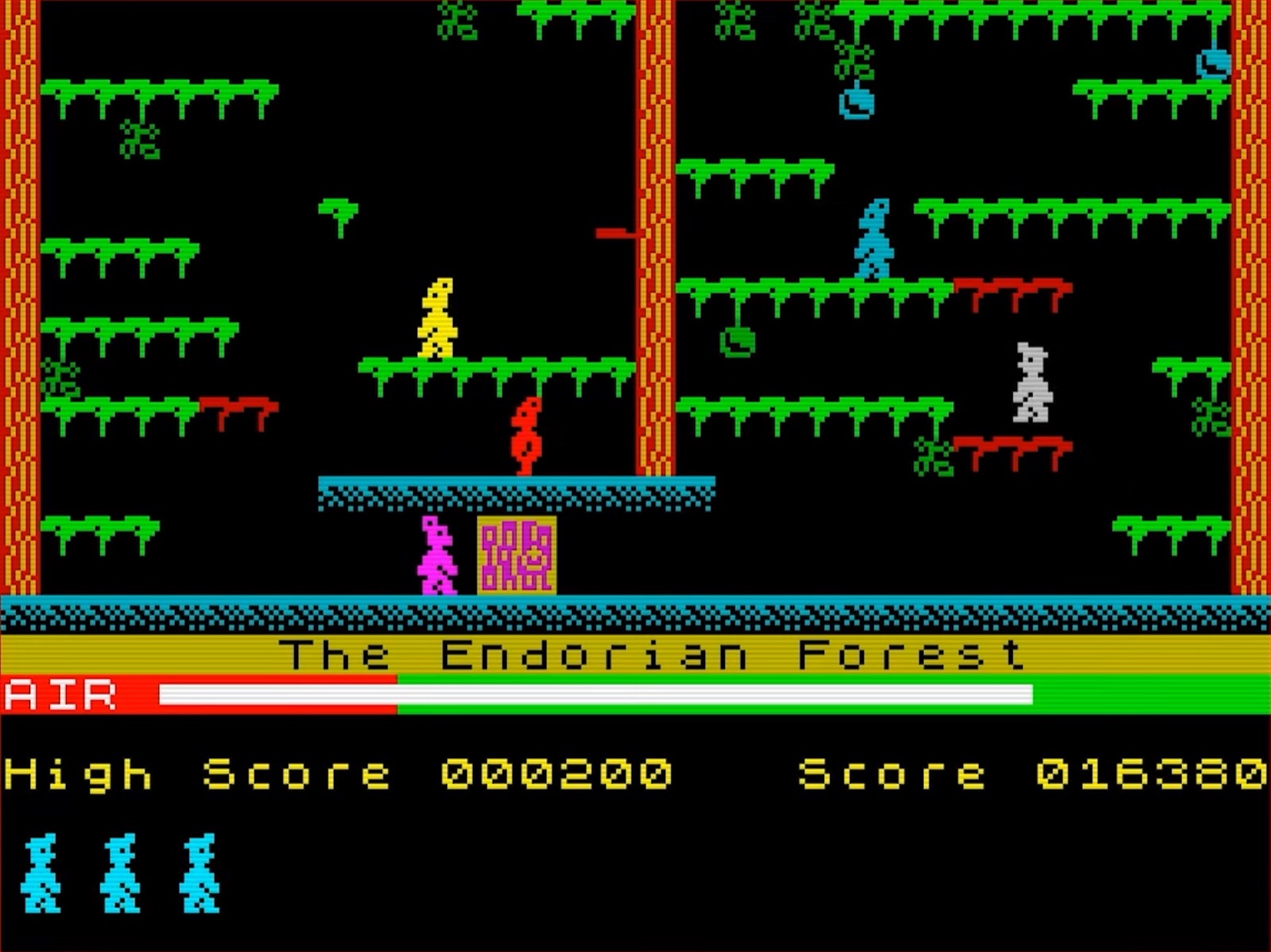 The Endorian Forest
Skylab Landing Bay — Falling satellites rain down as deadly hazards, so you have to think quickly and read their trajectory.
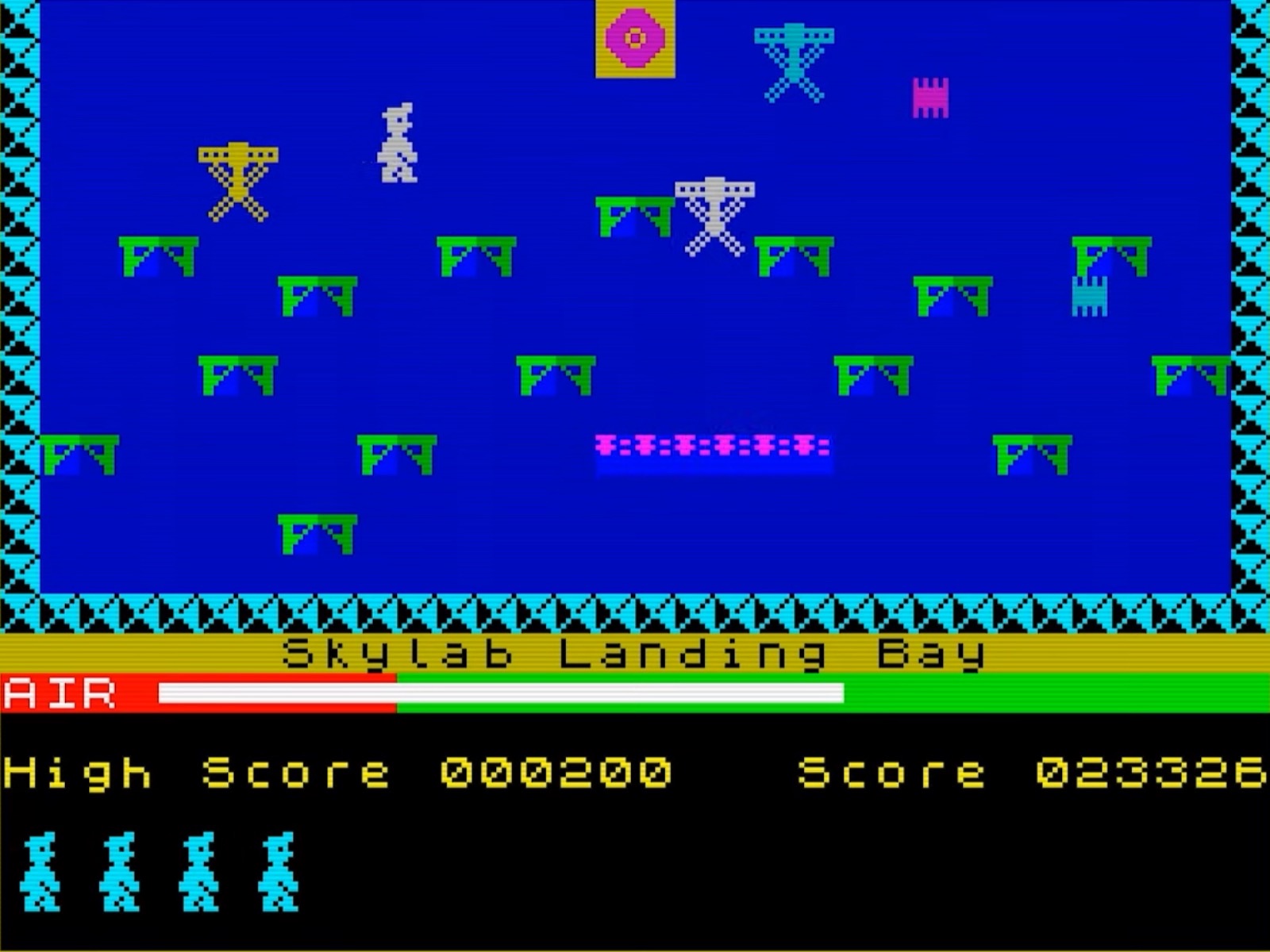 Skylab Landing Bay
Tips for Playing
- Commit to your jumps — unlike modern platformers, once you’ve pressed jump, you’re committed. Learn the arc and use it to grab keys without banging your head on a nasty.
- Learn the enemy patterns — most enemies follow set paths, and knowing their routes is half the battle.
- Plan your route — some levels require you to collect keys in a specific order to avoid getting trapped.
- Watch the oxygen — it acts as a time limit, so don’t waste it on unnecessary movements.
- Be patient — rushing is what gets you killed. Careful, deliberate movements will always get you further.
Secrets and Speedruns
Type 6031769 on the original Bug-Byte version (or TYPEWRITER on the Software Projects release) and you can warp between caverns using the number keys. There’s a catch, though: finish The Final Barrier legitimately and you’re rewarded with a little swordfish surprise, but use the cheat and it never appears. Speedrunners take note — the tool-assisted run on TASVideos bans the cheat for exactly that reason, and still gets through all twenty caverns in about 15 and a half minutes.
The Blue Danube
Manic Miner was one of the first Spectrum games with continuous in-game music. The title screen plays Strauss’s The Blue Danube, while the in-game tune is Grieg’s In the Hall of the Mountain King — a weirdly elegant soundtrack for what is essentially a manic scramble through robot-infested caverns. It’s one of those things that just lodges in your brain.
Conversions
Manic Miner was made famous on the Spectrum, but it went everywhere.
The Commodore 64 version was a faithful conversion with its own feel — the SID chip gave it a distinctive soundtrack compared to the Spectrum’s beeper — and it reached number one in the charts in early 1984.
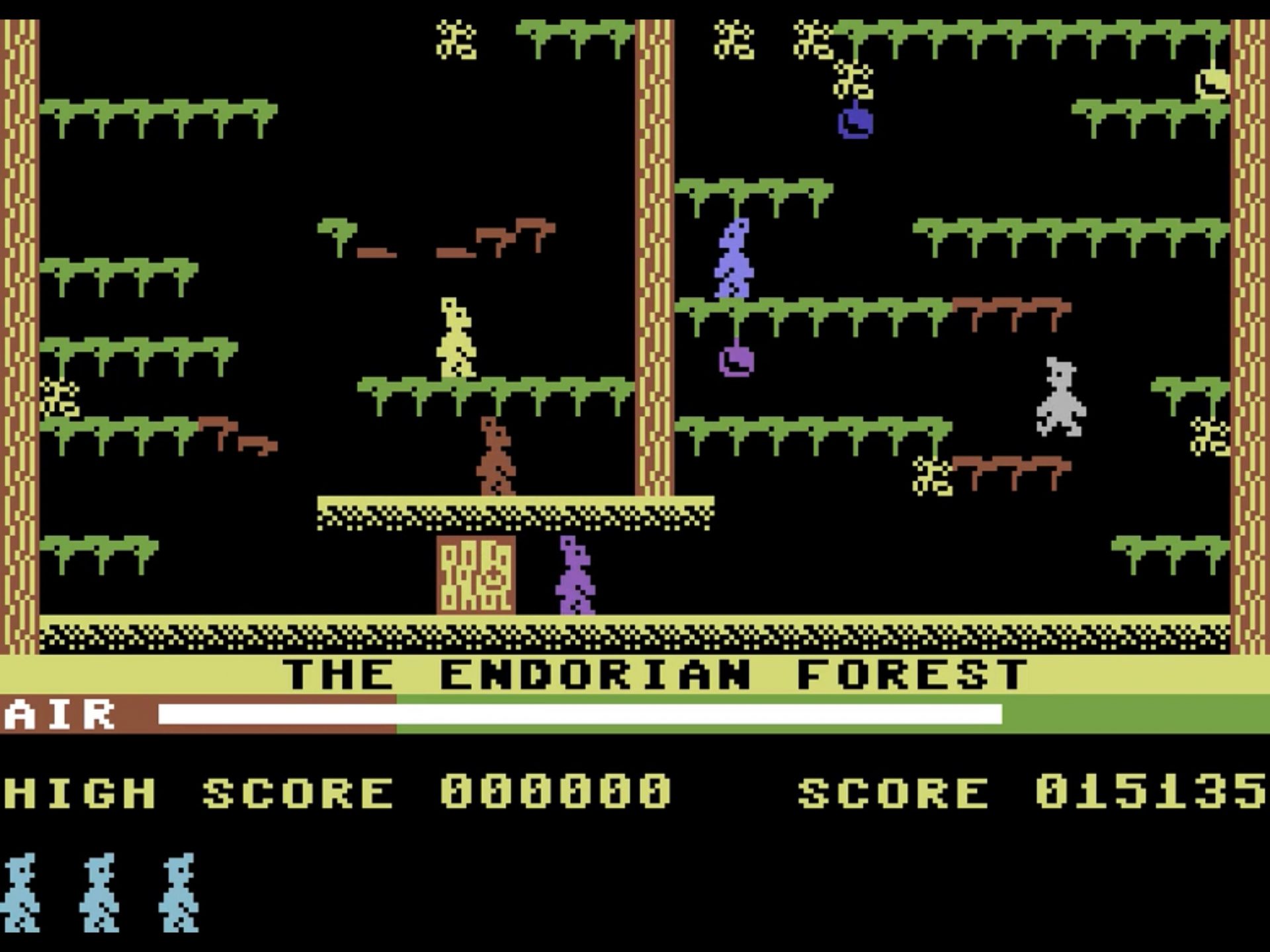 The Commodore 64 version of Manic Miner
The BBC Micro version, published by Software Projects in 1984, is pretty much intact apart from renaming the Solar Power Generator level to The Meteor Shower. It uses MODE 1 graphics, which allows high resolution but limits the screen to 4 colours at a time — slightly less colourful than the Spectrum original, but without the attribute clash.
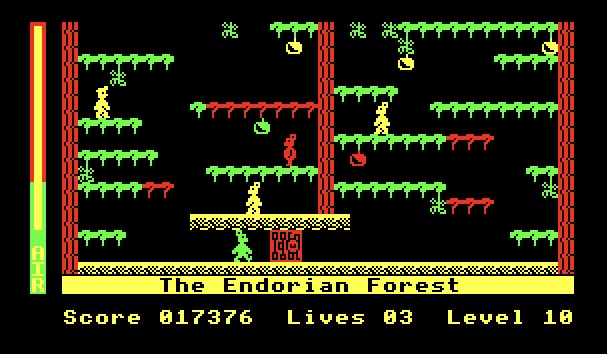 The BBC Micro version — fewer colours, but no attribute clash
The 1992 SAM Coupé version, by Matthew Holt with music by František Fuka, is a remake from scratch that adds 40 new levels to the original 20. And in August 2026, BBG Entertainment announced an authorised reboot for PC, Xbox, PlayStation and Switch, with all 20 original levels, a switchable modern look and online leaderboards. It got off to a bumpy start when the publisher admitted using AI in the trailer, but it’s good to hear the producer say Smith will properly share in its success this time.
On Real Hardware
I hadn’t played Manic Miner for years until a ComicCon where some retro gamers had a setup running. I played it with my son James, who was about 8 at the time. When we got home, I fired up my Spectrum and he just wanted to jump around the screen. Those big sweeping jumps that had me pulling my hair out as a kid were pure entertainment for him.
If you want to play it today, Spectrum emulators like Fuse will run it perfectly. But if you can, there’s nothing quite like loading it from tape on real hardware and hearing that familiar loading screech — followed, of course, by The Blue Danube.
The Legacy of Manic Miner
Retro Gamer has called Manic Miner one of the most influential platform games of all time, and it’s hard to argue. It led directly to Jet Set Willy in 1984 — a sprawling, non-linear mansion that was one of the first “explore anywhere” platformers, and which came with a colour code sheet for copy protection, no doubt partly thanks to people like me and my mates. Fans have been building their own caverns and mansions with editors ever since.
But for me, the real legacy is what it proved. One teenager, eight weeks, a borrowed computer and a Tandy in a bedroom on the Wirral, and the result was a game that playgrounds up and down the country obsessed over — and copied to death. Forty-odd years later it’s still being remade, still being speedrun, and my son still thinks the jumping is the best bit. Not bad for a summer’s work.
If you’re a fan of Spectrum platformers, have a look at my reviews of JetPac, Atic Atac, Bugaboo and Jumping Jack, or check out my Top 10 ZX Spectrum Games.
Frequently Asked Questions
When was Manic Miner released?
Manic Miner was released in 1983 for the ZX Spectrum, originally by Bug-Byte Software and later re-released by Software Projects.
Who created Manic Miner?
Matthew Smith, a teenage programmer from Wallasey. He wrote it in Z80 assembly language on a Tandy TRS-80 and transferred it to the Spectrum, taking about eight weeks.
How many levels are in Manic Miner?
There are 20 caverns, each with its own layout, enemies and hazards. The SAM Coupé remake added 40 more.
What is the cheat code for Manic Miner?
On the Bug-Byte version it’s 6031769 (Matthew Smith’s driving licence number). On the Software Projects version it’s TYPEWRITER.
What is the sequel to Manic Miner?
Jet Set Willy, released in 1984, takes the platforming formula and expands it into an open-world mansion exploration game.
Sources
- Sinclair User, December 1984 — Matthew Smith interview (Planet Sinclair)
- Matthew Smith email interview, 1999 (Planet Sinclair)
- Big K article on Matthew Smith
- The Matthew Smith Mystery — JSW Remakes
- Manic Miner — Spectrum Computing (reviews and awards)
- Manic Miner — Wikipedia
- Games on the Mersey — The Digital Antiquarian (the Liverpool scene and Eugene Evans)
- Antique Code Show: Manic Miner — The Register
- From Bedrooms to Billions review — The Skinny
- Manic Miner TAS — TASVideos
- BBG Entertainment Manic Miner reboot — Time Extension
More like this

Atic Atac Game Review for the ZX Spectrum
Atic Atac was a classic action adventure game for the Sinclair ZX Spectrum by Ultimate Play the Game, one of the first 48k Spectrum titles

Tranz Am Review for the ZX Spectrum
Tranz Am on the ZX Spectrum: Ultimate's 1983 16k top-down racer across a post-apocalyptic USA, hunting the 8 Great Cups while dodging rivals and running out of fuel.

Sabre Wulf: ZX Spectrum Classic by Ultimate
Face the dangers of the jungle, unravel secrets, collect amulets & confront the Sabre Wulf in this ZX Spectrum classic
Comments