JetPac for the ZX Spectrum by Ultimate Play the Game
By RolyRetro · · Updated · ZX Spectrum
A new kind of game for the Spectrum
JetPac was one of the first of the games released, in 1983, for the 16k Sinclair ZX Spectrum computer, and developer Ultimate managed to fit a lot into the tiny memory. This game didn’t fit into any easily definable retro gaming genre, as it had a number of elements, being part shooter, part action-platformer. What it did do was deliver to early adopter Spectrum owners the arcade experience they had been looking for in their humble home computer.
I played it on my 48k Spectrum, from a cassette I bought at John Menzies in Grays. These days I play it on a new (old) Spectrum that I’ve fitted with a DivMMC SD card interface, plugged into a 9-inch Sony PVM, a professional broadcast monitor that makes the Spectrum’s colours look better than they ever did on the family telly.
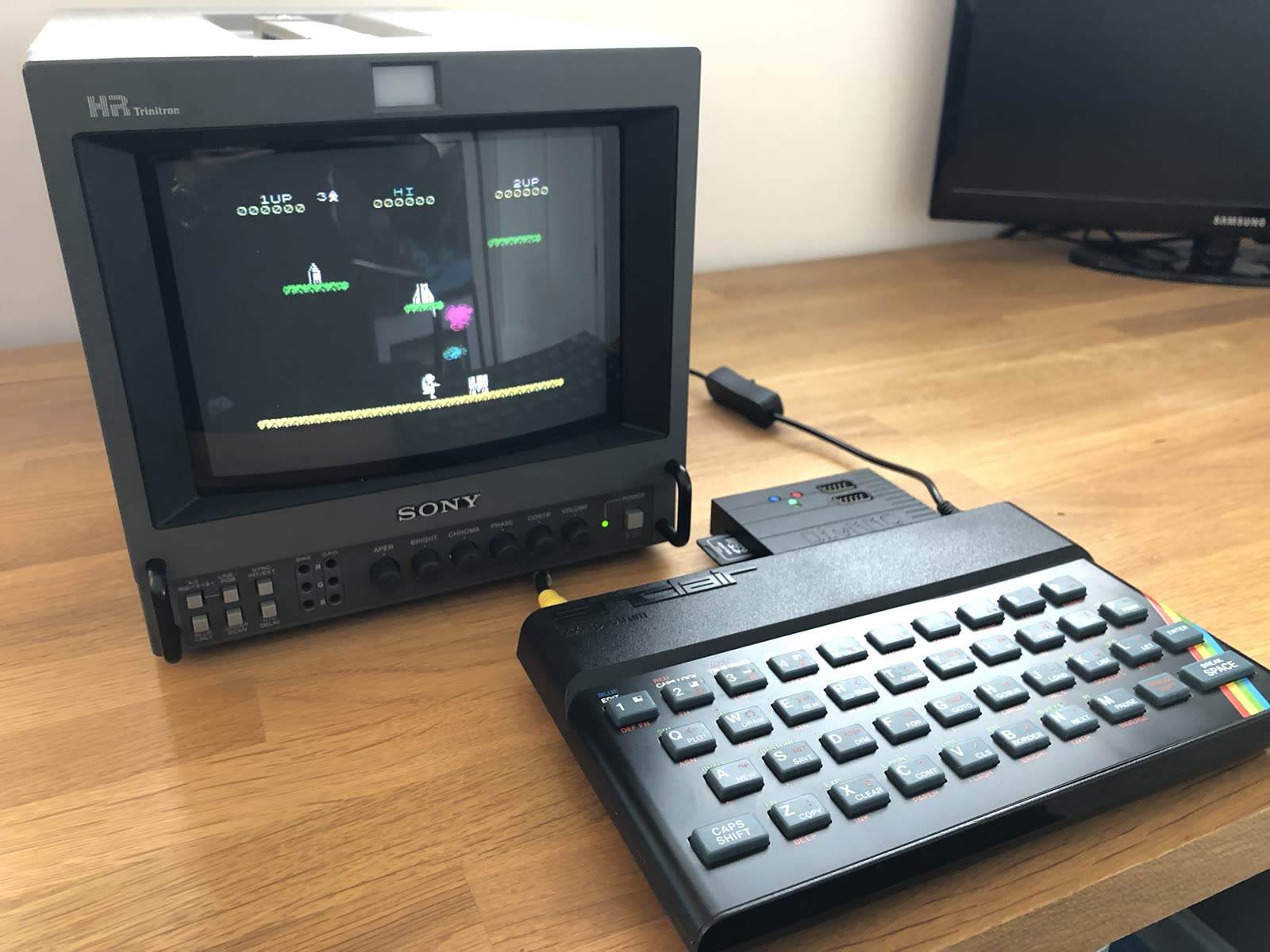 Jetpac on my Spectrum and Sony PVM. The rocket starts the game in three pieces: base on the ground, middle and nose cone on the platforms.
How Jetpac was made
Jetpac was the first game from Ultimate Play the Game, the company founded in 1982 by brothers Tim and Chris Stamper, with Tim’s wife Carol, in Ashby-de-la-Zouch in Leicestershire. The brothers had already been making arcade games, and it shows. Chris wrote the code and Tim drew the graphics, and they squeezed the whole thing into the 16k Spectrum so that every Spectrum owner could play it, not just the ones who’d paid extra for 48k.
It went on sale in May 1983 for £5.50 and sold more than 300,000 copies, earning Ultimate around £1 million. Not bad for a first attempt. It also set the pattern for the run that followed: Pssst, Tranz Am, Atic Atac and Sabre Wulf, each one a must-buy on the day it came out.
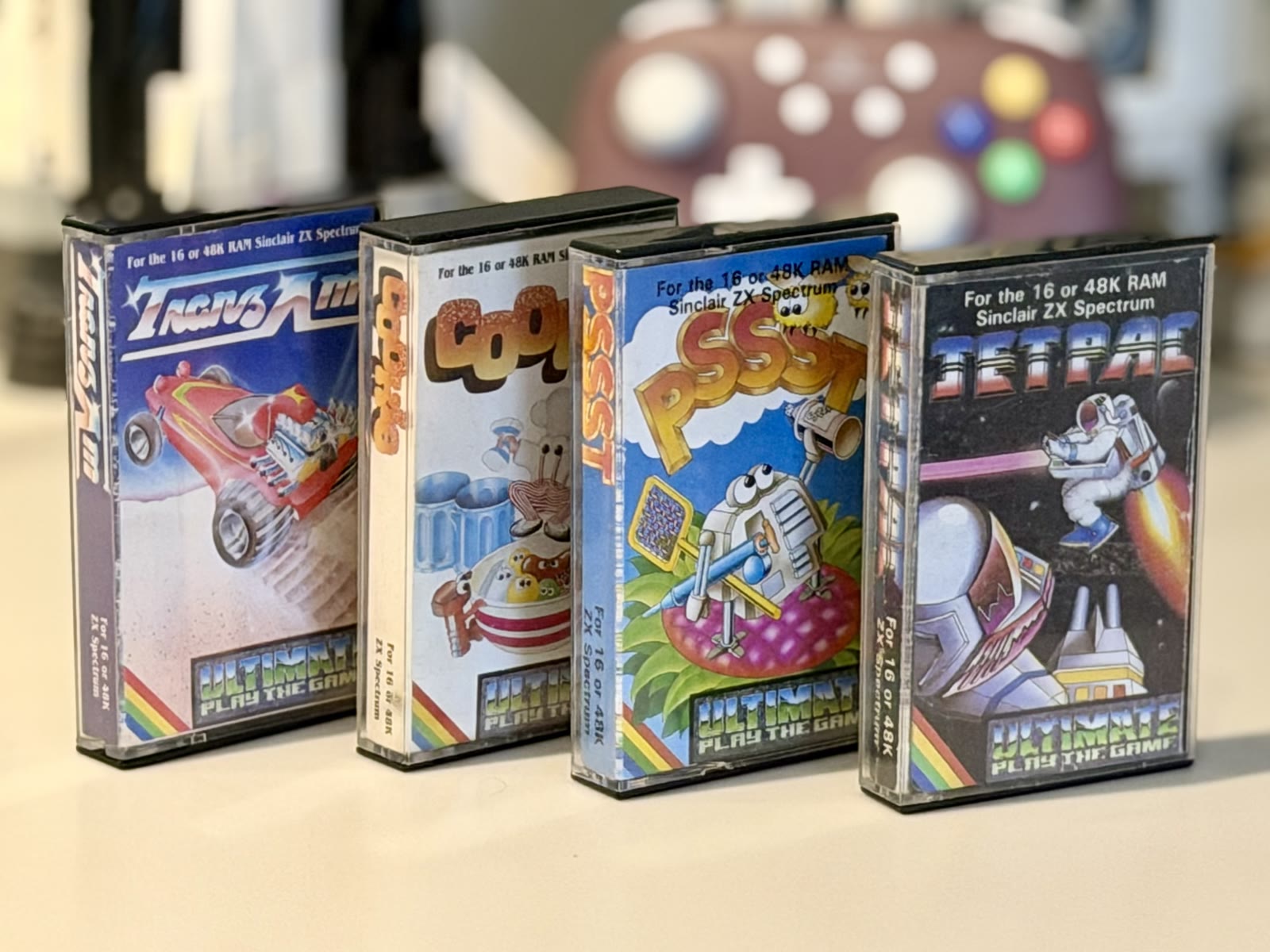 My own cassettes of Ultimate’s four 16K Spectrum games: Tranz Am, Cookie, Pssst and Jetpac, where it all started
JetPac Gameplay
Due to the memory constraints of the basic 16k Spectrum model, JetPac did away with multiple screens and stuck to a very simple formula. Use your JetPac to collect space ship parts that fall from the sky, kill the aliens that try to attack you, build a rocket from the parts and take off in it when its complete. Then do it all over again, repeatedly, until you die. And that’s it.
Seeing off the “Tribbles”, fuelling up and blasting off, squeaks and plops included
Despite the simple premise, one which would not hold the attention of many 10 year old game veterans today, Ultimate managed to build a sense of achievement into JetPac, as well as a desire to progress further through the game. You were pushed to tackle just one more screen, in order to see a new alien type with a different attack pattern. Every few screens you would get a new rocket, starting with an Apollo 13 style vehicle, then a space shuttle (Tetris on the Gameboy also did this as a reward for completion).
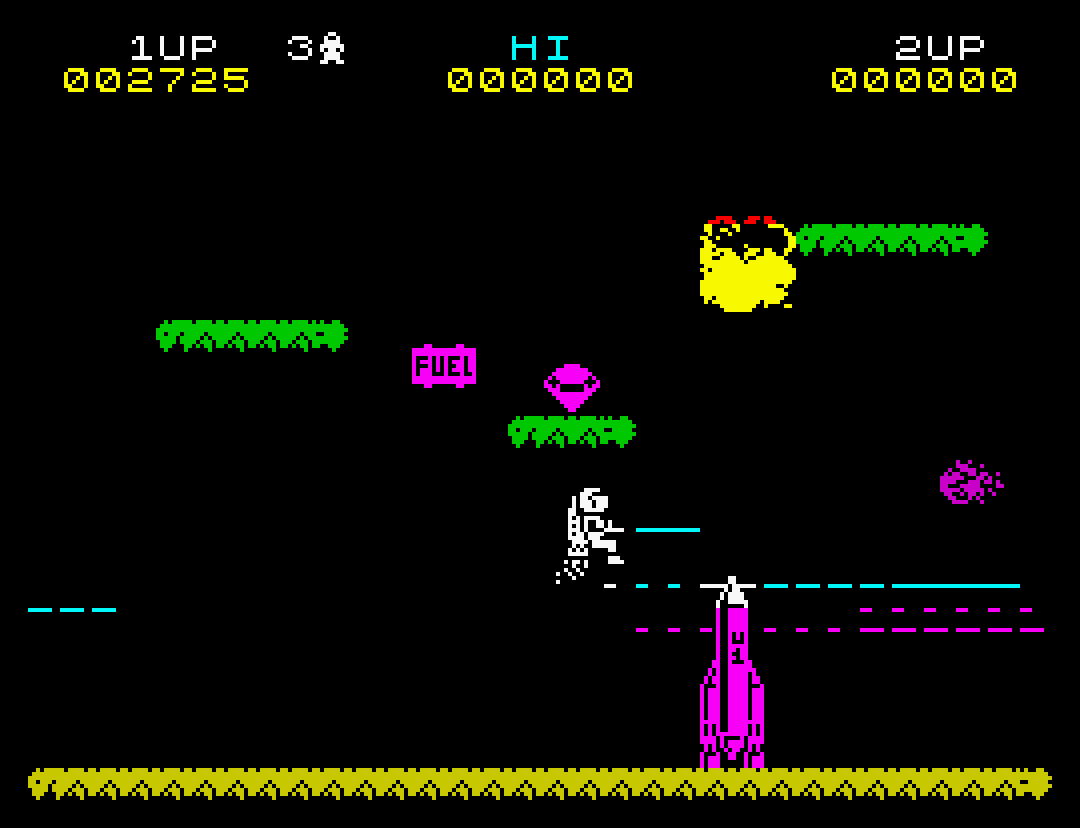 JetPac Spectrum Gameplay
There was also a great sense of colour in the game, from the garish alien designs to the multi coloured laser blast, but again due to memory limitations the only sound was the squeak of your laser and the plop when the aliens were destroyed. Gems, gold bars and other treasure also drop in from time to time, worth a detour for the bonus points if you’re feeling brave.
Jetpac Spectrum Levels
At the start of the game the rocket is in three sections, scattered across the ground and the platforms. You drop each one onto the base in the right order, then fill the rocket with six fuel pods, carried over one at a time, before climbing aboard to take off for the next planet.
After that first level the rocket stays in one piece and only needs refuelling. Every four levels, though, you get a brand new rocket (and an extra life), which arrives in three pieces and has to be built all over again. There are four rocket designs in all:
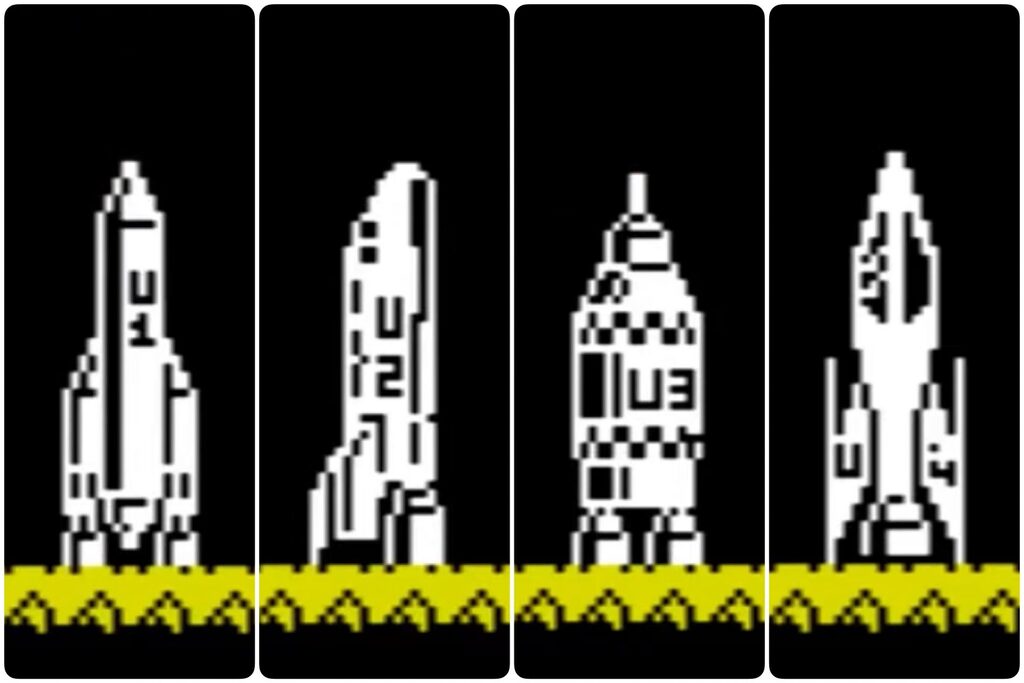 JetPac spaceships U1 to U4
- Apollo (U1) - an 60’s style rocket that could have been part of the US/USSR space race
- Space Shuttle (U2) - unmistakably a US space shuttle style rocket
- Transport Rocket (U3) - a larger rocket that looks like it could be used for cargo transportation
- Star Trek (U4) - a futuristic rocket that resembles something out of Star Trek
After 16 levels, and all four rockets, the game loops back to the beginning. The aliens run on a shorter cycle, changing every level and coming back round after eight.
Jetpac Alien Types
There were 8 different alien types in the game, each with their own movement patterns and behaviours, some trickier than others to defeat. To beat the game you had to learn these patterns, given that the only way to die is being hit by an alien creature (there were no alien bullets).
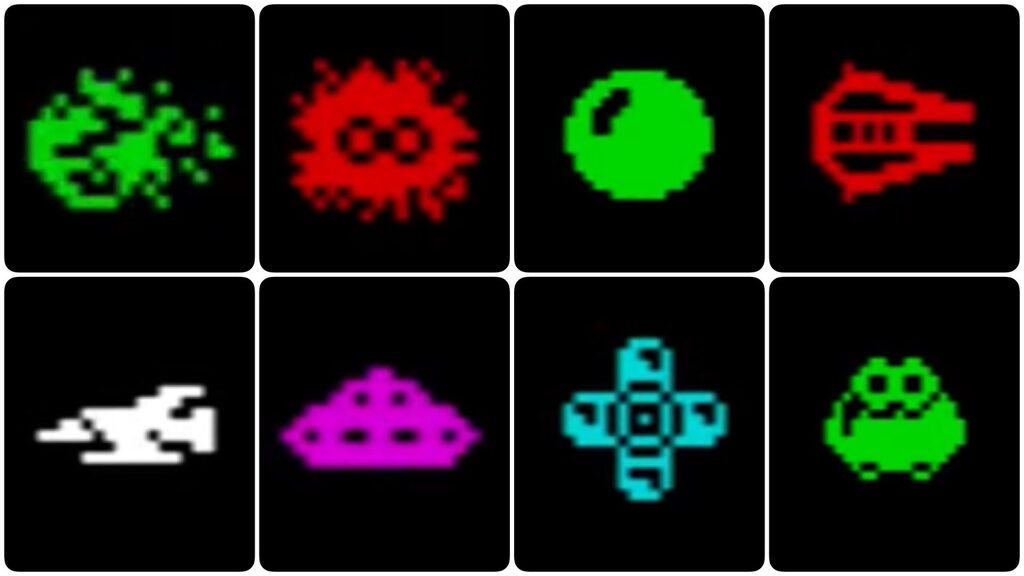 JetPac Alien Types
- Wave 1 - Asteroids attack you travelling horizontally or at a downward angle, exploding on impact with a platform or the ground.
- Wave 2 - The first wave of aliens look a bit like the furry Tribbles from Star Trek, but with eyes. These aliens bounce around the screen at 45 degree angles, so their trajectory is fairly predictable
- Wave 3 - I’m calling these aliens Space Bubbles - float Horizontally, rising and falling at 45 degrees. They also bounce, making them a bit more difficult to predict than the Tribbles
- Wave 4 - The fourth wave features Fighter jets. They hover at side of screen then launch at you, changing altitude (but not direction) to home in on you like a guided missile. Fortunately they explode if they hit a platform, so you can hide from them
- Wave 5 - These aliens can only be described as Flying Saucers - they swarm all over you and do not explode when they hit a platform, so need to be despatched quickly
- Wave 6 - the next aliens appear as Crosses - with varying degrees of diagonal trajectory, they can also bounce between platforms
- Wave 7 - To me these aliens look like Snow Speeders, but unlikely to take down an AT-AT as they travel in straight line until they hit something then explode
- Wave 8 - these I am calling Bubble Tribbles, as that is what they look like. More dangerous than the regular Tribbles from Wave 2 as they swarm towards you
Tips on beating JetPac
There is no traditional “End” to JetPac, just completion of the 16 levels before the game loops back to level 1. The objective however becomes getting to the end of the 16 levels with your 3 lives, and amassing the biggest score possible, This is no mean feat with an onslaught of aliens and some very fast gameplay.
The trick with defeating all of these alien types, other than just avoiding them, is to spend most of the game waiting in the top right platform, firing left and right, and preventing any alien getting near you. When a piece of rocket ship, a fuel tank or a bonus item begin falling, you can then swoop down from your perch and intercept them. Travelling back to you perch automatically deposits the item along the way.
You can clear most of the screen from your safe position and time your dive for when the screen is less populated. in this way you spend most of your time invulnerable, only risking damage when you need to emerge to collect an item.
JetPac Critical Reception
JetPac won Game of the Year at the 1983 Golden Joystick Awards, run by Computer & Video Games magazine. The sound was never going to win any prizes (a squeak and a plop), but for me the speed and the colour more than made up for it.
The magazines were just as keen. Computer & Video Games gave it 9 out of 10, and Home Computing Weekly gave it four stars, with a line that ended up in the mail-order adverts:
“Good graphics with many small touches that put this program well ahead of the pack.”
Home Computing Weekly, 1983
CRASH didn’t exist when Jetpac came out, but when it rounded up the Spectrum’s shoot-’em-ups in 1984 it was clearly already tired of finding new ways to praise Ultimate:
“There’s not much can be said about Ultimate that hasn’t already been said. Graphics and presentation are of the highest standard… Highly recommended.”
CRASH, 1984
JetPac on other platforms
The success of JetPac on the ZX Spectrum led to conversions for other home computers of the era, each with their own strengths and limitations.
Commodore VIC-20 Version (1983)
The VIC-20 version of JetPac is much closer to the Spectrum than the BBC version, with almost identical graphics and gameplay. The game relied on an 8k expansion pack being fitted to the VIC-20, although still less memory than the already tiny 16k of the Spectrum.
The VIC-20 version of JetPac was a huge success, like the Spectrum it stretched the boundaries of what was possible on a simple home computer, and a standout title for the Commodore 64’s baby brother.
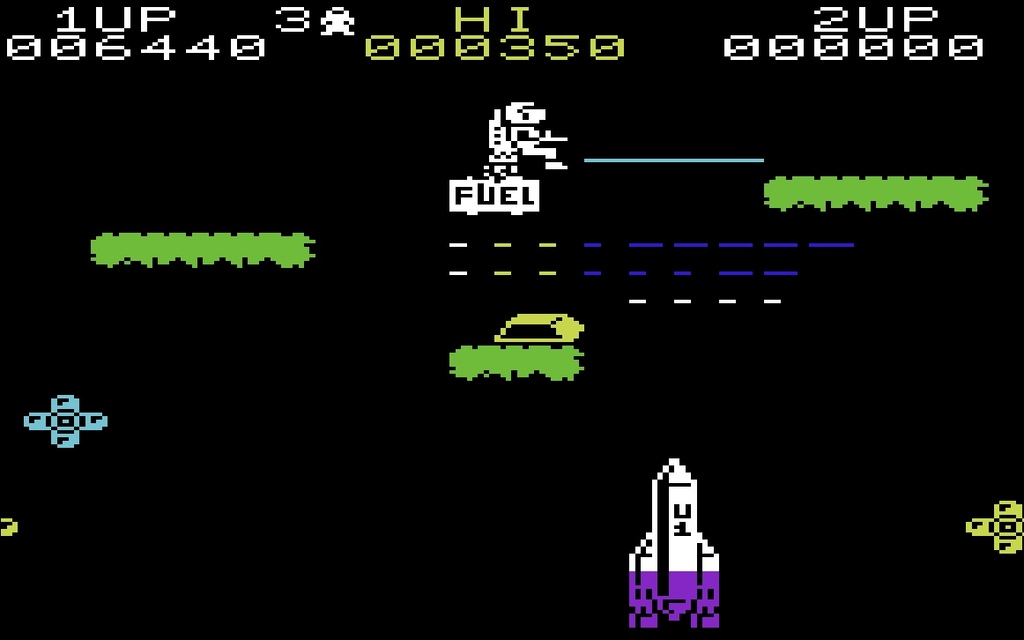 Vic-20 version of JetPac
There was never an official release for the Commodore 64, but unofficial conversions exist online.
BBC Micro Version (1984)
JetPac on the BBC Micro was visually different to the Spectrum version, with more chunky graphics and a quite basic sound effects. Gameplay was marred by annoying aliens which were incredibly difficult to avoid, resulting in a frustrating gaming experience.
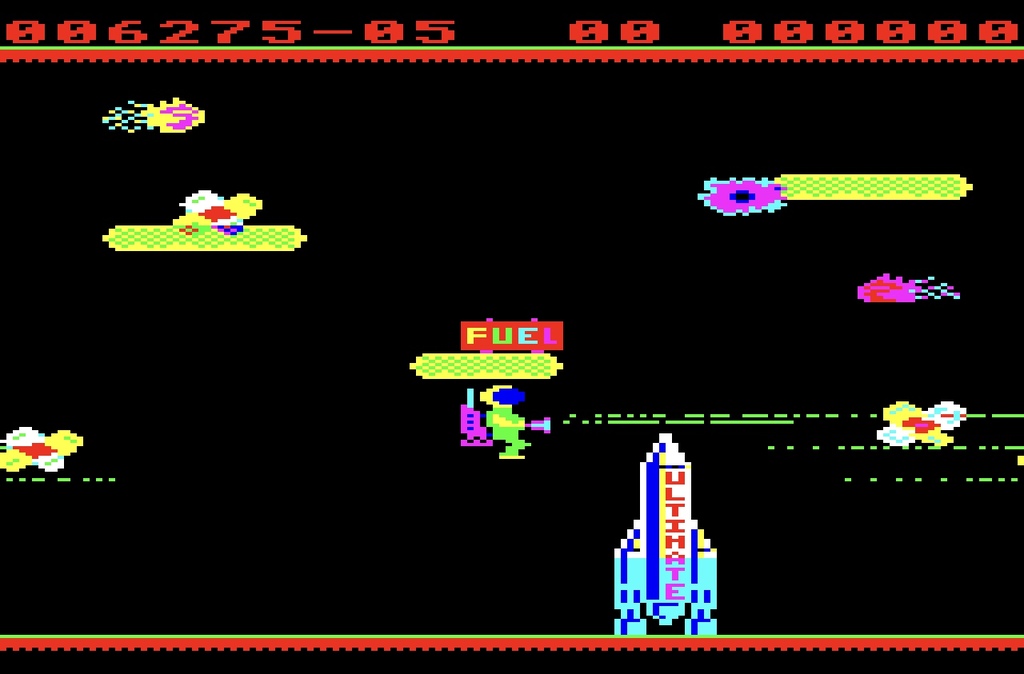 JetPac for the BBC Micro
JetPac Sequels and Modern Revivals
Ultimate became Rare in the mid-80s, and Rare was bought by Microsoft in 2002, so the JetPac name has turned up again every so often over the years.
Lunar Jetman (Ultimate - 1983)
Lunar Jetman was released by Ultimate the same year as JetPac, and is probably the closest thing to a true sequel to the original game.
In Lunar Jetman you had a buggy to ride around the planet surface, with items scattered across a map which was much larger than the side-scrolling screen. You still had to exit the vehicle to collect the items, and return to the buggy to refuel your JetPac. The mission in Lunar Jetman was to destroy 3 enemy bases using bombs that first had to be located and transported.
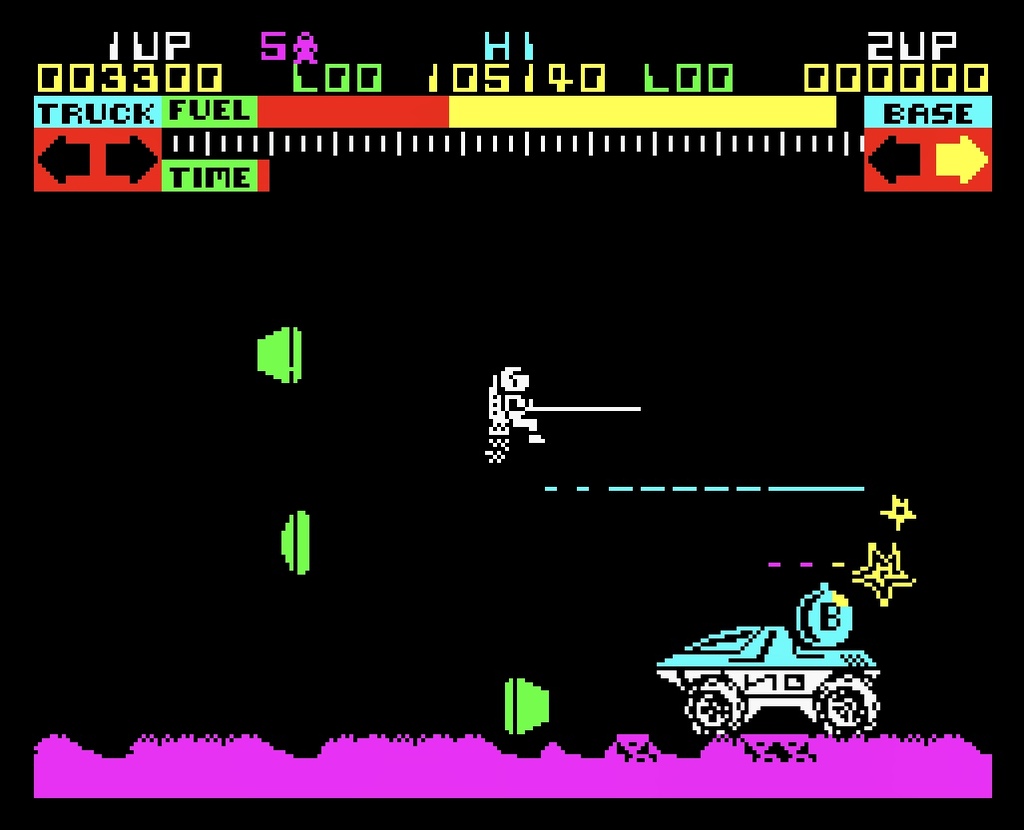 JetPac sequel Lunar Jetman
Development for the 48k Spectrum allowed more depth of gameplay and variety of graphics than the original, and it even featured voice synthesis if you had a Currah Speech Pack. It’s difficult to describe how excited I was to play Lunar Jetman on its release, and I wasn’t disappointed.
Solar Jetman (Zippo/Rare - 1990)
Solar Jetman was developed for Rare by Zippo Games and released on the Nintendo Entertainment System in 1990.
The links to JetPac and Lunar Jetman are tenuous, as there is no actual Jet Pack in the game. It’s more a gravity-based game, similar to arcade title Gravitar, where the mission was to use thrusters to safely traverse rocky landscapes. As such it is a sequel in name only. A Commodore 64 version was finished, but after poor sales of the NES cart it was never released, and it never made it to the Spectrum either.
Jetpac Refuelled (Rare - 2007)
Jetpac Refuelled was made after Rare were acquired by Microsoft, the original JetPac game being refreshed for Xbox Live Arcade on the Xbox 360 in 2007.
The original game was enhanced with modern graphics and sound, and a number of new features introduced including weapons upgrades, smart bombs and a speed boost. The game also featured a 2 player mode, both local and online, where players could compete for high scores and places on a global league table.
JetPac Refuelled was a remake rather than a sequel, given the almost identical gameplay. Although modern reviews claim it was an improvement over the original, it made nowhere near the splash that JetPac did on the Spectrum in 1983.
Link to JetPac Refuelled on xbox
Playing JetPac today
The easiest legal way to play the original is Rare Replay, the 2015 compilation of 30 Rare games for the Xbox One (it also runs on the Xbox Series X|S). It includes the Spectrum JetPac, Lunar Jetman, Solar Jetman and Jetpac Refuelled.
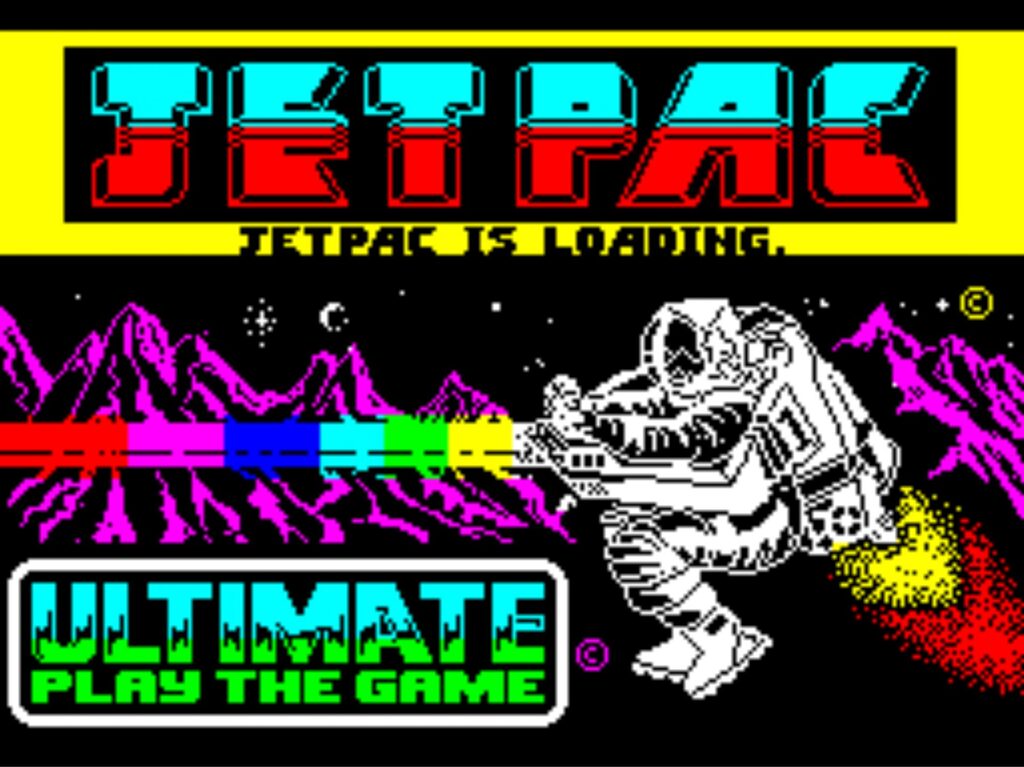 JetPac loading screen for the ZX Spectrum
There’s also a version tucked away in Donkey Kong 64 on the Nintendo 64, of all places. Collect 15 Banana Medals and you can play JetPac on a machine in Cranky Kong’s lab, and beating Cranky’s high score earns you the Rareware Coin.
Spectrum emulators will run the original too, but if you want the real thing, an original 48k Spectrum with a modern SD card interface like the DivMMC loads it in seconds rather than minutes. Hooked up to my Sony PVM, I was able to loop the game and see all four rockets, just as I had 40 years earlier.
JetPac Price
When JetPac launched in 1983 it was available on cassette for £5.50, and a little later on ROM cartridge for Sinclair’s Interface 2, which loaded instantly but cost £14.95. Due to its cult status in the retrogaming community is fetches a relatively high price today, with original cassettes starting at around £10. Today you can pick up a copy on eBay for:
- Between £10-£20 the Spectrum cassette
- Over £50 for the rarer ROM cartridge
Final Thoughts on JetPac
JetPac was a masterstroke of packaging in a time when memory was incredibly expensive. Developers Ultimate had to think about not only the gameplay but how they could most effectively fit it into the space available, and maximise the number of Spectrum owners that could play the game.
JetPac, like many of the early 16k Spectrum games from Ultimate, showed what could be achieved with fairly basic computer hardware. It also made Ultimate’s next release a must-have, and as I said above, I could barely wait for Lunar Jetman. If you like it, Manic Miner and the rest of my top 10 Spectrum games are well worth a look.
Frequently Asked Questions
Who made Jetpac?
Jetpac was made by Ultimate Play the Game, the company founded by Tim and Chris Stamper in Ashby-de-la-Zouch. Chris wrote the code and Tim did the graphics. Ultimate later became Rare.
When was Jetpac released?
Jetpac came out for the 16k ZX Spectrum in May 1983, priced £5.50. The VIC-20 version followed in 1983 and the BBC Micro version in 1984.
How many levels are there in Jetpac?
There are 16 levels, made up of four rockets with four levels each. After level 16 the game loops back to the start.
Does Jetpac have an ending?
No. Once you’ve flown all four rockets the game starts again from the first one, so the real goal is a high score.
Where can I play Jetpac today?
The original Spectrum version is part of Rare Replay on the Xbox One and Xbox Series X|S. It’s also hidden in Donkey Kong 64, and it runs on any Spectrum emulator or an original Spectrum.
Sources
Quotes from elsewhere, for anyone who wants to read more:
- Home Computing Weekly review, quoted in a mail-order listing in Sinclair User, issue 17, August 1983, Internet Archive
- CRASH, 1984, from the CRASH magazine collection, Internet Archive
More like this
Manic Miner for the ZX Spectrum
How a teenager in Wallasey wrote Manic Miner in eight weeks on a borrowed Spectrum and a Tandy, and made one of the most iconic British games ever.
Atic Atac Game Review for the ZX Spectrum
Atic Atac was a classic action adventure game for the Sinclair ZX Spectrum by Ultimate Play the Game, one of the first 48k Spectrum titles

Tranz Am Review for the ZX Spectrum
Tranz Am on the ZX Spectrum: Ultimate's 1983 16K racer across a post-apocalyptic USA, hunting the 8 Great Cups before your fuel runs out.
Comments