Elite's Commando for the ZX Spectrum
By RolyRetro · · Updated · ZX Spectrum, Arcade Games
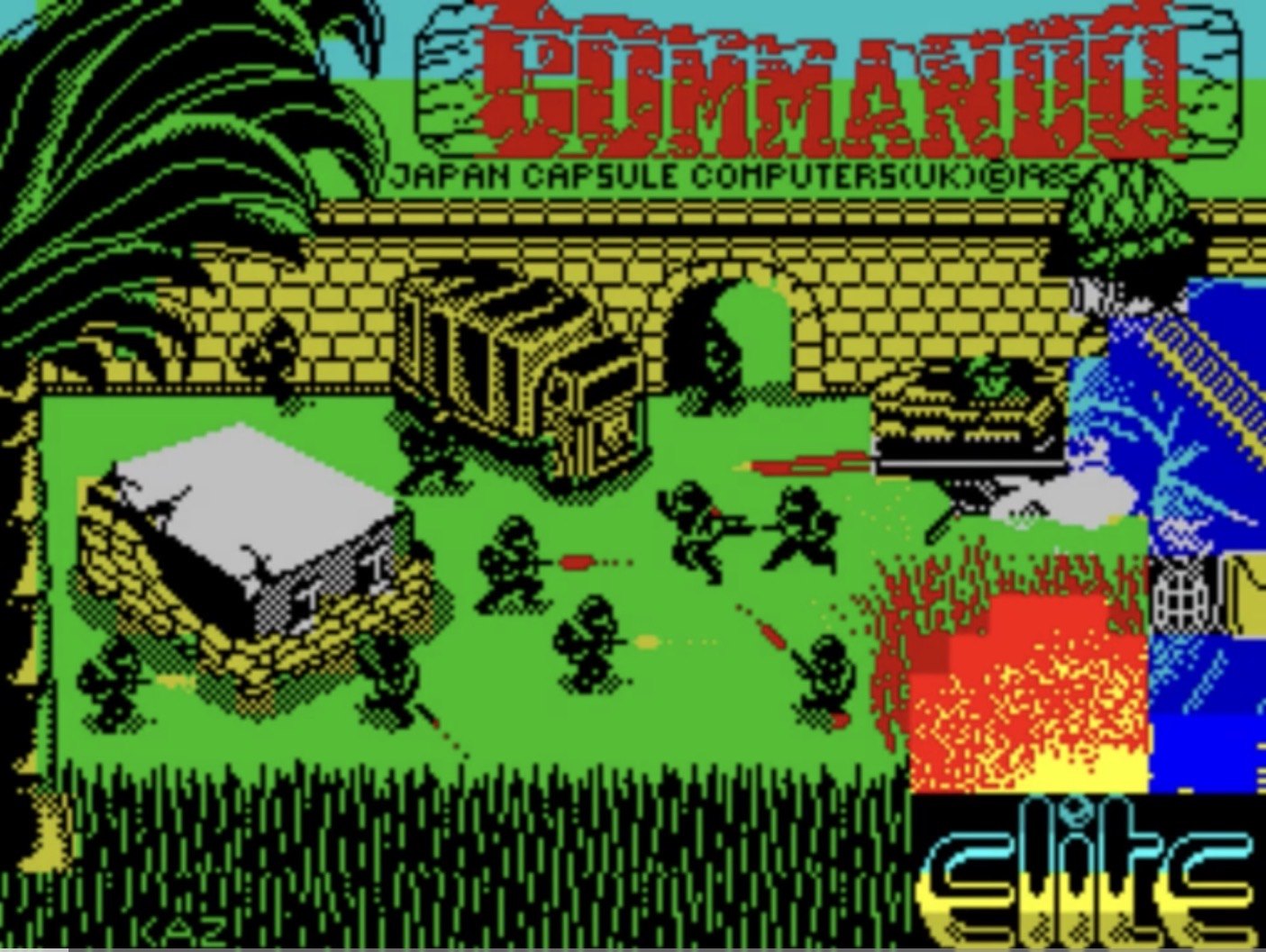
The original Commando was a 1985 arcade game by Capcom, a vertically scrolling run-and-gun shooter starring Super Joe, the commando of the title. It’s generally credited with popularising the run-and-gun genre, and clones such as Ikari Warriors and an official Rambo game followed. Elite Systems’ conversion reached the ZX Spectrum in November 1985, in time for Christmas.
What I remember about Commando
I remember playing the original Capcom Commando in the arcade and loving the run-and-gun format, which was different to a lot of the space shooters I was accustomed to playing. When I played it on the Spectrum, I was pleased to see the gameplay was well replicated, even though the graphics and colours were limited and the sound was just a series of tinny beeps.
The arcade original
Capcom’s Senjō no Ōkami (“Wolf of the Battlefield”) was designed by Tokuro Fujiwara, who was working on Ghosts ’n Goblins at the same time, and it reached arcades in Japan and North America in May 1985 and Europe in July. Data East distributed it in the US. It is unrelated to the Schwarzenegger film of the same name, which came out about six months later, so the name is a coincidence of timing.
You play Super Joe, dropped into a jungle by helicopter with an unlimited-ammo rifle that fires in eight directions and a limited supply of grenades, which are thrown towards the top of the screen however you are facing. At the end of each area the screen stops, and soldiers stream out of a gate or fortress while a cowardly officer runs off; shooting him in the back earns bonus points. There are eight different areas in the arcade game, and then it loops.
The arcade game was a big earner. Game Machine had it as the most popular arcade game in Japan for May 1985, and Wikipedia reports it as the highest-grossing arcade game of 1985 in the UK, ahead of Track & Field.
Commando on the ZX Spectrum
Elite Systems, who were based in Aldridge in the West Midlands and had made their name with home conversions of arcade hits, released the Spectrum version in November 1985 at £7.95. Spectrum Computing credits Keith Burkhill and Nigel Alderton with the code, and Rory C. Green and Karen Trueman with the graphics (Trueman also drew the loading screen). It’s a 48K game and plays with Kempston, Sinclair (Interface 2) and Cursor joysticks or redefinable keys.
Area 1 on the Spectrum, with the beeps (press Sound on)
Crash reviewed it in its Christmas Special 1985 (issue 24, January 1986) and described the structure well: you have to take each fortress, passing through several areas each with its own mini fortress on the way, and the soldiers pour out of the doors “spewing bullets from their guns and lobbing grenades all over the shop”. Enemies include soldiers with bazookas and mortars, and vehicles that have to be avoided or destroyed with a well-aimed grenade. Boxes of grenades are scattered around the battlefield to replenish your supply.
One of the Crash reviewers called it “about the best arcade conversion your Spectrum is likely to see”, noting that all eight areas had been copied “with meticulous attention”, right down to where the soldiers attack from. It didn’t escape the usual Spectrum compromises. The graphics were rather bland in colour, the arcade’s stereo sound was inevitably lost, and playing with the keys was “a bit of a pain” at the end of an area. Another reviewer was less impressed by the jeep, “which looks more like a tape deck”.
Sinclair User (issue 47, February 1986) gave it 5 out of 5 and found it “powerfully addictive”, with the right mix of suspense in seeing how far you can get and satisfaction in zapping moving targets. The reviewer noticed that the view is from a height, not directly overhead, so that men and machines are foreshortened, that Super Joe is black while the enemy are mostly blue (so he’s hard to pick out at first), and that the enemy shimmer and disintegrate when hit while Super Joe just sinks into the ground, with no “distasteful death throes”. There’s a nice touch in the high score table, whose military stencil letters you have to shoot to spell your name, and they spin like fairground targets when hit. The faults were minor: ghosts appear in front of the gates rather than behind them, some figures glide backwards until they melt into a wall, and the scoring isn’t explained anywhere, on the inlay or on screen.
Your Sinclair, in its second issue (also February 1986), called it “an almost exact copy of Commando, the arcade hit” and made it a Hot Shot. It points out what had to go: the helicopter that drops Super Joe off at the start, and the sound, “the taktaktaktak of the machine guns and the kerpow of the grenades”. You start with a sub-machine gun with unlimited fire power and six hand grenades, and the reviewer warned that after an hour or so of keyboard bashing your arms would ache.
Computer & Video Games (January 1986, issue 51) made it a Blitz Game, and the review opens: “Go totally over the top as Super Joe, crack commando, takes on the world in an explosive rescue mission. Forget Rambo — old Joe’s in a class of his own on this battlefield.” The reviewers played the Spectrum version and thought “the graphics, sound, animation and game play are all excellent”, better, “we’re afraid to say, than the Commodore version”. They liked the “big, well animated” Super Joe, the well drawn background and enemy soldiers, the choice of colours, and the smooth scrolling with “colour clash problems kept to a minimum”, which is not how Crash saw it. It’s “really a pretty straightforward shoot-out”, but “difficult enough to keep your interest and addictive enough to keep you coming back for more”, and the only hint for beginners was to “keep moving fast and keep blasting everything in sight!”. The ratings were 9 for graphics, 7 for sound, 9 for value and 10 for playability, and the verdict was “Spectrum owners shouldn’t miss this Elite version of the classic arcade game”. The reviewers hadn’t yet seen the Amstrad or BBC versions, and pointed Commodore owners towards Alligata’s Who Dares Wins II and Ocean’s forthcoming Rambo as alternatives.
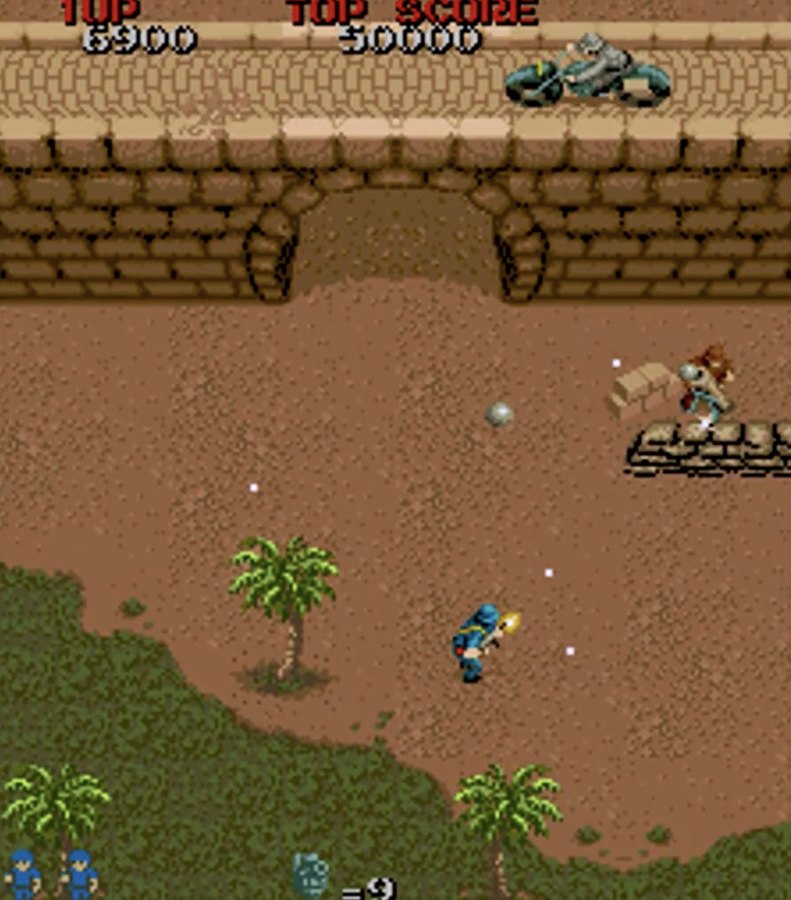
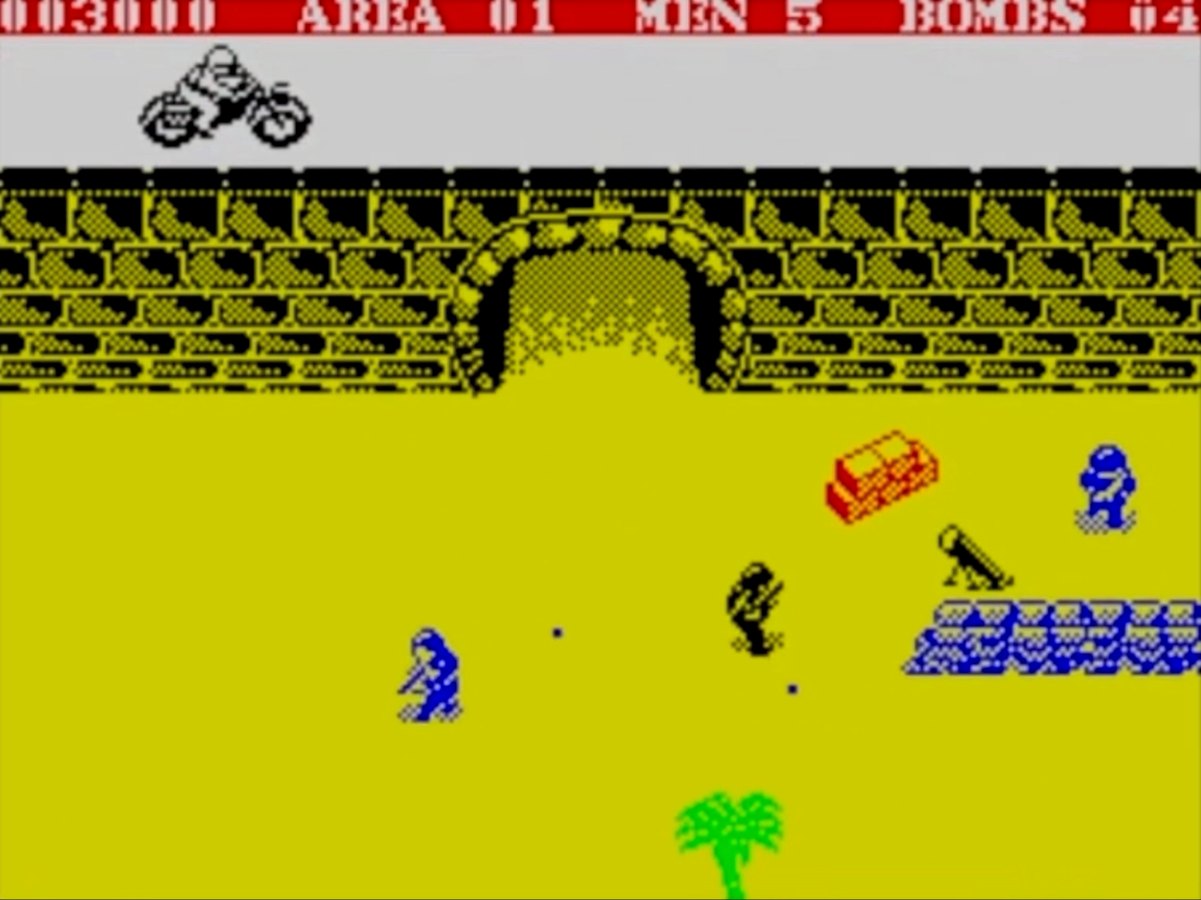
Commando in the arcade (left) and on the Spectrum (right): the same bridge and motorbike patrol, minus most of the colour
The competition: win a real Commando machine
Elite didn’t just release the game, it gave away the real thing. Computer & Video Games ran an Elite Commando competition in its December 1985 issue (number 50), “to celebrate the release of their official Commando games on the Spectrum and C64”, with a genuine Capcom Commando arcade machine as the prize. The page opens by asking which game “makes Beach Head look like a Sunday School outing”, and which arcade machine “has been causing as much of a stir in the arcades as Space Invaders”. The answer, naturally, was Commando.
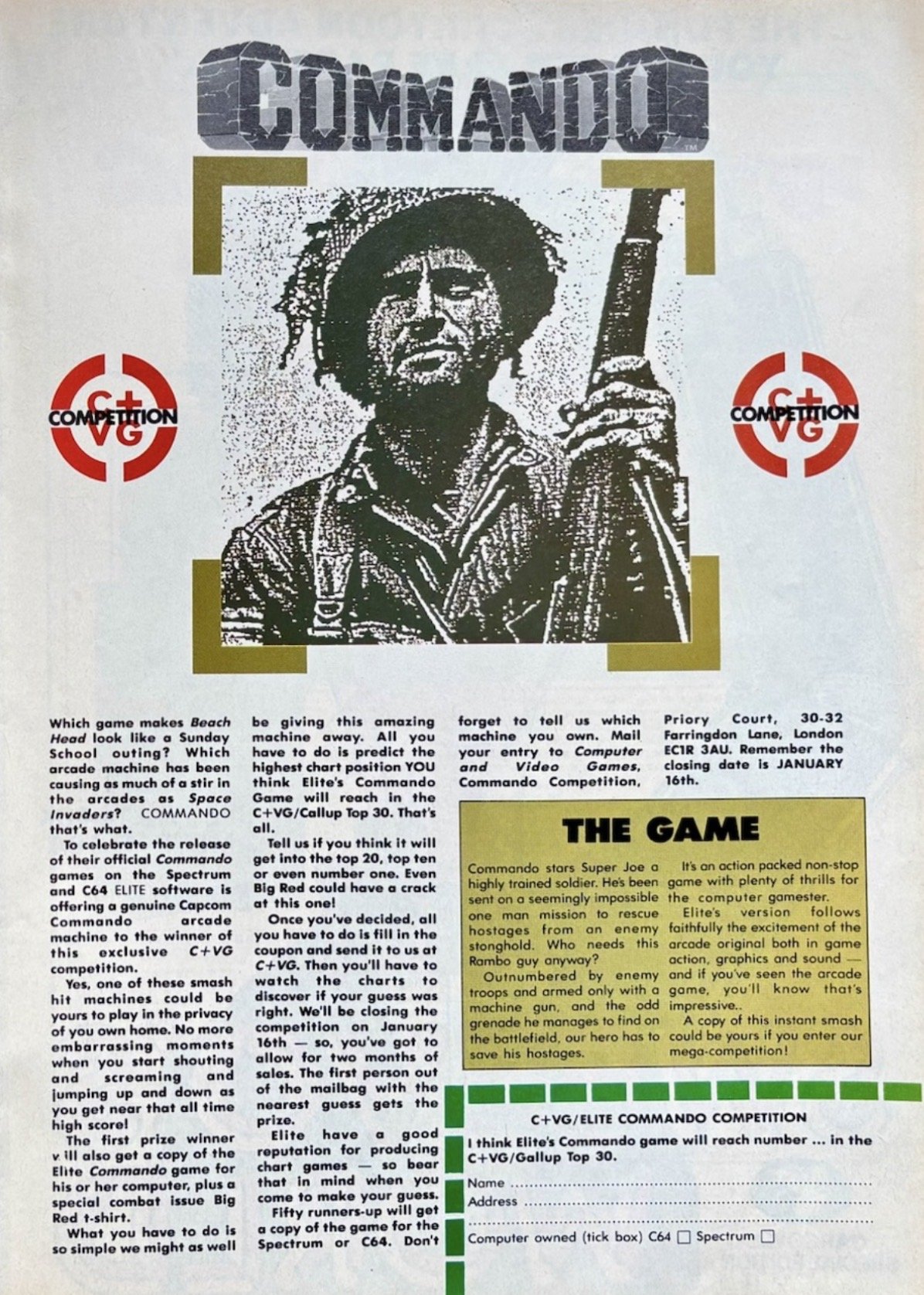
Winning didn’t take any skill at the game. You had to predict the highest position Commando would reach in the C+VG/Gallup Top 30, with the closing date of 16 January leaving “two months of sales” to find out. Whoever sent the nearest guess first won the machine, to play in the privacy of their own home, with no more “embarrassing moments when you start shouting and screaming and jumping up and down as you get near that all time high score”. The first prize winner also got a copy of the game for their computer and a special combat issue Big Red T-shirt (Big Red being the magazine’s mascot), and fifty runners-up got a copy for the Spectrum or C64.
The panel describing the game said Elite’s version “follows faithfully the excitement of the arcade original both in game action, graphics and sound”, which the reviewers a month or two later would not entirely agree with (see below), and asked who needs “this Rambo guy anyway”. The page also noted that Elite had “a good reputation for producing chart games”, which turned out to be fair: Wikipedia reports that the home computer versions topped the UK software chart in December 1985 and January 1986, so a guess of number one would not have been a bad one.
What the magazines said
It was very well received:
- Crash: 94%, and a Crash Smash, in January 1986.
- Sinclair User: 5 out of 5, February 1986.
- Your Sinclair: a Hot Shot and 9 out of 10, February 1986.
- Your Computer: 4 out of 5, January 1986.
- Computer & Video Games: a Blitz Game, January 1986, with 9 for graphics, 7 for sound, 9 for value and 10 for playability.
Readers agreed. Spectrum Computing’s players give it 8.2 out of 10 from 43 votes, and it won the Crash Readers’ Award for best shoot ’em up in 1985 (and the Golden Joystick for best arcade-style game, although sources disagree on whether that was the 1985 or 1986 ceremony). Time was less kind to it: Your Sinclair gave it just 6 out of 10 in a 1989 review, by which point the Spectrum had much better shooters.
The Elite conversions as a group sold extremely well. Wikipedia reports that the home computer versions topped the UK software chart in December 1985 and January 1986, and that Commando was the UK’s seventh best-selling game of 1985. (That figure is for the home computer versions generally, not the Spectrum one specifically.)
Other home versions
Elite released versions for the Commodore 64, ZX Spectrum, BBC Micro and Amstrad CPC in November 1985, with the BBC and Electron versions developed under contract by Catalyst Coders. The C64 is famous for its music: Rob Hubbard wrote an extended version of the arcade theme, apparently in under twelve hours. Capcom’s own NES version came out in Japan in September 1986 and in North America that November, and sold about 1.14 million copies worldwide; it repeats four level designs to make 16, and has a few extras the arcade didn’t. Activision released the Atari 2600 version in 1988, and an Atari 7800 version followed in 1989.
On the Spectrum, the game was reissued by Encore in 1988 for £1.99 and was included in compilations such as Frank Bruno’s Big Box (1988), Commando + Scooby-Doo (1989) and Thrill Time Gold 3 (1990). Elite’s own follow-up, Duet, was first called Commando ’86 and then Commando ’87. Capcom’s official sequel was Mercs (1989), which sold less well than Commando, and the arcade Bionic Commando was marketed outside Japan as a Commando sequel too.
Playing Commando today
Capcom has re-released the arcade original in several compilations (including Capcom Classics Collection and Capcom Arcade Cabinet on PS3 and Xbox 360) and the NES version arrived on the Wii Virtual Console in 2010 as Wolf of the Battlefield: Commando. The Spectrum original can be played in any emulator, and a 128K hack with a soundtrack exists. A later Wolf of the Battlefield: Commando 3 was released for Xbox Live Arcade and PSN in 2008.
These days I play it through emulation on my Steam Deck.
Commando FAQ
Who made the arcade Commando and when?
Commando was developed and published by Capcom and designed by Tokuro Fujiwara. It reached arcades in Japan and North America in May 1985 and in Europe in July 1985. Data East distributed it in North America.
Who made the ZX Spectrum version of Commando?
Elite Systems published it in November 1985 for £7.95. Spectrum Computing credits Keith Burkhill and Nigel Alderton with the code, and Rory C. Green and Karen Trueman with the graphics.
How was the ZX Spectrum version of Commando reviewed?
Very well. Crash gave it 94% and a Crash Smash, Sinclair User 5 out of 5, and Your Sinclair 9 out of 10 and a Hot Shot.
What is Commando about?
You play Super Joe, a lone soldier who fights through enemy territory on foot with a rifle and a limited supply of grenades, taking on soldiers, vehicles and fortresses.
Is Commando on the Spectrum 48K or 128K?
The original release is a 48K game. A 128K hack with a soundtrack exists, but it is not an official release.
What was the sequel to Commando?
Capcom’s arcade sequel was Mercs, released in 1989 and known in Japan as Senjō no Ōkami II. Wolf of the Battlefield: Commando 3 followed in 2008 on Xbox Live Arcade and PSN.
Sources
- Computer & Video Games issue 50, December 1985: Elite Commando competition (scan on the Internet Archive)
- Crash issue 24, Christmas Special 1985 (January 1986): Commando review (scan on the Internet Archive)
- Computer & Video Games issue 51, January 1986: Commando review, p.17 (scan on the Internet Archive)
- Sinclair User issue 47, February 1986: Commando review, p.56 (scan on the Internet Archive)
- Your Sinclair issue 2, February 1986: Commando review, p.28 (scan on the Internet Archive)
More like this
Star Wars Arcade Game by Atari
Atari's 1983 Star Wars arcade game, from an Army tank trainer to the Death Star trench, and the vector cabinet I've owned for ten years and played for fifteen minutes.

OutRun Arcade Game by Sega (1986)
How Yu Suzuki's road trip round Europe in a hired BMW became OutRun, Sega's 1986 arcade classic: the Ferrari, the radio, the cabinets and how to play it today.
Manic Miner for the ZX Spectrum
How a teenager in Wallasey wrote Manic Miner in eight weeks on a borrowed Spectrum and a Tandy, and made one of the most iconic British games ever.
Comments