Star Wars Arcade Game by Atari
By RolyRetro · · Arcade Games
I have owned an Atari Star Wars arcade machine for more than ten years. In that time I have played it for about fifteen minutes. Those were a very good fifteen minutes.
The problem isn’t the game, which is a very fine game indeed, but the screen. Star Wars draws everything in glowing vector lines on a Wells Gardner 6100 monitor, and the 6100 is famous among collectors for exactly one thing: not working. Mine has done its best to live up to the reputation.
So this is the story of a game that started life as something else entirely, with a controller designed for the US Army, and went on to become one of the most loved licensed games of the arcade era. And of the one in my house, which is mostly a very large ornament.
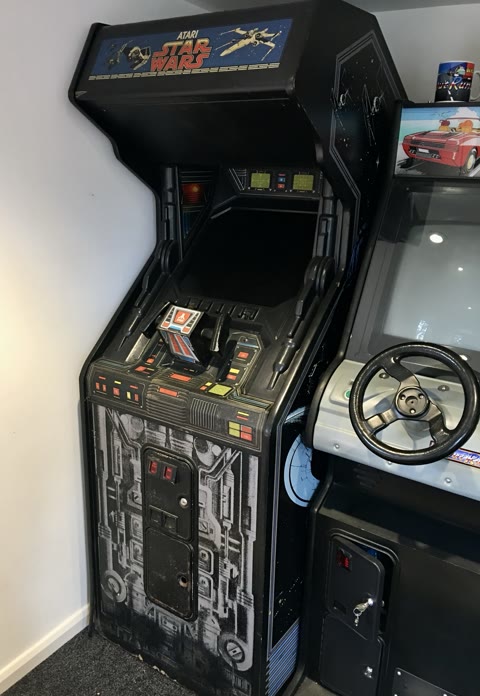
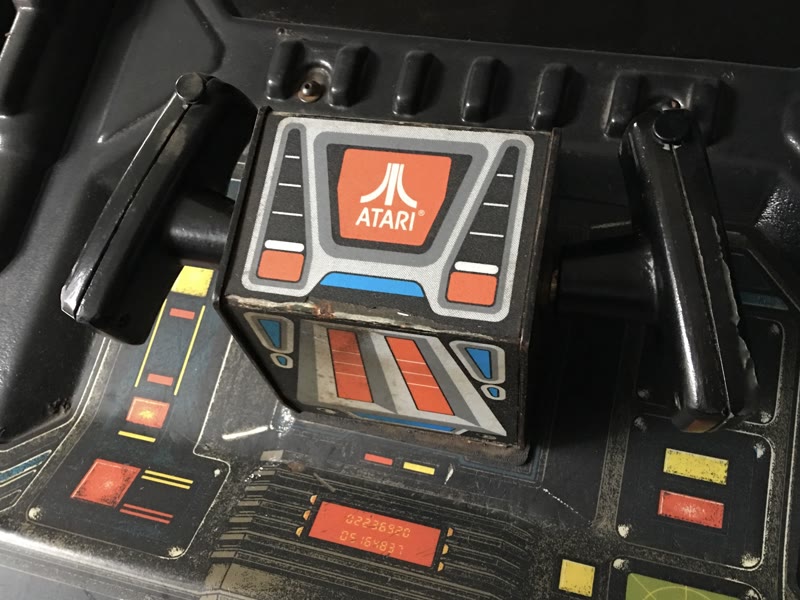
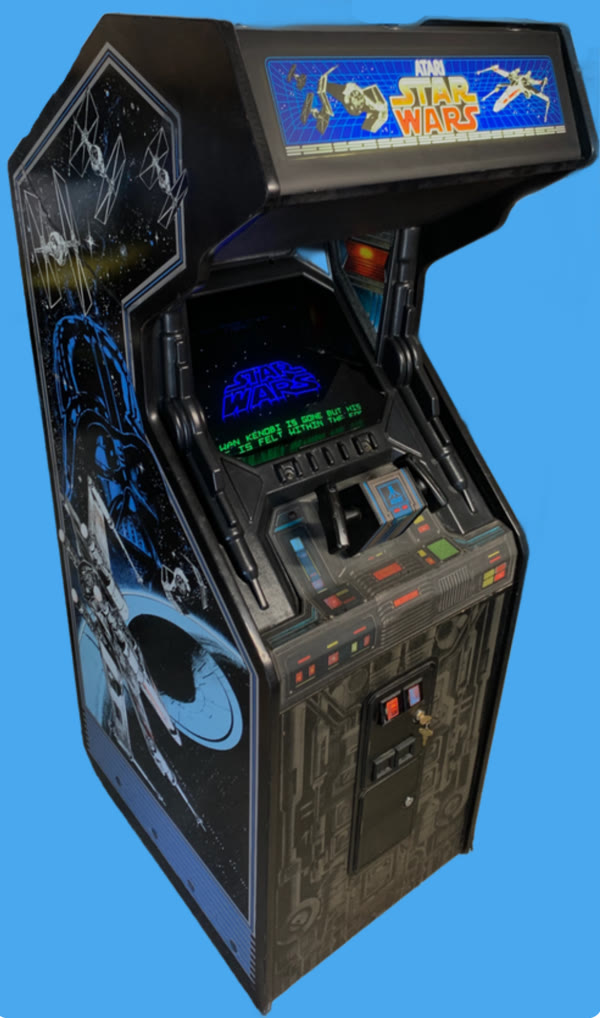
My Star Wars, next to the OutRun, and its yoke, which actually came from a Return of the Jedi cabinet that used the same controller
My Star Wars Story
I first played Star Wars in Southend, in the sit-down cockpit version, back when a Friday night in the Southend arcades was the highlight of the week. The cockpit was the one everyone wanted: you climbed in, the cabinet wrapped round you, the yoke was in your hands and Obi-Wan was in your ears. It was as close as any of us were going to get to flying an X-wing.
Some of my fifteen minutes on film: the TIE fighter attack on my own Wells Gardner monitor
Years later I bought one of my own on eBay, “playing blind”. The seller told me the board worked and the sound worked, but there was no picture, because the vector monitor was dead. It cost a fortune, as I mentioned at the time in the Arcade Shed build, and getting a picture out of it has turned out to be the hard part.
The upright used a 19-inch Wells Gardner 6100 (the cockpit had a bigger 25-inch Amplifone), and the 6100 is a notoriously temperamental monitor, and mine has found most of the ways a 6100 can fail. The “bottlecap” transistors short out. The deflection board overheats. And the high voltage unit, in my case, eventually caught fire, which is exactly as alarming as it sounds. Then there’s the AR2 board, which regulates the power supply and doubles as the amplifier for the sound, and which has needed its own bag of new capacitors. Working on it has taught me a lot about monitors, most of which I would rather not have needed to know. In more than ten years of ownership, I’ve had about fifteen minutes of blissful play out of it.
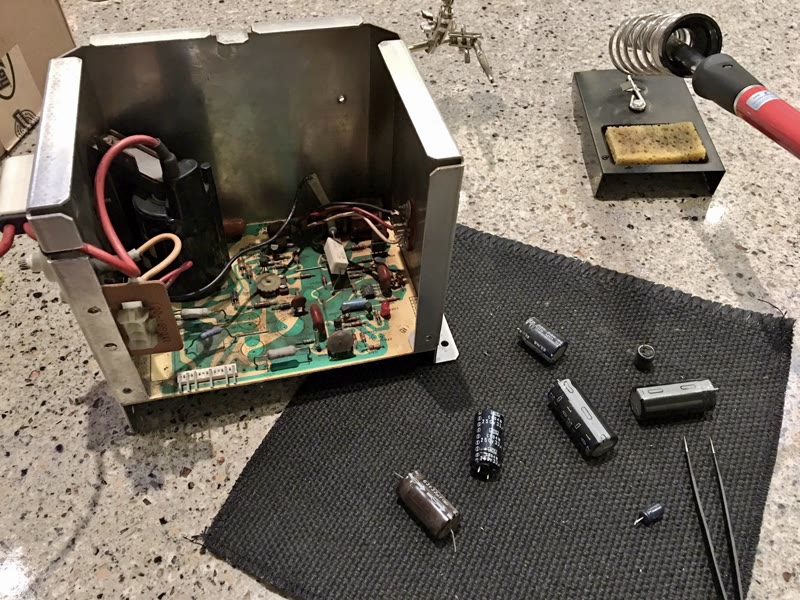
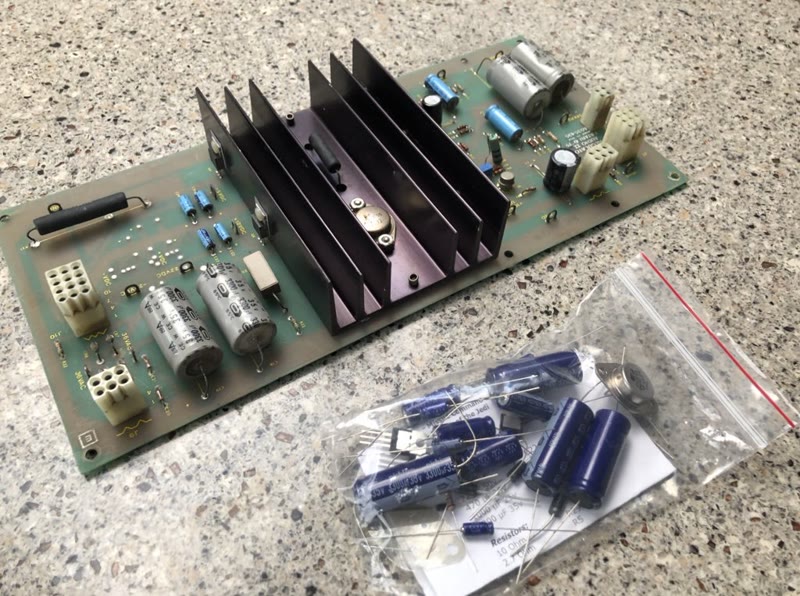
The high voltage unit, before it caught fire, and the AR2 power and sound board with its bag of new capacitors
The Story Behind Star Wars
Warp Speed: a game looking for a film
Star Wars started life as something else entirely. Jed Margolin, a hardware engineer in Atari’s research group, had joined the company with one ambition:
“The Star Wars game came about because I wanted to do a 3D space war game. I mean, I really wanted to do a 3D space war game. It is why I went to work for Atari.”
Jed Margolin, speaking to The Arcade Blogger
The result was a 3D vector project called Warp Speed, and Ed Rotberg, who went on to make Battlezone, headed it at first. According to an engineer who shared a lab with him, Rotberg’s prototype was two cabinets back to back, with two players dogfighting in full 3D. It was amazingly difficult to play, as most people couldn’t cope with flying freely in three dimensions, so it was cancelled and the hardware went into Battlezone instead. But the original Warp Speed proposal already had a very particular goal in mind:
“A feeling similar to the end of Star Wars can be achieved by the player and is a desirable goal.”
So when Atari signed a deal with Lucasfilm in 1982 to make arcade games based on the films, there was already a game waiting for a licence.
Mike Hally takes the controls
The man who got the job was Mike Hally, a young project leader who had joined Atari from university to design pinball tables. He’d seen Margolin’s hardware and knew exactly what to do with it:
“It was 3D vector hardware that wasn’t really being built for a game, but I took a look at it and thought, ‘Man, this would be perfect for Star Wars.’”
Mike Hally, Star Wars Insider #218, 2023
He wrote the proposal, Atari put him in charge, and he described it later as “the most excited I’ve ever been in my life”. The plan was simple: the end of the film. “Luke Skywalker flying his X-wing, shooting TIE fighters, trying to get down to the Death Star past the gun turrets, and then diving into the trench to get to the exhaust port,” as he put it. “It was perfect for a videogame.” Greg Rivera and Norm Avellar programmed it, Earl Vickers arranged John Williams’ music, and it took about two years, twice as long as a typical Atari game.
From joystick to yoke
The first version used an ordinary joystick, and when Atari put it in front of a focus group, players couldn’t work out which way to push it to steer. That persuaded Atari to pay for a proper flight controller. Mechanical engineer Jerry Liachek, who also designed Missile Command’s trackball, adapted the yoke from the controller on the Bradley trainer, the version of Battlezone that Atari built to train US Army gunners. So the controller that let a generation of kids blow up the Death Star started out teaching soldiers to aim the gun on a fighting vehicle.
The other big addition was the voices. Star Wars was Atari’s first talking game, with lines from the film like “Use the Force, Luke” and “Yahoo! You’re all clear, kid!”, and getting them in took the team many hours. Industrial designer Mike Jang sketched the cockpit, borrowing the hydraulic rams from the Millennium Falcon’s ramp for the moulding round the screen.
The Lucasfilm test
Lucasfilm checked everything. Hally loaded a test cabinet into a truck and drove it up to Skywalker Ranch himself:
“The people at Lucasfilm were worried about every little detail, just like they were with their movies… he had a whole entourage of people that played the game, went through all the levels, asked a zillion questions.”
Mike Hally, The Ted Dabney Experience podcast, 2022
It passed, and so did the arcade test: the day after a cabinet went into a test location, the arcade rang to say there had been an unbroken queue for it. George Lucas himself sat down in a cockpit cabinet in August 1983, with Atari and Warner executives watching nervously as he played in stony silence, until he climbed out and said, “That was great!” Atari gave him the cabinet, with a plaque on the side: “A special thanks for creating THE FORCE behind so much fun.”
Playing Star Wars Arcade
You sit (or stand) at the yoke, which has a trigger and a thumb button on each handle, all four of them firing your lasers, and you steer a gunsight round the screen while the X-wing does the flying. Before you start, the game lets you pick your starting wave, with a bonus for being brave enough to skip the easy ones. You have a set of shields rather than lives (six on the standard settings): every hit from a fighter, fireball or obstacle takes one away, and if you get hit with none left, it’s game over. You don’t have to destroy everything to make progress, either: each phase is a matter of surviving long enough, shooting whatever you can on the way.
Each wave recreates the end of the film in three parts.
Part 1: the TIE fighter attack
Part 1: the TIE fighter attack, on wave 3 with eight shields left
It starts out in space near the Death Star, in a dogfight with a swarm of TIE fighters and Darth Vader’s own ship. The fighters don’t shoot lasers so much as lob fireballs at you, which you can shoot down before they hit, and a lot of the skill is in deciding whether to go for the fighters or the fireballs. All the while, the speech is doing its job: “Red Five standing by”, Luke protesting “I cannot shake him!”, and Vader’s “I have you now!”
Part 2: the Death Star surface
Part 2: the Death Star surface on wave 3, picking off the towers for 50,000 points
Then you swoop down onto the surface of the Death Star. On the first wave this part is skipped altogether, but from the second wave you’re flying over artillery bunkers, and from the third, laser towers rise up out of the surface to meet you. Each tower you shoot is worth more than the last, starting at 200 points, and taking out every last one earns a 50,000-point bonus. Watch the Death Star as you fly in after the dogfight, too: its yellow grid lines spell out “May the Force be with you” on odd-numbered waves and the names of some of the developers on even ones. You’ll only really see it if you pause the game.
Part 3: the trench run
Part 3: the trench run, ducking under the catwalks on wave 3
And then the bit everyone was waiting for. You drop into the trench, with turrets firing from the walls, fireballs coming down it and, on later waves, catwalks and other obstacles to weave round or under. As you go in, Obi-Wan tells you to “Use the Force, Luke!”, and he means it: if you get to the end without firing a single shot until the exhaust port, you get a bonus of 100,000 points (a bit less on the first two waves). Hit the port with your torpedo and the Death Star explodes in a riot of colour, you get a shield back, and it all starts again, faster and nastier, with the fighters firing more often. Miss, and you’re straight back to the start of the trench for another go.
A Hit in the Arcades
Star Wars came out in America in May 1983 and reached the UK that September. Atari built 12,695 of them, 10,245 uprights and 2,450 cockpits, making it their best-selling arcade game of 1983, and it topped the Play Meter chart in America that October. In Japan, the trade paper Game Machine named it the most successful upright or cockpit game of November 1983.
It also became a game for the long haul. In June 1985 a team of three players in Leeds kept a single game going for nearly five days and scored 1,000,000,012 points, a record Guinness still lists.
The reputation has only grown since. When Next Generation ranked the best games of all time in 1996, it put Star Wars at number 58 and summed it up neatly:
“Probably the best licensed game ever.”
Next Generation, September 1996
Star Wars Home Conversions
The arcade game came home in two waves, and neither could quite fit an arcade vector machine into a home computer.
The first came from Parker Brothers in 1983 and 1984, as Star Wars: The Arcade Game, for the Atari 2600, Atari 5200, the Atari 8-bit computers, ColecoVision and Commodore 64. These did their best with much less powerful hardware, but none of them had a vector screen to play with.
The second came in 1987 and 1988, when Domark published conversions by the British company Vektor Grafix for the ZX Spectrum, Amstrad CPC, BBC Micro, Acorn Electron, Atari ST, Amiga and Commodore 64 (the Atari 8-bit version was done by Zeppelin Games). These kept the wireframe look, and the Spectrum version in particular was a surprisingly good effort: Crash gave it 84%, and Your Sinclair and Sinclair User both gave it 8/10. The Atari ST and Amiga versions added mouse control and digitised sound effects, and COMPUTE! called the ST version “amazing, smoothly animated”. In America, Broderbund published the PC, Mac and C64 versions, and the Mac one even had sampled speech from the films.
More recently, the arcade original (along with The Empire Strikes Back and Return of the Jedi) turned up as an unlockable extra in Star Wars Rogue Squadron III: Rebel Strike, and in 2019 Arcade1Up made a three-quarter-size replica of the upright cabinet with all three games inside.
In the Culture
The Star Wars cabinet turned up on the big screen in 1984, most notably in Gremlins, where the Gremlins themselves have a go on an upright. It has also turned up inside other Star Wars games, as a cabinet in the background or a game you can play.
What Players Remember
It’s not just me. Under The Arcade Blogger’s article on the cockpit’s development, one reader remembered first playing it “at a motorway stop on a school trip”, with “almost the whole year group gathered around the cabinet”. Another recalled an “Atari Experience” arcade in Las Vegas in 1984 or 1985 with a Star Wars built into a powered motion cabinet, and has been searching for evidence of it ever since. And a commenter who says he shared a lab with Ed Rotberg at Atari left the best footnote of all: he’d played the original two-player Warp Speed prototype a lot, and it “sounded like a blast, but was amazingly difficult to play”.
Playing Star Wars Today
If you can find a cabinet with a working monitor, play it. MAME will run Star Wars, and you can get somewhere near with a flight stick, but I don’t play it on an emulator. Having played it for real on my own machine, it just isn’t the same: you need the yoke in your hands, the vector display glowing in front of you and the booming stereo sound to really experience the game. When my 6100 is sulking, I wait.
The Legacy of Star Wars
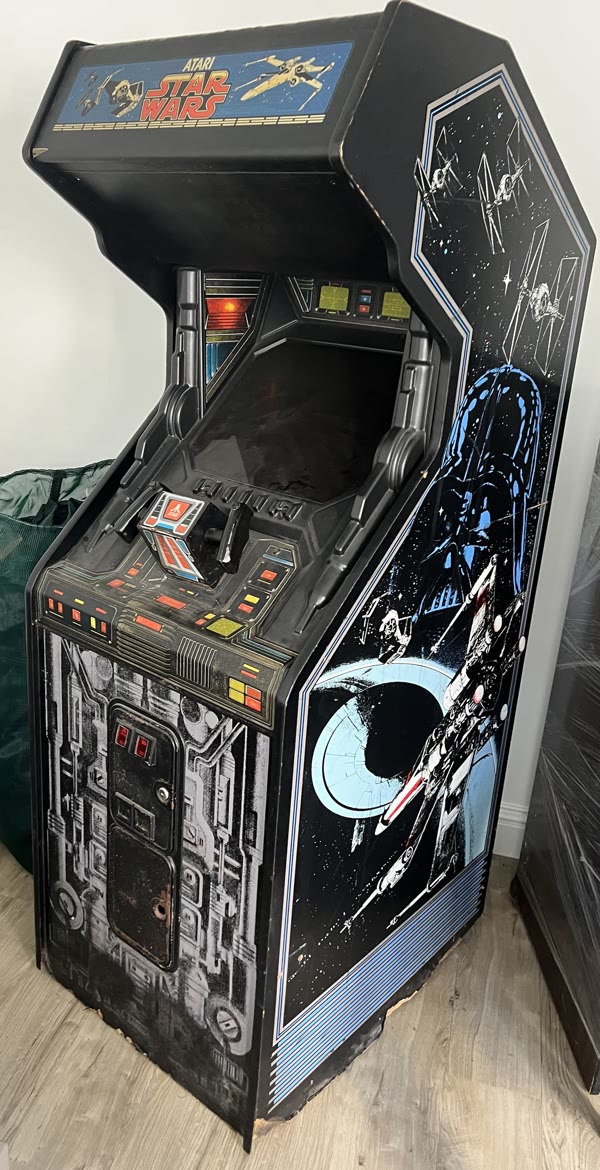
Atari followed it with Return of the Jedi in 1984, a raster game that used the same yoke, and then The Empire Strikes Back in 1985, sold as a conversion kit for the original cabinets. Its makers later admitted it got less attention than the first game because it wasn’t as fresh, and operators with a working Star Wars had little reason to change it.
Forty-odd years on, the original is still the Star Wars game people remember: the yoke, the voices, the trench and that hidden message in the grid. I just wish mine would show it to me a bit more often.
Sources
- Jed Margolin and Mike Hally quotes, the Warp Speed proposal, the cockpit design and reader memories: Atari Star Wars: Arcade Cockpit Development, The Arcade Blogger (Hally’s “most excited” line is from Retro Gamer #149)
- Mike Hally, Star Wars Insider #218 excerpt, StarWars.com, 2023
- Mike Hally on the Lucasfilm test, from The Ted Dabney Experience podcast, quoted in Atari’s Star Wars 1983 coin-op, Film Stories
- George Lucas’s verdict: The Dot Eaters
- Next Generation, “Top 100 Games of All Time”, September 1996
- Development, sales, charts and records: Star Wars (1983 video game) and Star Wars: The Empire Strikes Back (1985 video game), Wikipedia
More like this

OutRun Arcade Game by Sega (1986)
How Yu Suzuki's road trip round Europe in a hired BMW became OutRun, Sega's 1986 arcade classic: the Ferrari, the radio, the cabinets and how to play it today.
BAS Arcade Cabinet Restoration - Part 2
Part 2 of my BAS Arcade Cabinet restoration, where I renovate the coin doors, marquee and metalwork of this iconic British JAMMA machine

The Arcade Shed Build - Part 1
Follow the build of an arcade shed at the bottom of my garden, using a standard wooden shed with extra insulation for use all year round.
Comments