Gyruss arcade retro review
By RolyRetro · · Updated · Arcade Games
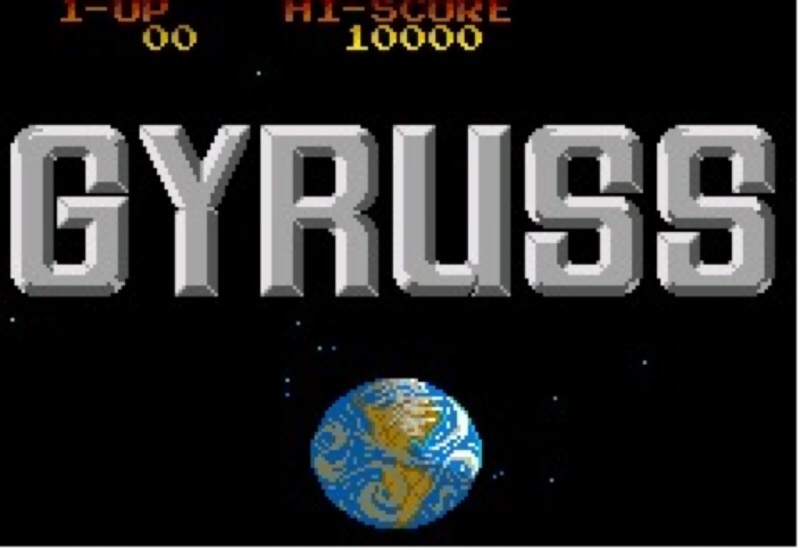
Gyruss: Konami’s shooter in the round
I found this game on holiday in Spain, around the same time that I discovered another Konami classic, Track & Field. This was in the early 80’s, a time when games arcades were massively popular and new games were launched seemingly on a weekly basis. These days I have a Gyruss cabinet of my own, a Centuri original, although it’s currently awaiting restoration (more on that later).
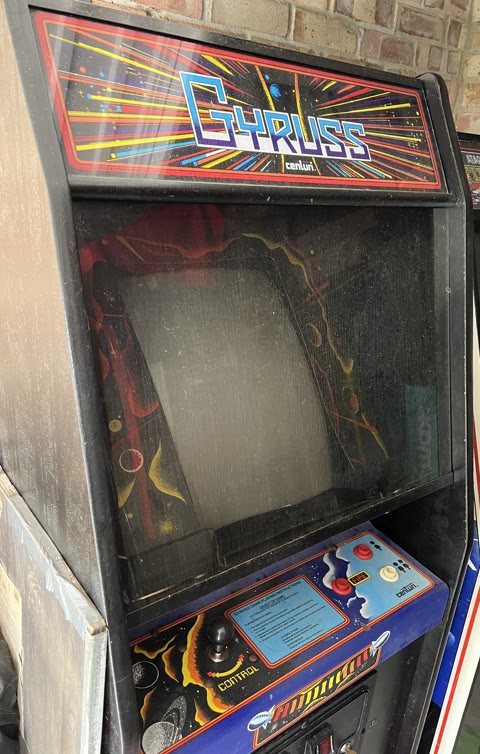
My Centuri Gyruss cabinet, awaiting restoration, and the game itself in MAME. Turn the sound on for the Bach
How Gyruss plays
Gyruss was a memorable arcade shooter for 2 main reasons, the first being the Tempest-like 3D perspective, where your ship travelled in a circle around the edge of the screen, with aliens emerging from the centre and flying out towards you. It’s basically Galaga in the round. The aliens also fired various missiles as you spun around the edge of the screen, which was slightly disorientating as you looped left to right and top to bottom. Clearing each section advanced you closer to the next “planet”, flying through the solar system: it starts “2 warps to Neptune”, then three warps each to Uranus, Saturn, Jupiter, Mars and finally Earth, and then round you go again.
The other memorable feature for me was the fantastic music, a version of Bach’s Toccata and Fugue in D minor that perfectly matched the pace of the action on screen. I would play for the music alone, which seemed to blast out of the speakers on all the cabs I played this on. It was in stereo, too.
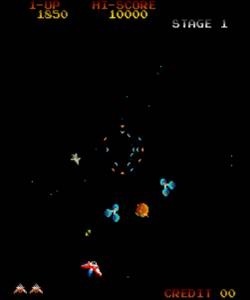 Gyruss arcade game screenshot
There’s more going on than the swirling alien fleets. Asteroids fly straight out from the centre and can’t be destroyed, and pairs of laser generators fire a beam across your path until you shoot one of them out. After each wave, three satellites appear in front of you, and if you only have the basic gun, the middle one is a glowing, sun-like object: shoot it and your ship gets a double shot, which makes life a lot easier. That’s a nice risk and reward, as you have to go after it while everything else is still shooting at you.
On reaching each planet there’s a bonus stage, Galaga-style, where the enemies can’t hurt you and you rack up points by clearing them all as they fly their patterns.
Simple in format but a great score chaser, you could play this all day and not get bored.
The making of Gyruss
Gyruss was designed by Yoshiki Okamoto, whose first game for Konami had been Time Pilot. It was his second and last: he was fired after Gyruss over a pay dispute, went to Capcom, designed 1942 and later produced Street Fighter II. Konami’s loss, as it turned out.
The music was arranged by Masahiro Inoue, and the stereo came from separate audio circuits for the two channels, driven by five sound chips.
Gyruss in the arcades

Gyruss came out in early 1983. Centuri had it in America first, from March, and Konami’s own version followed in Japan that June, when the trade paper Game Machine listed it as the seventh most successful arcade game of the month.
Computer and Video Games reviewed it in their Arcade Action column in August 1983 under the headline “Aliens in stereo”, which tells you what caught their ear:
“An eight-way joystick and marvellous stereo background music help to lift this space game out of the ordinary.”
Computer and Video Games, August 1983
They also claimed that a good player could take over the enemy fleets and fly them in formation, which doesn’t seem to be in the game at all, so I suspect a misunderstanding (or wishful thinking).
Gyruss home versions
Parker Brothers brought Gyruss home in 1984 for the Atari 2600, Atari 5200, Atari 8-bit computers, ColecoVision and Commodore 64. The 2600 version could only be a disappointment after the brilliance of the arcade original. A ZX Spectrum version was written but never released.
Konami’s own NES version, published by its Ultra Games label in America in 1989 (after the Famicom Disk System in Japan in 1988), is more of a remake than a conversion. It adds a super phaser, boss fights at each planet, extra planets (Pluto, Venus, Mercury and the Sun), 39 stages instead of the arcade’s 24 and a proper ending. Here is a great review by Nintendo Legend.
The game even made it onto Xbox Live Arcade in April 2007, remastered in HD, and it’s turned up on Konami compilations including Konami Arcade Classics on the PlayStation and Konami Collector’s Series: Arcade Advanced on the Game Boy Advance.
Playing Gyruss today
My own Centuri cabinet is awaiting restoration, so for now it’s a very large ornament. The instruction card on its control panel still explains the “Chance Stage” and the double firepower you get for destroying the middle satellite, which is reassuring.
For everyone else, there’s the 2007 Xbox 360 version, and the arcade original runs in MAME. The Bach still sounds great.
Frequently Asked Questions
When was Gyruss released?
Gyruss came out in the arcades in 1983: from March in North America, where Centuri distributed it, and in June in Japan.
Who made Gyruss?
Konami, with Yoshiki Okamoto as designer. He’d previously made Time Pilot, and went on to Capcom, where he designed 1942 and produced Street Fighter II.
What is the music in Gyruss?
An electronic arrangement of Johann Sebastian Bach’s Toccata and Fugue in D minor, arranged by Masahiro Inoue, played in stereo.
How do you get the double shot in Gyruss?
After each wave, three satellites appear in front of you. Shoot the glowing, sun-like one in the middle and your ship gets a double shot.
Was Gyruss on the NES?
Yes. Konami’s Ultra Games label released it in North America in 1989. It’s an expanded remake, with boss fights, extra planets, 39 stages and a proper ending.
Sources
- Arcade review, Computer and Video Games, August 1983, Internet Archive
- Release dates, staff, music, chart position and home versions: Gyruss, Wikipedia
- Xbox Live Arcade release: HEXUS, April 2007
More like this
Star Wars Arcade Game by Atari
Atari's 1983 Star Wars arcade game, from an Army tank trainer to the Death Star trench, and the vector cabinet I've owned for ten years and played for fifteen minutes.

OutRun Arcade Game by Sega (1986)
How Yu Suzuki's road trip round Europe in a hired BMW became OutRun, Sega's 1986 arcade classic: the Ferrari, the radio, the cabinets and how to play it today.
BAS Arcade Cabinet Restoration - Part 2
Part 2 of my BAS Arcade Cabinet restoration, where I renovate the coin doors, marquee and metalwork of this iconic British JAMMA machine
Comments