Tempest arcade classic from Atari
By RolyRetro · · Updated · Arcade Games

Atari had huge success in 1979 with the vector graphics based Asteroids, followed by two further classics: Battlezone in 1980, and the fantastic Tempest in October 1981. Tempest was host to a number of “firsts” for an arcade game, including the first game to feature a kind of “continue”, based on the player’s performance in the previous game. It was also one of the first games to feature full colour vector graphics (rather than using coloured overlays), and to great effect.
It came in three cabinets: the tall, angular upright, a smaller cabaret, and a cocktail table with a two player “flip” screen and a glass top you could balance your shandy on. The cocktail is very rare, though, and I never actually found one. My Tempest was the full-size upright at Mr B’s Amusements in Southend: tall, angular and impossible to miss, with that spinner front and centre.
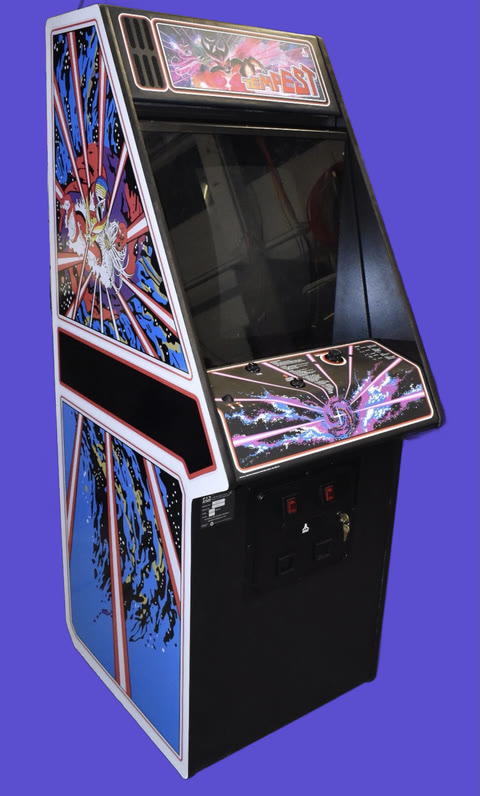
An original Tempest upright, and the game itself on a real vector monitor. Turn the sound on for the full arcade experience; the noise of every other machine in the place you’ll have to imagine.
Life on the Rim: How Tempest Plays
The design of the game is fairly unique, being a 3D “out of the screen” shooter, where the player rotates around the rim of a 3D tunnel, and aliens emerge from the centre. The shape of the tunnel changes between levels, sometimes not even a tunnel at all, but more of a stepped 3D panel. The player shoots down into the tunnel as the aliens emerge, firing back up the tunnel. The player can also use a smart bomb (the Superzapper) once every level to destroy everything on the screen. Reach the end of the level, and the player warps down into the tunnel, avoiding debris on the way left by some of the more nasty aliens.
The aliens vary, from basic shapes that just come out and try and crash into you, to electrified beings that can zap you if you linger in the wrong part of the tube. The ones everyone remembers are the Flippers, which flip end over end up to the rim, grab your ship and drag it down into the depths. There are basic 16 levels, increasing in difficulty, which then loop in variations including invisible levels, with a total of 99 levels. You steer with a spinner, a weighted knob that you can send whirring round the rim with a flick of the wrist, and it’s the reason Tempest feels like nothing else. It’s also the reason it has never quite worked with a joystick.
From Nightmare to Coin-Op
Tempest was designed and programmed by Dave Theurer, who had just finished Missile Command, so not a man short of ideas about things raining down on you. The plan was a first-person version of Space Invaders, and by most accounts it didn’t work. The story goes (and it has been retold so often that it’s hard to pin down) that Theurer had a nightmare about monsters climbing out of a hole in the ground, and woke up knowing how to fix it: put the player on the rim, and have the monsters come up the hole. The game was called Vortex in its prototype stage. It was also Atari’s first colour vector game, using its new Color-QuadraScan display, after a run of black and white vector games where any colour came from a plastic overlay. Operators were keen: around 20,000 machines were reportedly sold to distributors before it was even released.
Theurer was a perfectionist, which turned out to be expensive. Shortly before the game shipped, he noticed that an Atari logo on screen was slightly off-centre and nudged it into place. Unfortunately, the game’s own anti-tampering checks relied on things being exactly where they were supposed to be, and the change introduced a bug that could, with the right score, award the player 40 free credits. He initially blamed the hardware. It was quietly fixed in later ROMs, and arcade operators were presumably thrilled.
How Tempest Was Received
America’s Electronic Games magazine reviewed it in March 1982, and didn’t hold back:
“Tempest is undoubtedly the most original entry into the coin-op world since Asteroids. This is the long-anticipated debut of full-color Quadrascan, Atari’s vector graphics monitor – and the wait was certainly worth it!” — Electronic Games, March 1982
It finished in the same spirit: “‘Tempest’ is so wildly refreshing, so totally unlike any other videogame, it will have arcaders drooling over the prospect of color Quadrascan games yet to come.” Two months later, its Coin-Op Corner strategy guide called Tempest “not only the most visually striking coin-op around, but one of the most challenging as well”, and offered the sound advice to avoid the novice level, partly because starting higher earned a bonus. Which is the continue system I mentioned, doing its job of extracting more coins. It also had the sort of cool that money can’t buy: Tempest turns up at the end of Rush’s 1982 video for Subdivisions, being played in an arcade, which is about as 1982 as it’s possible to get.
Tempest at Home: From the 2600 to the Jaguar
As per the standard Atari approach, a home version for the 2600 was started, but it was never released: only an unfinished prototype survives, dated January 1984, and its programmer is a bit of a mystery. Given what the 2600 did to other arcade games, Tempest may have had a lucky escape.
The version I played most was on the BBC Micro. Superior Software released an official, Atari-licensed Tempest for the BBC Micro and Acorn Electron in 1985, and I owned it on tape. I can no longer find the tape, so you’ll have to take my word for it. The Micro User called it “a faithful replica” of the arcade game, though it noted that “there is no button for the Super Zapper, so you have to reach for the keyboard every time you want to use it”, which was very much the BBC Micro experience.
Superior Software’s Tempest on the BBC Micro. No vector monitor, but a respectable impression of one, right up to the point where it all goes wrong.
No home computer of the time could really recreate the vector graphics feel, and it was a crime that Atari never ported any of its games to the Vectrex console which really could have done it justice. The best-known Tempest since the arcade original is Jeff Minter’s Tempest 2000, which arrived on the Atari Jaguar in 1994 and was one of the few reasons to own a Jaguar. Minter, who has never knowingly under-done a light show, followed it years later with Tempest 4000 in 2018.
Playing Tempest Today
The arcade original is included in Atari 50: The Anniversary Celebration and Atari Vault, and MAME emulates it well. The trick is the controller: Tempest without a spinner is like Pong without a paddle. A mouse or trackball is a reasonable stand-in, and you can buy USB spinners if you’re serious. Original cabinets do come up for sale, but like any colour vector game they need a monitor in good health, so look before you leap.
Tempest or Battlezone?
I’ve written about Battlezone before, and I own one, so this is a slightly awkward thing to admit: Tempest had more longevity for me. The changing shapes of the tube gave it much more variety from level to level, and the sessions went on far longer, partly on that BBC Micro at home, where nobody was charging me by the go. Battlezone has the cabinet in my house. Tempest is the one I kept coming back to. If you like Tempest, Gyruss took a similar idea of flying round the edge of the screen and is well worth a look.
Tempest FAQ
Who made Tempest and when was it released?
Tempest was designed and programmed by Dave Theurer for Atari and released in October 1981. It was one of the first games to use full colour vector graphics.
How do you play Tempest today?
The arcade original is included in Atari 50: The Anniversary Celebration and Atari Vault, and MAME emulates it well. You really want a spinner, though a mouse or trackball is a reasonable stand-in.
What home versions of Tempest were there?
A 2600 version was started but never released, and only an unfinished prototype survives. Superior Software released an official BBC Micro and Acorn Electron version in 1985, and Jeff Minter’s Tempest 2000 arrived on the Atari Jaguar in 1994.
How does Tempest play?
You rotate around the rim of a 3D tunnel using a spinner, shooting down at aliens as they climb up towards you. You also get a Superzapper smart bomb once per level, and there are 16 different tube shapes that repeat in new colours at higher difficulty, with levels numbered up to 99.
Sources
Quotes from elsewhere, for anyone who wants to read more:
- Electronic Games, March 1982 and May 1982, Internet Archive
- The Micro User review of the BBC Micro version, via Every Game Going
More like this
Elite's Commando for the ZX Spectrum
Elite Systems' Commando (1985) brought Capcom's run-and-gun arcade hit to the ZX Spectrum. Gameplay, the arcade original, Crash's verdict, ports and sequels.
Star Wars Arcade Game by Atari
Atari's 1983 Star Wars arcade game, from an Army tank trainer to the Death Star trench, and the vector cabinet I've owned for ten years and played for fifteen minutes.

OutRun Arcade Game by Sega (1986)
How Yu Suzuki's road trip round Europe in a hired BMW became OutRun, Sega's 1986 arcade classic: the Ferrari, the radio, the cabinets and how to play it today.
Comments