Time Crisis retro arcade review
By RolyRetro · · Updated · Arcade Games

Time Crisis: the light gun game with a foot pedal
In the same way that Operation Wolf blew away the arcade competition with its 2D light gun game in 1987, Time Crisis did the same but in full 3D in 1995. Released after Sega’s Virtua Cop, the first real 3D light gun game, Time Crisis featured superior graphics, a proper storyline and a killer feature: the ability to duck behind objects using a foot pedal attached to the machine.
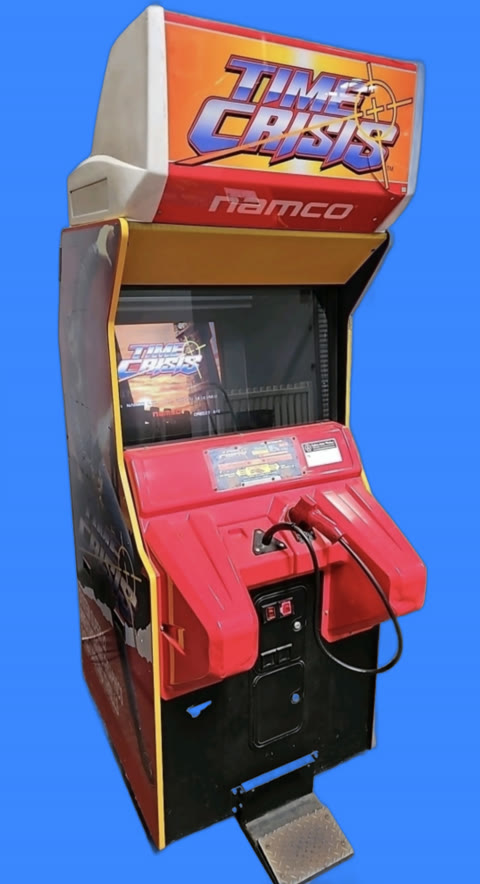
A Time Crisis cabinet, foot pedal and all, and the arcade game in an emulator: duck, reload, pop up and shoot before the clock runs out
How Time Crisis plays
This is the defining feature of Time Crisis: the game retained the joy of firing a gun rather than moving a joystick, but the play mechanic was moved on from “shoot before you get shot” to “use duck and cover tactics to shoot at the right time and avoid getting hit”. Take your foot off the pedal and your agent ducks behind cover; press it and he pops up to shoot. The enemy AI forces you to take cover in order for them to come out of their hiding places, and as the view is obscured while you are hiding, you come out blind, blasting for all you are worth at the on screen baddies.
Of course the game, due to the control mechanism, was on rails, but this seemed less of an issue when you had some control over the player in each scene. To ratchet up the tension, each area starts with a one-minute time limit that keeps ticking, even between scenes, and you only get more time by clearing each fight, which forces you to take chances in order to progress. You were also forced to hide in order to reload, rather than shooting off screen as per the light gun game standard.
The storyline was a standard “storm the castle, kill the bad guys at each level, defeat the boss and rescue the girl”, but it was well implemented, with animated cut-scenes to give you a break from the frenetic action. You play Richard Miller, an agent of the V.S.S.E., sent to rescue Rachel MacPherson, the daughter of the new president of the republic of Sercia, from Sherudo Garo’s island castle. There are three stages, each with a boss at the end, and his head of security, Wild Dog, who has a habit of not quite dying, became the series’ recurring villain.
The making of Time Crisis
Time Crisis ran on Namco’s Super System 22 arcade board, which is why it looked so good. The gun came from Namco’s earlier Point Blank, with a blowback mechanism that kicked back with every shot, so firing it felt like firing something. Among the producers was Toru Iwatani, the creator of Pac-Man, which is not where I’d have expected his career to go.
It was a one-player game. Two-player Time Crisis didn’t arrive until the sequel.
Time Crisis in the arcades
The game arrived in arcades at the end of 1995, at £1 a go in the UK, and Computer and Video Games was not entirely won over when it reviewed it in February 1996:
“A very obvious Virtua Cop-inspired gun game. Of course, there has to be at least one original feature and in Time Crisis it’s the Action Pedal. It completely changes the style of the game as players can now duck behind objects to avoid being shot.”
Computer and Video Games, issue 171, February 1996
C+VG gave it three out of five. Arcade operators were rather keener: by April 1996 the Japanese trade paper Game Machine had it as the most successful arcade game of the month, and America’s Next Generation gave it five stars, preferring it to Virtua Cop 2 because of that pedal.
Time Crisis on the PlayStation
Lucky PlayStation owners were treated to an excellent port of the game in 1997 (June in Japan, November in the UK and America), sold in a bundle with Namco’s new GunCon light gun. C+VG had heard the rumours a year earlier and guessed a recoiling gun might cost “up to £50-£60”. In the end the GunCon didn’t recoil at all, and the home version halved the frame rate and lost a few scenes, but it was still remarkably close to the arcade game, and Namco added a new Special mode with its own story and branching routes, which is more than most arcade conversions bothered with.
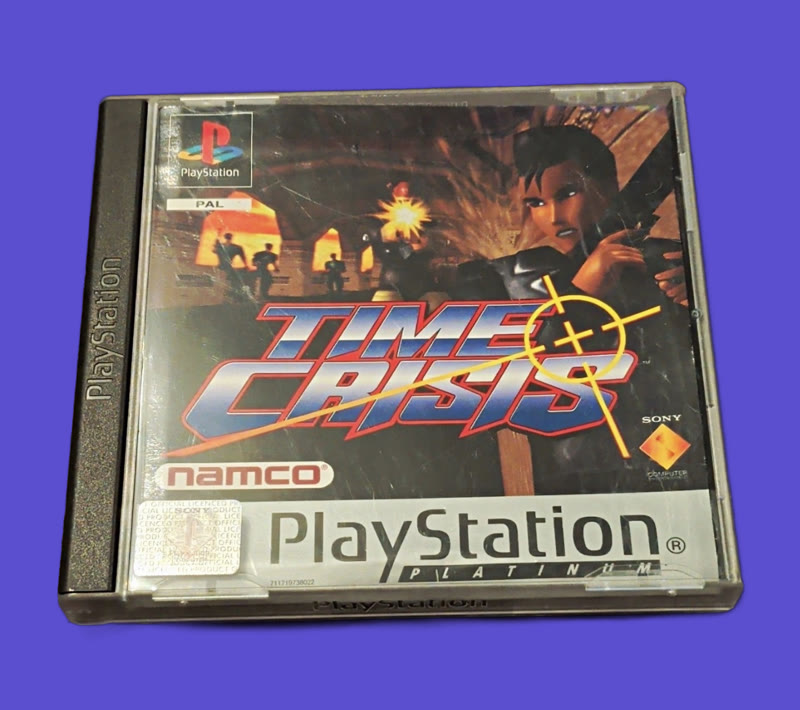
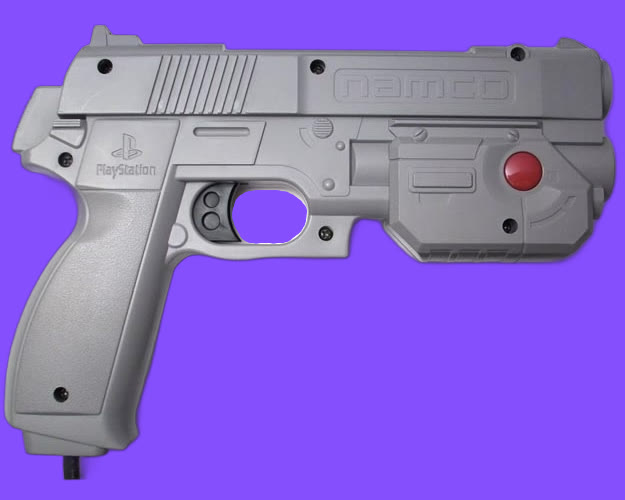
My PAL Platinum copy of Time Crisis and my Namco GunCon
This time C+VG gave it five out of five, and Electronic Gaming Monthly named it their Light Gun Game of the Year for 1997.
The big difference at home was the lack of a foot pedal. On the GunCon, the job went to the red button on the side of the gun: hold it down to pop up from cover and shoot, and let go to duck back down and reload. In other words, the pedal moved to your thumb.
If you’ve got the gun out, the Die Harder section of Die Hard Trilogy is another PlayStation light gun game from the same era, and well worth a look.
Time Crisis sequels
Various arcade sequels followed, with PlayStation conversions keeping track:
- Time Crisis II (arcade 1997, PlayStation 2 2001): two linked machines, so you and a friend could finally play together, and a more forgiving timer.
- Crisis Zone (arcade 1999): a spin-off with a machine gun and a SWAT team.
- Time Crisis: Project Titan (PlayStation 2001): a home-only sequel for the original GunCon.
- Time Crisis 3 (arcade and PlayStation 2, 2003), Time Crisis 4 (arcade 2006, PlayStation 3 with the GunCon 3) and Razing Storm (arcade 2009).
- Time Crisis 5 (arcade 2015): two pedals and Unreal Engine graphics, and the only main game in the series never to come home.
Playing Time Crisis today
That’s the tricky part. The original arcade game has never had a modern re-release, and light guns like the GunCon only work with old CRT televisions, so the PlayStation version needs a PlayStation, a GunCon and a big old telly to play properly. Arcade machines are the easiest way, and the later Time Crisis cabinets still turn up in arcades, bowling alleys and seaside amusements.
I’m lucky enough to still have my PlayStation and GunCon, which have seen plenty of action over the years on Time Crisis and Point Blank. (For Die Hard Trilogy I had to use Konami’s Hyper Blaster instead, as it doesn’t work with the GunCon.)
That foot pedal was the masterstroke, and it’s what made Time Crisis play so differently from the light gun games that came before it.
Frequently Asked Questions
When did Time Crisis come out?
Namco released Time Crisis in the arcades in December 1995. The PlayStation version followed in 1997, bundled with the GunCon light gun.
Can two people play the original Time Crisis?
No. The original arcade Time Crisis is a one-player game. Two-player play arrived with Time Crisis II in 1997, using two linked machines.
What does the pedal do in Time Crisis?
It controls cover. With your foot off the pedal you duck behind cover, safe from enemy fire, and you reload there. Press the pedal and you stand up to shoot. On the PlayStation version with the GunCon, the red button on the side of the gun does the same job: hold it to come out and shoot, release it to take cover and reload.
Was Time Crisis on the PlayStation?
Yes. Namco’s PlayStation version came out in 1997 with the GunCon light gun, and added an extra Special mode with its own story. Electronic Gaming Monthly named it Light Gun Game of the Year.
Can you play Time Crisis on a modern TV?
Not with the original light gun. The GunCon relies on the timing of an old CRT television, so it doesn’t work on flat-screen TVs. The arcade machines are the easiest way to play it today.
Sources
- Arcade review, Computer and Video Games, issue 171, February 1996, and Namco light gun news, issue 176, July 1996, Internet Archive
- Release dates, staff, hardware, chart position, awards and sequels: Time Crisis (video game) and Time Crisis, Wikipedia
More like this
Elite's Commando for the ZX Spectrum
Elite Systems' Commando (1985) brought Capcom's run-and-gun arcade hit to the ZX Spectrum. Gameplay, the arcade original, Crash's verdict, ports and sequels.
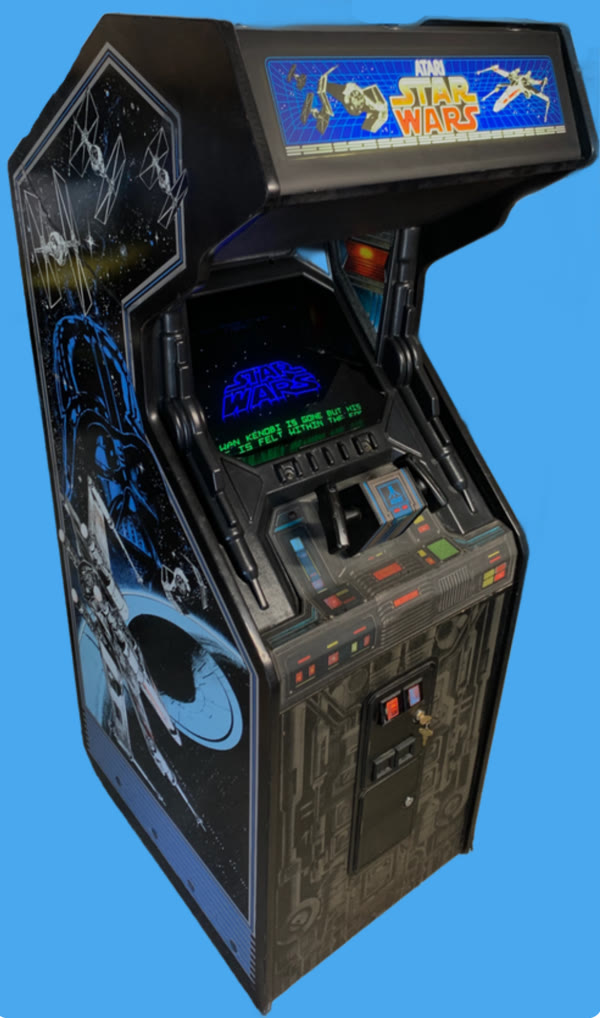
Star Wars Arcade Game by Atari
Atari's 1983 Star Wars arcade game, from an Army tank trainer to the Death Star trench, and the vector cabinet I've owned for ten years and played for fifteen minutes.

OutRun Arcade Game by Sega (1986)
How Yu Suzuki's road trip round Europe in a hired BMW became OutRun, Sega's 1986 arcade classic: the Ferrari, the radio, the cabinets and how to play it today.
Comments