Chase HQ Arcade Game by Taito
By RolyRetro · · Updated · Arcade Games

If someone had taken every 80s buddy cop movie, boiled them down to the best bit — the car chase — and poured the result into an arcade cabinet, you’d get Chase HQ. A black Porsche 928, a dispatcher called Nancy crackling through the speakers, and a gear stick with a big red turbo button on top. For the price of a few coins you got to be Crockett, or Axel Foley, or whoever you fancied. Not bad for a Wednesday afternoon.
Taito released it in 1988, and it became Japan’s highest-grossing dedicated arcade game of 1989. Over here it hoovered up 10p pieces at a rate that would make a fruit machine jealous.
My Chase HQ Story
I loved Chase HQ. To me it was the natural arcade successor to OutRun — a driving game, but with the added thrill of chasing down the bad guys and starring in your own buddy cop movie. I was 18 in 1989, so I did technically have a driving licence, but the only thing I was chasing in my Mark 2 Ford Escort was the hope that it would start on a cold morning. Chase HQ let me drive a Porsche 928 at ridiculous speed through traffic — which was about the only way that was ever going to happen.
And Nancy’s voice. Giving you the run-down of your next target, that crackle of “This is Nancy at Chase H.Q.!” — I can still hear it now.
I played it in a small arcade next to the railway station in Grays — a poky little place with some fruit machines and a Nemesis cabinet. I’d sneak in there after school some days on the way home, and Chase HQ always got my coins first.
The Spectrum version I actually bought myself, which was rare — most of my games were either gifts or “borrowed” from mates. But Chase HQ had earned it. It was a good game in its own right, but controlling a high-speed police pursuit on a rubber keyboard wasn’t quite the same as gripping a steering wheel and stamping on a pedal. If I hadn’t loved the arcade game so much, maybe I’d remember the Spectrum version more fondly — but that cabinet next to Grays station had rather set the bar.
If Beverly Hills Cop Was an Arcade Game
Chase HQ was very much of its era — so 80s in its style that it could have been directed by Jerry Bruckheimer, starred Eddie Murphy, and had a soundtrack by Harold Faltermeyer. The influence of Miami Vice and Beverly Hills Cop is all over it: the fast cars, the buddy partnership, the sun-soaked roads, the synth-drenched soundtrack.
But where those films had you sitting on a sofa eating crisps, Chase HQ put you behind the wheel. Insert a coin and Nancy would brief you on your target — their crime, their car, their location. Then it was pedal down, gear into high, and weave through traffic until the shout went up: “There he is! Let’s get ’im!”
The concept was simple. You weren’t racing anyone to a finish line. You were hunting them down and ramming them off the road until their expensive sports car caught fire and they were hauled away in handcuffs. Subtle it wasn’t, but it was a blast.
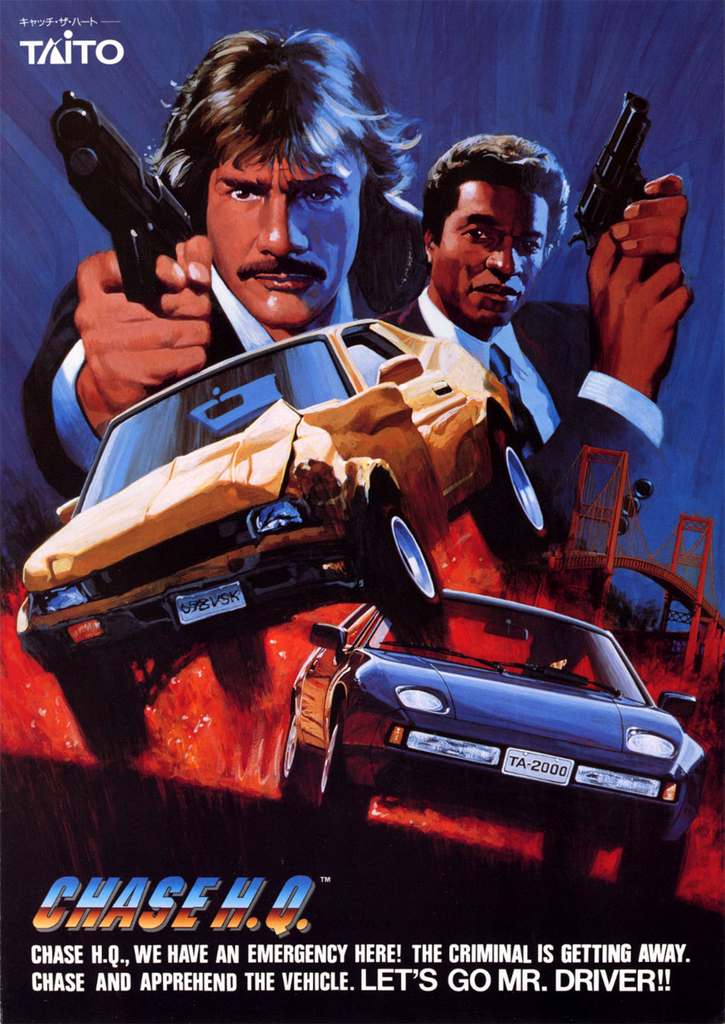 Chase H.Q. Arcade Flyer
The Team Behind the Cabinet
Chase HQ was built by a small team at Taito’s development division: designer Hiroyuki Sakou, programmers Takeshi Ishizashi, Takeshi Murata and Kyoji Shimamoto, with music by Takami Asano. The game ran on Taito’s Z-System hardware — a dual Motorola 68000 setup with a Z80 handling sound, sharing DNA with the board that powered Sega’s OutRun.
That shared architecture wasn’t coincidence. Chase HQ wore its OutRun influence openly — the pseudo-3D road rendering, the branching paths, the sense of speed — but Sakou’s team added something OutRun never had: a reason to drive fast beyond the clock. The pursuit mechanic, the ramming, the escalating criminal targets — these turned a driving game into something closer to an interactive action film.
The game was also a bit of a technical showcase. Those digitised voice samples were pretty special for 1988 — Nancy’s dispatcher calls, your partner’s shouts, the crunch of metal on metal. Most arcade cabinets didn’t talk to you like that. And the cabinet itself was an elaborate affair: a steering wheel, pedals, a hi/lo gear selector, and a big red turbo button that you absolutely did not need to hit as hard as everyone did. Sirens blared from the machine during attract mode, with flashing lights above the screen — the arcade equivalent of a neon sign saying “put your money in here.”
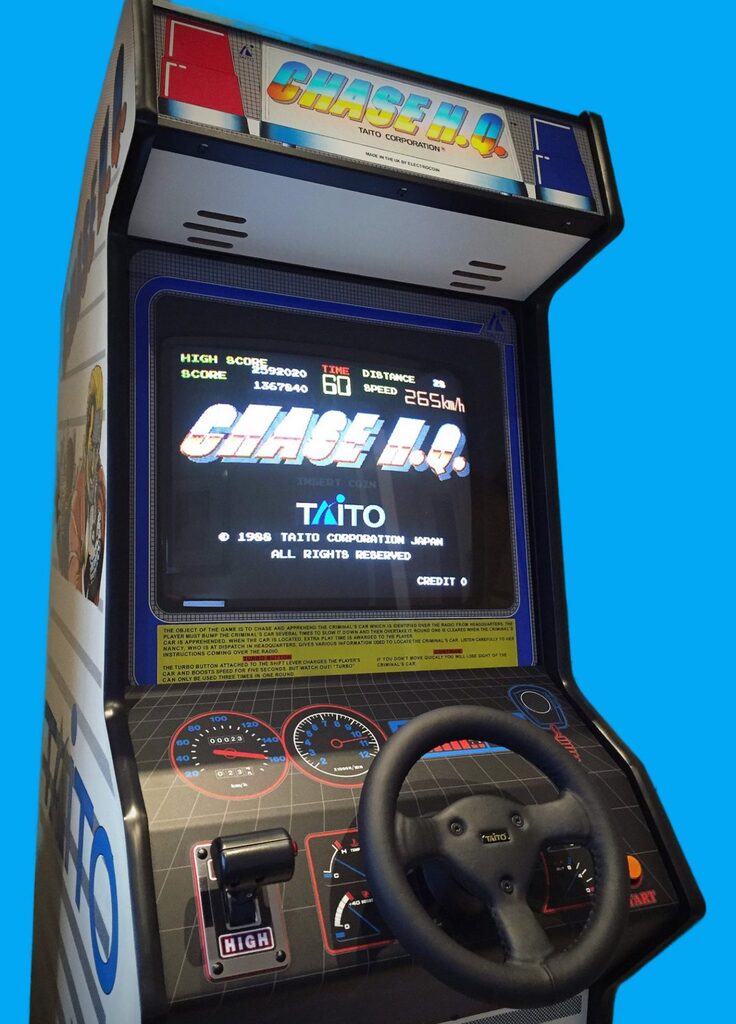
One final piece of trivia: Chase HQ was the debut of Taito’s modern grey-and-blue logo, the one that would appear on their games for decades afterwards. The Cutting Room Floor discovered it had been lurking unused in the code of Rainbow Islands and Continental Circus, but Chase HQ was where it first appeared on screen.
The Chase Is On
Insert a coin and Nancy gives you your briefing — the name of the criminal, the car they’re driving, and the road they’re on. Jump in your black Porsche 928, floor it in low gear, and you’re off through traffic with your partner shouting encouragement from the passenger seat.
A graphic shows your proximity to the target as you weave through traffic, taking branching paths through half-finished roads littered with barricades and cones. Catch up within sixty seconds and the real fun begins — ram the target’s car until the damage bar fills, using your three turbo boosts to close the gap whenever they pull ahead.
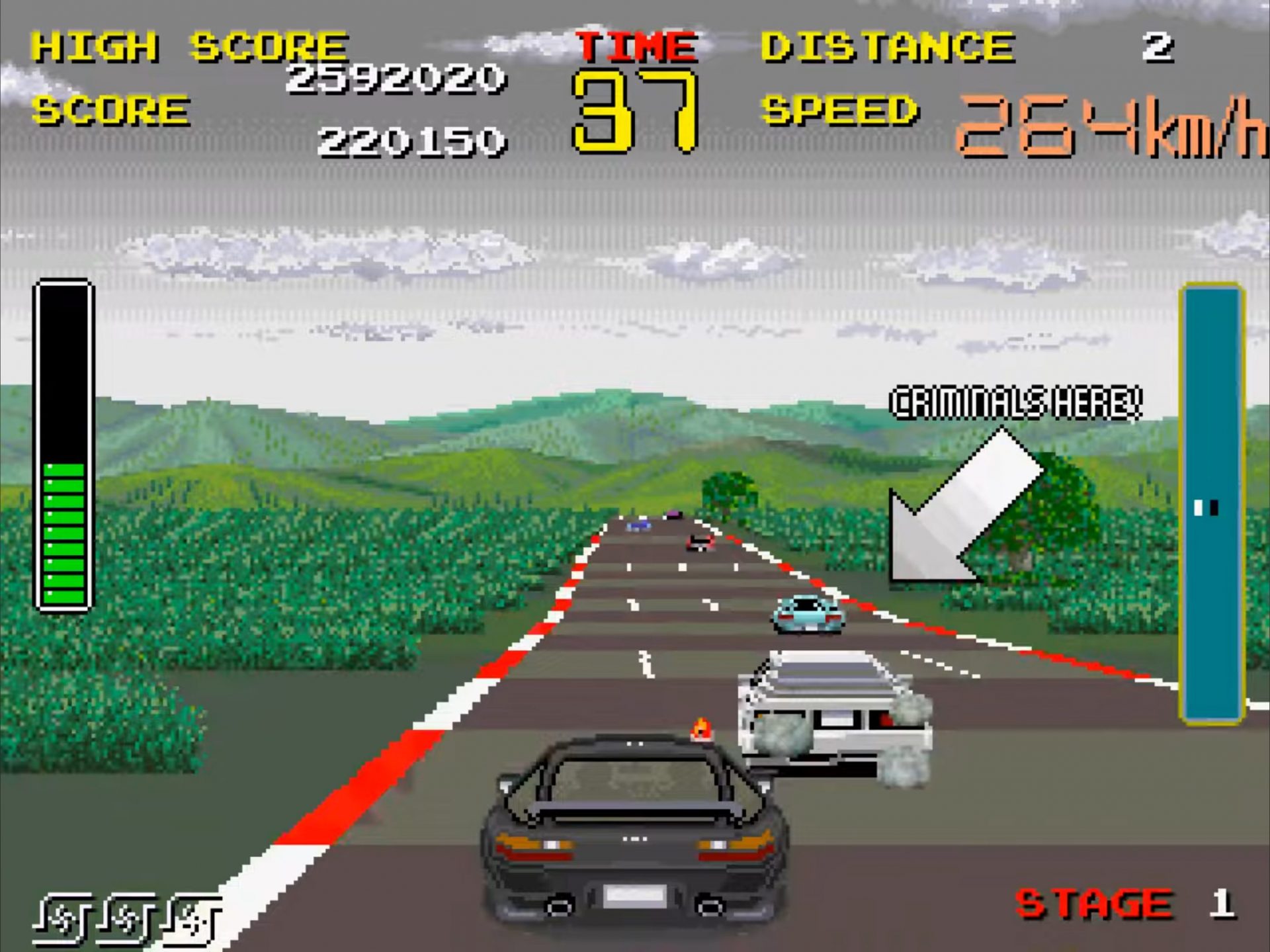 Chasing down a Lotus Esprit in Chase HQ
Deliver enough damage before the timer runs out, and the criminal is forced to the roadside and carted off in handcuffs, their expensive sports car in flames. Nancy will then present you with a new, faster, more robust target. Through the game you’ll encounter:
- Lotus Esprit Turbo — driven by Ralph, the Idaho Slasher. Given the Lotus reputation for electrical faults, this one probably burst into flames of its own accord
- Lamborghini Countach — driven by Carlos the armed robber. Not the best choice for a getaway vehicle considering those scissor doors, and there’s very little luggage space for the proceeds of any robbery
- Porsche 911 — driven by some “Chicago Pushers”. Now this is a proper getaway car: quick, bomb-proof, and favoured by both drug dealers and their yuppie clients
- Ferrari 288 GTO — driven by an LA Kidnapper. The kidnapper would have been better off keeping the car than demanding a ransom — these are now worth over £4 million
- Red Porsche 928 — driven by a Russian spy. We presume he’s Russian as it’s red, and the car isn’t identified in the game. Presumably the player car was reused as a villain to save on graphics resources, or possibly licensing fees to a fifth manufacturer
It’s great to see real cars being used, given how precious manufacturers can be about their vehicles being shown damaged. Each enemy was tougher than the last, and the cabinet was designed to keep you feeding it coins. That said, a skilled player could complete the entire game in around ten minutes.
What They Said at the Time
The Spectrum conversion, handled by Ocean Software, arrived in December 1989 and the reviews were extraordinary. All three major Spectrum magazines gave it over 90%:
Crash awarded it 95% and a Crash Smash — Crash, Issue 71, December 1989
Sinclair User gave it 96% — Sinclair User, 1989
Your Sinclair awarded it 94% and a Megagame — Your Sinclair, Issue 50, February 1990
Computer & Video Games gave it a “C+VG Hit” in their January 1990 issue, and Julian Rignall in The Games Machine scored it an astonishing 97%. It won the Golden Joystick Award for Best Coin-op Conversion of the Year (8-bit) in 1989, and — perhaps the ultimate accolade — the readers of Your Sinclair voted it the number one ZX Spectrum game of all time in the magazine’s final issue. It features in my own Top 10 ZX Spectrum Games too.
That’s not bad for a rubber-keyboard version of an arcade powerhouse.
 Chase H.Q. on the ZX Spectrum — Ocean’s remarkable conversion
The Sound of the Arcade
If Chase HQ has a single defining element, it’s Nancy. “This is Nancy at Chase H.Q.!” — six crackly digitised words that are lodged permanently in the brain of anyone who played the game in the late 80s. She was your dispatcher, and the voice that somehow made standing in a dingy arcade feel like reporting for duty.
The 128K Spectrum version managed to keep Nancy’s voice, which was quite an achievement for the hardware. The 48K version couldn’t stretch to it, and honestly, you noticed. Chase HQ without Nancy is a bit like Beverly Hills Cop without the Axel F theme — it still works, but something’s not quite right.
Composer Takami Asano’s synth soundtrack did the rest, all urgent pulses and 80s energy. Between the voice work, the sirens, and the music, Chase HQ was one of those games where what you heard was half the experience.
Ocean’s Impossible Conversion
The home computer ports were always going to be a challenge. The Z-System hardware that powered the arcade cabinet had more raw grunt than any 8-bit micro could dream of, and then there were the physical controls — no rubber keyboard was going to replicate a steering wheel and turbo button.
Ocean Software, the Manchester-based conversion specialists, gave the Spectrum version to programmer Jon O’Brien, with graphics by Bill Harbison, music by Jonathan Dunn, and cover art by the legendary Bob Wakelin. What O’Brien achieved was remarkable — a game that captured the spirit and tension of the arcade original within 48K of RAM. The sense of speed was there, the pursuit mechanic worked, and on the 128K Spectrum, Nancy’s voice survived the journey home.
It wasn’t perfect — it couldn’t be. But it was good enough to win Game of the Year, and that said everything about the quality of the conversion and the strength of the original concept. There were also conversions for the Amstrad CPC, Amiga, and later for the NES, Game Gear and Master System, but it’s the Spectrum version that British players remember most fondly.
The game has even been fully reverse-engineered — a developer called David Thomas reconstructed the entire Spectrum version in portable C code, published on GitHub. A fitting tribute to O’Brien’s original work.
What Players Remember
Chase HQ is one of those games that people remember physically. Not the graphics or the scores, but the feeling — the steering wheel under your hands, the gear stick clicking between high and low, that turbo button under your thumb. One writer on Petrol Blog said Chase HQ is the game they remember most from their teenage years, and they still mutter its lines decades later. I know the feeling.
Most players never saw all five criminals. The cabinet was hungry for coins, and the difficulty ramped up pretty sharply after the first couple of stages. But that was part of it, really — you’d walk away from the machine already working out where you’d lost time, mentally saving your turbo boosts for the final ram, fully intending to come back tomorrow with another handful of 10p pieces.
Playing Chase HQ Today
Finding an original Chase HQ cabinet in the wild is increasingly rare — I know from my own arcade cabinet restoration how much work is involved. Threads on the UKVAC forum describe what it takes to bring surviving Chase HQ machines back to life — including the discovery that Electrocoin, who distributed the cabinets in Europe, had wired the speakers backwards from factory.
The Spectrum version is playable through emulation, and the fully reverse-engineered C port means the game can theoretically run on almost anything. The arcade original is available through MAME for those who want the authentic experience minus the coin slot.
The game spawned three sequels — Special Criminal Investigation (1989), Super Chase H.Q. (1992), and Chase H.Q. 2 (2007) — but none captured the lightning-in-a-bottle quality of the original. The dangerous driving mechanic lived on through games like Road Rash on the Mega Drive and the Burnout series, but Chase HQ remains the purest distillation of the idea. If you’re interested in the state of arcade gaming today, have a look at what happened to the arcades.
The Legacy of Chase HQ
Chase HQ worked because Taito understood what people actually wanted from an arcade game — not to race, but to be the hero of the kind of film they’d rented from the video shop the weekend before. They took the buddy cop genre, stripped it down to the car chase, and built a cabinet around it.
The steering wheel, the gear stick, Nancy’s voice, the siren, the turbo button — it all added up to something that felt bigger than a game. For a lad in his late teens whose actual driving experience involved coaxing a Ford Escort through Essex traffic, it was pretty special.
Chase HQ remains one of my all-time favourite arcade games.
Sources
- Crash Magazine, Issue 71, December 1989 — Chase HQ Spectrum review (95%, Crash Smash)
- Sinclair User, December 1989 — Chase HQ Spectrum review (96%)
- Your Sinclair, Issue 50, February 1990 — Chase HQ Spectrum review (94%, Megagame)
- Computer & Video Games, January 1990 — Chase HQ review (C+VG Hit)
- The Games Machine — Julian Rignall’s Chase HQ review (97%)
- The Cutting Room Floor (tcrf.net) — Chase HQ unused content and Taito logo history
- UKVAC Forum (ukvac.com) — Chase HQ cabinet restoration threads and Electrocoin wiring discovery
- Petrol Blog (petrolblog.com) — Chase HQ player memories feature
- David Thomas — Chase HQ Spectrum reverse-engineering project (GitHub)
- Japan Amusement Machine and Marketing Association (JAMMA) — 1989 arcade earnings data
- Bob Wakelin archive — Ocean Software cover art credits
More like this
Star Wars Arcade Game by Atari
Atari's 1983 Star Wars arcade game, from an Army tank trainer to the Death Star trench, and the vector cabinet I've owned for ten years and played for fifteen minutes.

OutRun Arcade Game by Sega (1986)
How Yu Suzuki's road trip round Europe in a hired BMW became OutRun, Sega's 1986 arcade classic: the Ferrari, the radio, the cabinets and how to play it today.
BAS Arcade Cabinet Restoration - Part 2
Part 2 of my BAS Arcade Cabinet restoration, where I renovate the coin doors, marquee and metalwork of this iconic British JAMMA machine
Comments