Space Ace arcade review
By RolyRetro · · Updated · Arcade Games

The space themed Laserdisc sequel to Dragon’s Lair
It was a wet summer holiday in 1984 and I was with my cousin in an arcade on Canvey Island in Essex. Frankie Goes to Hollywood was in the Top 10 with “Two Tribes”, and the famous fight scene between Reagan and Chernenko was blasting out of the video juke box. I looked up from the 2p falls at the voice emanating from a cabinet at the front of the arcade…
Space Ace - Defender of justice, truth and the planet Earth!
I walked over to the crowd forming around the machine, and that was me set for the rest of the summer.
Typical gameplay sequence from Space Ace
In June 1983 Cinematronics released Dragon’s Lair, the first Laserdisc based game in US arcades (its designer Rick Dyer had been inspired by Sega’s Astron Belt, which he saw at the 1982 AMOA trade show). This was a milestone in arcade game technology, effectively allowing a player to direct the actions of a character in a full colour Disney style cartoon. The use of a Laserdisc player hidden within the cabinet allowed a film to be “played” on screen through the timing of joystick and key presses. Getting the timing or input wrong resulted in the film switching to a context sensitive death scene, effectively rendering the game to a test of memory.
Dragon’s Lair was also the first arcade game to cost 50 cents a go, and by February 1984 had reportedly earned more than $32 million for Cinematronics. The Pioneer Laserdisc players shipped in the cabinets were built for watching films, not for being searched back and forth all day, and they often failed.
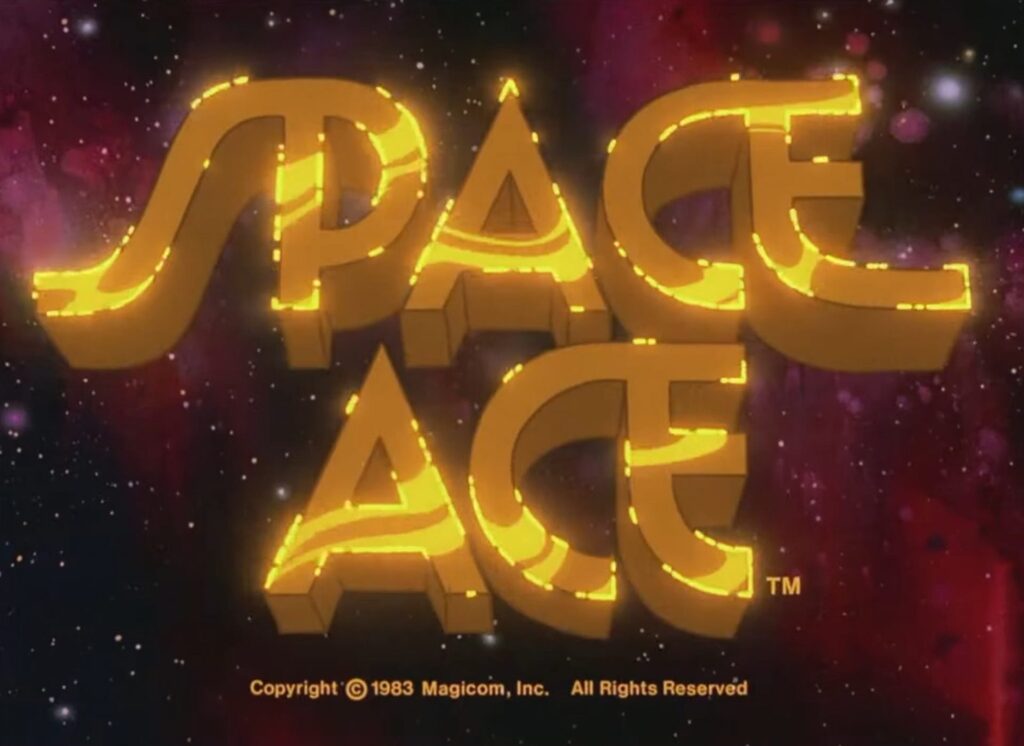 Space Ace Arcade Title Screen
Whilst the gameplay was so-so, it was the quality of the animation, which was by Disney veteran Don Bluth, which kept players coming back for more.
Space Ace in the arcade
Space Ace was unveiled in October 1983, only four months after Dragon’s Lair, with a limited release that December and a wide release in North America on 29 April 1984 (Europe followed that April). It was made by the same team under Don Bluth, as Dragon’s Lair, with a budget of $2.5 million. To keep costs down the studio used its own staff as voice actors: Bluth himself voices Commander Borf (electronically altered), and he said afterwards he’d have preferred an actor such as Paul Shenar. It was sold either as a dedicated cabinet or as a conversion kit to turn an existing Dragon’s Lair into Space Ace, and Wikipedia reports that it was a commercial success in North America, though not as big a success as Dragon’s Lair.
In contrast to the first game’s medieval theme, Space Ace was much more futuristic, and I felt much more fitting with the technology.
Space Ace Gameplay
You played hero Ace, who has to rescue his girlfriend Kimberly from the evil commander Borf. Borf has a secret weapon, the Infanto Ray, which he uses to zap Ace back to his childhood form, hampering his mission: Ace is partly hit at the start, which turns him into a teenager called Dexter, and the player guides Dexter through the scenes.
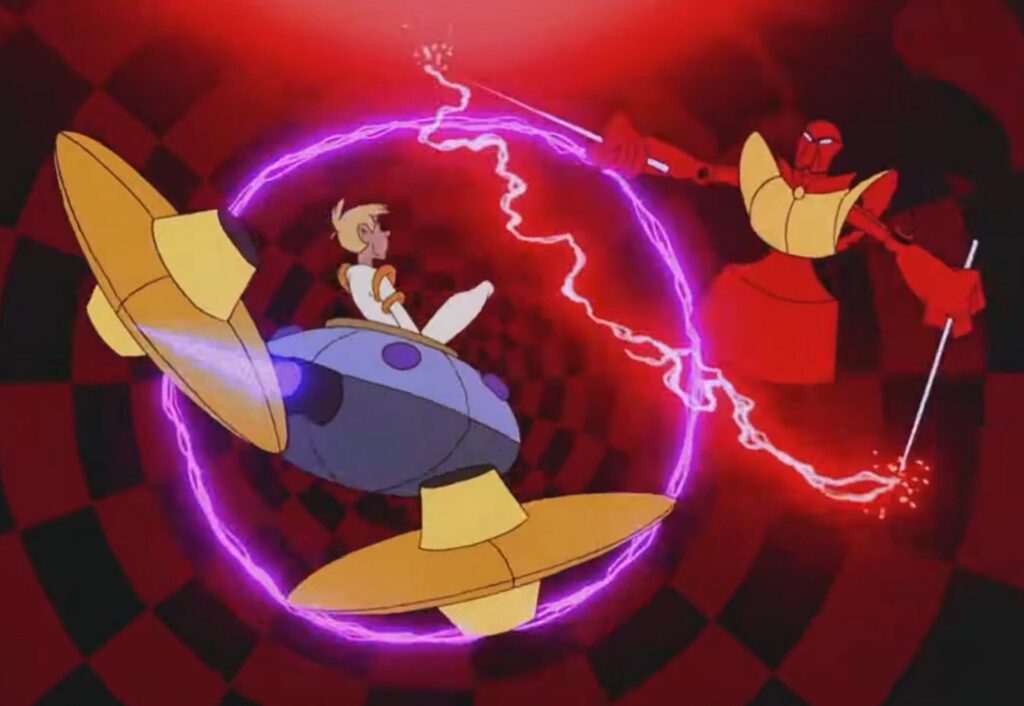 Space Ace flying section
The sequel brought some improvements on Dragon’s Lair. You could choose one of three skill levels, Cadet, Captain or Space Ace, for easy, medium and hard, and only the hardest shows every scene (about half the scenes are played on the easiest setting). Some scenes had a choice of route, and at certain moments an “ENERGIZE” message appears: press fire and Dexter transforms into Ace, who fights back against the enemies instead of running away from them, or you can stay a boy and dodge.
Cue much timed jumping between floating platforms, dodging laser blasts and flying spacecraft through obstacles on a journey to save Kimberly and the earth from the evil blue alien (which was also voiced by Don Bluth). Get all the way through and you’ve seen the entire game, plus the ending with baby Borf.
Space Ace home conversions
Although badly replicated on a number of platforms in period as a “graphics-only” based game with no video footage, it has subsequently been translated to DVD/CD-ROM and now Blu-Ray, allowing it to be played at home in an approximation of it’s former glory.
ReadySoft released versions for the Amiga, Atari ST, Apple IIGS, MS-DOS and Macintosh on floppy disks (the Atari ST version needed four of them), followed by a CD-ROM version, and a sequel for the same computers, Space Ace II: Borf’s Revenge, in 1991. The Philips CD-i version followed in 1993, and it was reportedly the UK’s top-selling CD-i game in April 1994, with the Sega CD version a year later. The 1994 Super Nintendo version by Absolute Entertainment is something else entirely: a top-down action game based on scenes from the original. Many retro gamers will remember the Amiga and the Super Nintendo versions, neither of which came close to the original.
Reviews of the home versions were mixed. Entertainment Weekly gave one B−, saying that thanks to very tricky timing it was such a frustrating experience “you may want to turn the disc into a Frisbee”, and Next Generation said of the Sega CD game that “you could surely train a monkey to do the same thing”.
Playing Space Ace today
Digital Leisure released Space Ace on DVD, which plays on most DVD players, although it lacks the arcade’s skill level select, and if you make a mistake you replay the entire scene, rather than carrying on roughly where you left off, as in the arcade. It has since been released for iOS (2009), the Wii (2010, in Dragon’s Lair Trilogy), PS3 (2011), Android (2012), Steam (2013) and Nintendo Switch (2019, also in Dragon’s Lair Trilogy).
For traditionalists it is also possible to emulate on a PC if you have a copy of the original laserdisc files and an emulator called DAPHNE, which can also use video streams made from the original laserdisc or from Digital Leisure’s DVD.
Space Ace - Video Game Marmite?
This is not a game for everyone, and many will state it was a passing fad and rightly so - the format was not long lived. You could claim it’s not even a proper video game, as you are never really in control of your character, you are just learning a pre-defined path through a video.
 Final scene with Space Ace, Kimberly and baby Borf
But for me this was a great arcade experience, a blockbuster summer movie that you could actually interact with, and whilst the technology now might seem clunky, and the gameplay limited, it kept me hooked for the rest of that wet summer on Canvey Island.
The game even had its own cartoon: a short-lived Space Ace series, with twelve episodes, was part of the 1984 Saturday Supercade block, with Nancy Cartwright (later the voice of Bart Simpson) as Kimberly.
Space Ace FAQ
Who made the Space Ace arcade game?
Space Ace was designed by Don Bluth, with Advanced Microcomputer Systems (later renamed RDI Video Systems) developing it and Cinematronics publishing it. It was unveiled about four months after Dragon’s Lair, and had a limited North American release in December 1983, with a wide release on 29 April 1984.
What is the story of Space Ace?
Commander Borf uses his Infanto Ray to turn Earthlings into infants, and it partly hits hero Ace, turning him into a teenager called Dexter. Borf also kidnaps Ace’s girlfriend Kimberly, and the player guides Ace through animated scenes by pressing the joystick or fire button at the right moment.
What are the skill levels in Space Ace?
There are three: Cadet, Captain and Space Ace, for easy, medium and hard. You only see every scene on the hardest level.
Who voices Commander Borf?
Don Bluth, the game’s director, voices Borf and several other characters. The voice is electronically altered.
Did Space Ace come out on home systems?
Yes. ReadySoft released versions for the Amiga, Atari ST, Apple IIGS, MS-DOS and Macintosh, and there were also versions for the Sega CD, 3DO and CD-i. The 1994 Super Nintendo version from Absolute Entertainment is a different top-down action game based on scenes from the original rather than the laserdisc animation.
Can you play Space Ace today?
Digital Leisure released a DVD version that plays on most DVD players, though it lacks the arcade’s skill-level select. Digital Leisure also publishes later versions, and the game has appeared on platforms including the Wii, PlayStation 3, iOS, Android, Steam and Nintendo Switch.
More like this
Elite's Commando for the ZX Spectrum
Elite Systems' Commando (1985) brought Capcom's run-and-gun arcade hit to the ZX Spectrum. Gameplay, the arcade original, Crash's verdict, ports and sequels.
Star Wars Arcade Game by Atari
Atari's 1983 Star Wars arcade game, from an Army tank trainer to the Death Star trench, and the vector cabinet I've owned for ten years and played for fifteen minutes.

OutRun Arcade Game by Sega (1986)
How Yu Suzuki's road trip round Europe in a hired BMW became OutRun, Sega's 1986 arcade classic: the Ferrari, the radio, the cabinets and how to play it today.
Comments